NADO Review 2026: Is Kraken’s Perp DEX Ready for the Hyperliquid Race?
NADO review 2026 covering perp trading, yield, fees, revenue data, liquidity risks, and whether Kraken’s Ink-based perp DEX is ready to challenge Hyperliquid.


NADO is one of the newer names in on-chain derivatives, but it is not trying to be just another perp venue. The platform is built around a CLOB, unified margin, and the Ink ecosystem, giving it a more professional trading angle than many pool-based decentralized exchanges.
The real question is not only whether NADO is fast or cheap. It is whether Kraken’s Ink-based perp DEX can build enough liquidity, revenue, and trader trust to compete in a market where Hyperliquid has already set a high benchmark.

Key Takeaways
- NADO is a perp-focused DEX on Ink with order-book trading, unified margin, and active incentive farming.
- Its fee and revenue data show real activity, but liquidity is still far below larger venues such as Hyperliquid and Aster.
- The main opportunity is early exposure to Ink-based trading; the main risk is relying too much on incentives, vault yield, and still-maturing liquidity.
NADO enters a crowded perp DEX market where liquidity, execution quality, and incentive design matter more than branding alone. Recent DefiLiban coverage of Binance Futures TradFi perpetual listings and CBRS being listed on Binance Futures shows how competitive futures markets can become when new products attract trader attention.
What Is NADO?
NADO is a decentralized exchange for perpetual futures, spot trading, and margin activity on Ink, Kraken’s Ethereum Layer 2 network. It uses an order-book model rather than a simple automated market maker.

That matters because order books are familiar to active traders. Instead of only swapping against a pool, traders can place limit orders, manage entries more precisely, and watch market depth.
NADO’s strongest positioning is not “highest yield” or “biggest exchange.” It is a more specific bet: professional-style derivatives trading on an L2 connected to the Kraken ecosystem.
How NADO Works
NADO combines off-chain matching with on-chain settlement. Orders can be matched quickly, while positions and balances are handled through smart contracts on Ink.

The important user-facing feature is unified margin. Instead of treating every position as isolated from the rest of the account, NADO lets collateral, spot holdings, and perp exposure interact inside one risk engine. This can improve capital efficiency, but it also means losses in one area can affect the whole account if risk is not managed carefully.
Pricing and risk management rely on oracle infrastructure, while the platform’s matching layer depends on a sequencer. These systems are useful, but they also introduce technical dependencies that traders should understand before using size.
NADO Trading Model
NADO is mainly built for active traders who want a CEX-like interface without giving up self-custody. The trading model centers on a central limit order book, multiple markets, leverage, collateral management, and hourly funding.

Data from perps.info places NADO in the mid-tier perp DEX category. It is not yet competing with Hyperliquid or Aster on total size, but it has enough activity to be evaluated as a real trading venue rather than a purely speculative launch.
NADO Market Position vs Other Perp DEXs
| Rank | Platform | Chain | 24h Volume | Open Interest | Markets | Fees Maker/Taker | Incentive Status |
|---|---|---|---|---|---|---|---|
| 1 | Hyperliquid | Hyperliquid L1 | $5.23B | $6.41B | 190 | 0.015% / 0.045% | Rewards |
| 4 | Aster | BNB Chain | $2.11B | $2.08B | 356 | 0.010% / 0.035% | Rewards |
| 5 | Lighter | Ethereum L2 | $1.70B | $764M | 160 | 0.00% / 0.00% | Rewards |
| 6 | edgeX | Ethereum L2 | $1.62B | $871M | 109 | 0.020% / 0.050% | Rewards |
| 8 | GRVT | zkSync | $754M | $59.8M | 112 | 0.010% / 0.040% | Farming |
| 14 | NADO | Ink | $286M | Not listed | 55 | 0.010% / 0.040% | Farming |
| 20 | dYdX | dYdX Chain | $126M | $60.1M | 294 | -0.011% / 0.030% | Rewards |
| 21 | GMX v2 | Arbitrum, MegaETH | $114M | $92.5M | 115 | 0.040% / 0.060% | Rewards |
NADO is not yet a top-five perp DEX by volume, but it is already large enough to compare with mid-tier order-book venues. Its 55 markets give it more breadth than many new perp platforms, while its daily volume remains far below Hyperliquid, Aster, Lighter, and edgeX.
That comparison matters because a perp DEX lives or dies by liquidity depth, not only by interface quality. A platform can advertise low fees, but the real trading cost also includes spread, slippage, funding, and execution quality during volatile periods.
For broader perp DEX context, DefiLiban’s report on Blockchain Katana acquiring IDEX and launching perpetual contracts is relevant because it shows that perpetual trading products are becoming a major competitive theme across decentralized exchanges.
Revenue Model and Fee Distribution
NADO’s revenue model is mainly tied to trading fees from spot and perpetual markets. The platform uses a maker-taker fee structure, where takers pay fees for removing liquidity and makers can receive better pricing or rebates at higher volume tiers.
According to DeFiLlama, NADO has already generated measurable protocol revenue rather than relying only on narrative or points farming. Source: DeFiLlama, data checked on May 19, 2026 UTC.
| Revenue Metric | Latest Data |
|---|---|
| TVL | $54.91M |
| Fees 24h | $33,648 |
| Fees 7d | $263,241 |
| Fees 30d | $1.49M |
| Cumulative fees | $13.38M |
| Revenue 24h | $25,249 |
| Revenue 7d | $191,856 |
| Revenue 30d | $1.07M |
| Annualized revenue | $13.09M |
| Cumulative revenue | $9.8M |
| Perp volume 30d | $6.424B |
| Cumulative perp volume | $58.665B |
| Open interest | $111.95M |
The fee model also has clear trader-level economics. NADO’s fee structure starts around 3.5 bps for entry-level takers, while high-volume users can reach lower taker fees and maker rebates.
| Trader Level | Example 30d Volume | Taker Fee | Maker Fee / Rebate | Cost on $50,000 Trade |
|---|---|---|---|---|
| Entry | $0 | 3.5 bps | 1.0 bps | $17.50 taker / $5.00 maker |
| Mid-tier | $25M | 3.0 bps | 0.5 bps | $15.00 taker / $2.50 maker |
| Elite | $5B+ | 1.5 bps | -0.8 bps rebate | $7.50 taker / $4.00 maker rebate |
This structure rewards large traders and market makers, which can help deepen the order book. The risk is that some activity may be incentive-driven. For long-term sustainability, the key metric is not only volume, but whether fees and revenue remain strong after rewards become less important.

Research-Based User Experience
From a product research perspective, NADO feels designed for users who already understand leverage. This is not a beginner-first app where the main action is a simple token swap.
The strongest part of the experience is the account structure. Collateral, leverage, spot balances, and perp exposure can work together, which gives skilled traders more flexibility. The weak side is the same: flexibility increases the need for discipline.

A casual user may look at NADO and see an opportunity to earn points or chase yield. A more experienced trader will look at the same platform and ask different questions: How deep is the book? How wide is the spread? How aggressive is the funding? How fast do liquidations trigger? How resilient is the venue during volatile sessions?
Yield Opportunities
NADO’s yield opportunities come from three main areas: lending activity, the NLP vault, and points. The lending side lets users supply assets and potentially earn from borrowers. This is a familiar DeFi model, but rates can move quickly when utilization changes.
The NLP vault is more complex. LPs may earn from strategies connected to market-making and liquidation activity, but this should not be treated like a simple stablecoin savings account. Vault returns can change based on volatility, trader PnL, liquidity conditions, and risk controls.
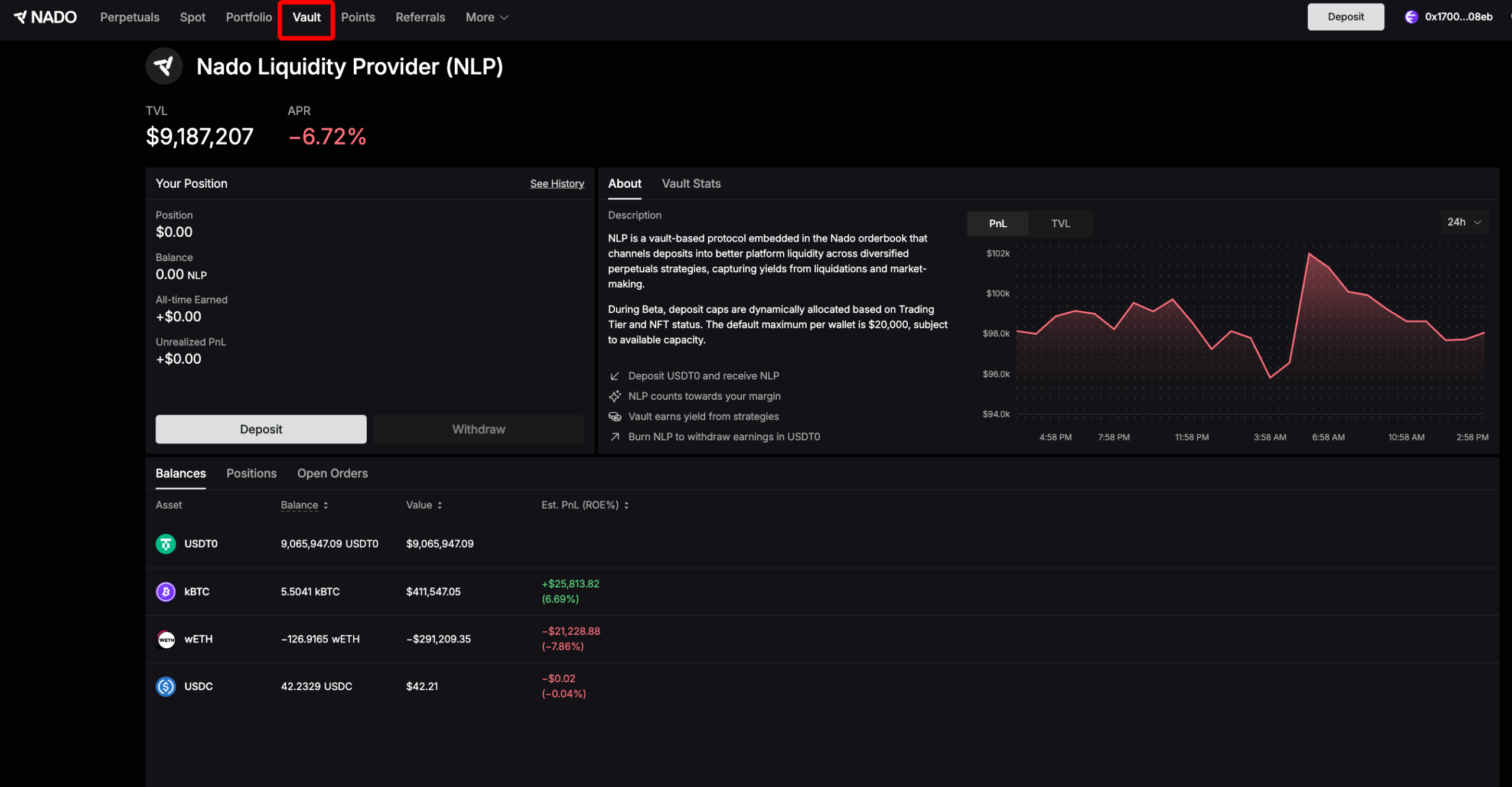
The points program is another incentive layer. NADO’s Season 1 system rewards trading, LP participation, referrals, and activity. Some public materials connect points with future INK allocation logic, but users should not treat points as guaranteed income until final distribution rules are confirmed.

NADO Yield and Risk Matrix
| Opportunity | Source of Return | Main Risk | Best For |
|---|---|---|---|
| Money markets | Borrower interest | Utilization spikes, liquidation pressure | Passive lenders who understand DeFi lending |
| NLP vault | Market-making, liquidations, vault strategy PnL | Strategy loss, withdrawal lock, market volatility | Risk-aware LPs |
| Points | Trading, market making, NLP, referrals | No guaranteed future value | Active users and campaign participants |
| Funding trades | Long/short funding imbalance | Basis risk, execution risk, liquidation | Advanced traders |
| Maker rebates | Providing order-book liquidity | Adverse selection, inventory risk | Market makers |
NADO yield is not one single product. It is a mix of lending yield, vault strategy exposure, incentive farming, and trader-side funding opportunities. This makes the platform more flexible, but it also means users need to separate real yield, campaign rewards, and trading PnL before judging returns.
Fees and Funding Rates
Fees are only one cost. On perp venues, funding rates can become more important than trading fees if a position is held for several days. NADO funding is designed to keep perp prices aligned with spot index prices. If perps trade above spot, longs generally pay shorts. If perps trade below spot, shorts generally pay longs.
Loris Tools tracks NADO funding across markets, which helps traders see whether holding a long or short position is becoming expensive. This is especially important during crowded trades, where funding can quietly drain PnL even if the entry was correct.
Funding design is not unique to NADO. New futures listings can create fresh liquidity and funding dynamics, especially when traders crowd into the same direction. That is why DefiLiban’s coverage of Binance Futures adding TradFi perpetual contracts is useful context for understanding how quickly perp markets can change after new products go live.
For anyone using leverage, the practical rule is simple: calculate fee, spread, slippage, and funding before entering. A trade that looks profitable on price alone may be weaker after all costs are included.
Tokenomics and Incentive Design
NADO does not currently trade around a separate widely available NADO token in the same way some DEXs have their own governance assets. The current incentive story is mainly based on points, Season 1 rewards, and the Ink ecosystem.
This can be positive because it avoids premature token speculation. But it also means users need to judge the platform by real usage rather than token price action.
The sustainability test is clear: if NADO can keep traders after points lose importance, the product has real traction. If volume falls sharply after incentives slow down, then the early numbers may have been more reward-driven than product-driven.
Strengths and Trade-Offs
NADO’s main strengths are fast execution, order-book trading, unified margin, Kraken-linked ecosystem credibility, and multiple ways to participate as a trader or LP.
The trade-offs are equally important. NADO is still young, liquidity is not yet as deep as the largest perp DEXs, and public security information should be reviewed carefully before depositing meaningful capital.
Compared with older venues, NADO still needs more time to prove it can handle stress conditions, attract organic volume, and maintain strong market depth without relying too heavily on rewards.
Security and Risks
NADO has several risk layers: smart contract risk, oracle risk, sequencer risk, liquidation risk, funding risk, and LP strategy risk. Perp trading already carries high risk because leverage can liquidate positions quickly. On-chain perps add more variables, including network conditions, contract behavior, data feeds, and front-end availability.
LPs also face a different risk profile from traders. A trader can close a position. A vault participant depends on the vault’s strategy, risk parameters, withdrawal rules, and market conditions.
Liquidation risk deserves special attention because it is not theoretical. DefiLiban’s coverage of a Bitcoin liquidation event that wiped out $50 million in shorts is a useful reminder that leveraged positions can be forced out quickly when volatility rises.
Who Should Use NADO?
NADO makes the most sense for active traders who understand margin, funding, liquidation, and order-book execution.
It may also appeal to market makers, points farmers, and LPs who can evaluate vault risk. However, beginners should start carefully. The platform’s flexibility can be useful, but it can also punish weak risk management.
If your goal is simple spot exposure, NADO may be more complex than necessary. If your goal is leveraged trading, NADO deserves research, but not blind trust.
Conclusion
NADO is a serious perp DEX candidate, not because it is already the biggest, but because its design has a clear thesis: combine professional order-book trading with unified margin on Ink.
The platform has real strengths in execution design, margin structure, and ecosystem positioning. Its long-term sustainability, however, depends on deeper liquidity, resilient risk controls, transparent security practices, and organic volume after incentives mature.
For traders, NADO is worth testing with controlled size. For LPs, the yield opportunity is interesting but should be treated as active strategy exposure, not passive stable income.
The best way to approach NADO is neither hype nor dismissal. Treat it as an early but meaningful perp DEX whose next stage will be judged by volume quality, liquidity depth, and risk performance during volatile markets.
FAQs
Is NADO a perp DEX?
Yes. NADO supports perpetual futures, spot trading, and margin activity on Ink.
What makes NADO different?
Its main difference is the combination of CLOB trading, unified margin, and Ink ecosystem positioning.
Does NADO offer yield?
Yes, mainly through lending, NLP vault participation, and points-based incentives.
Is NADO safe?
NADO still carries smart contract, liquidation, oracle, sequencer, and liquidity risks. Users should start small and verify current security information.
Who is NADO best for?
Active traders, market makers, and risk-aware LPs. It is less suitable for beginners who do not understand leverage.
What should traders check before using NADO?
Fees, funding rates, spread, slippage, liquidity depth, liquidation rules, and withdrawal conditions.
Defiliban · Oliver Benjamin

Oliver Benjamin
@oliver-benjamin