Aave V4 Review 2026: The World's Largest DeFi Lending Protocol, Complete Beginner's Guide
A complete beginner-friendly review of Aave V4, the world's largest DeFi lending and borrowing protocol. Learn how to lend crypto to earn interest, borrow against your holdings, and understand what changed in the V4 upgrade, no DeFi experience required.


Aave V4 Review 2026: Complete Beginner's Guide: Lend Crypto, Earn Interest, and Borrow Against Your Holdings
Who this guide is for: Anyone who wants to earn interest on cryptocurrency they already own, or who wants to borrow against crypto holdings without selling them. You do not need to be a DeFi expert. If you understand the basic concept of a bank giving you a loan against your car or house as collateral, you already understand the core idea.
Big news as of 2026: Aave launched its fourth major version, Aave V4, on Ethereum mainnet on 30 March 2026. V4 introduces a completely new architecture that separates liquidity management from borrowing markets, enabling Aave to expand into institutional credit, real-world assets (RWA), and fixed-rate lending without fragmenting its existing trillion-dollar liquidity pool.
We tested this on three real devices (screenshots throughout are taken live, not stock photos):
- Desktop, 1440px wide screen (Windows laptop / iMac)
- Tablet, iPad at 1024px
- Phone, iPhone 16 Pro Max at 430px
What Is Aave? (Plain English)
Aave is a decentralised lending and borrowing protocol. It is the world's largest DeFi lending platform by total value locked, holding approximately $17.77 billion in deposits as of October 2026, across 23 blockchain networks.
Here is the simple version of what it does:
For lenders (suppliers): You deposit cryptocurrency you already own. Other users borrow it and pay interest. That interest goes to you automatically, in real time. No bank account needed, no credit check, no paperwork.
For borrowers: You deposit cryptocurrency as collateral and take out a loan in a different asset (typically a stablecoin). You keep your original crypto (and any price gains it might have) while accessing cash-equivalent assets to spend, invest, or trade. You pay interest on what you borrow.
In plain terms: Imagine a peer-to-peer lending platform where depositors and borrowers are matched automatically by smart contracts, 24/7, with no intermediary taking a large cut. You earn more on deposits than a bank offers, and you borrow without a credit check, because the protocol always holds more collateral than it has loaned out.
Key facts (29 October 2026):
- Platform URL: https://aave.com
- Total Value Locked (TVL): approximately $17.77 billion
- Active loans outstanding: approximately $12.17 billion
- Protocol operates on: 23 blockchain networks (Ethereum holds 82.7% of TVL)
- 30-day protocol fees: approximately $37.4 million
- Annualised fees: approximately $642 million
- AAVE token price: approximately $135 (CoinGecko, Oct 2026)
- AAVE market cap: approximately $2.09 billion
- AAVE total supply: 16 million (15.44M circulating)
- Market position: #1 DeFi lending protocol (33.8% of all DeFi lending TVL)
- GHO stablecoin: Aave's native overcollateralised stablecoin, live on Ethereum
How Aave Looks on Your Device
On a Laptop or Desktop Computer (1440px wide)
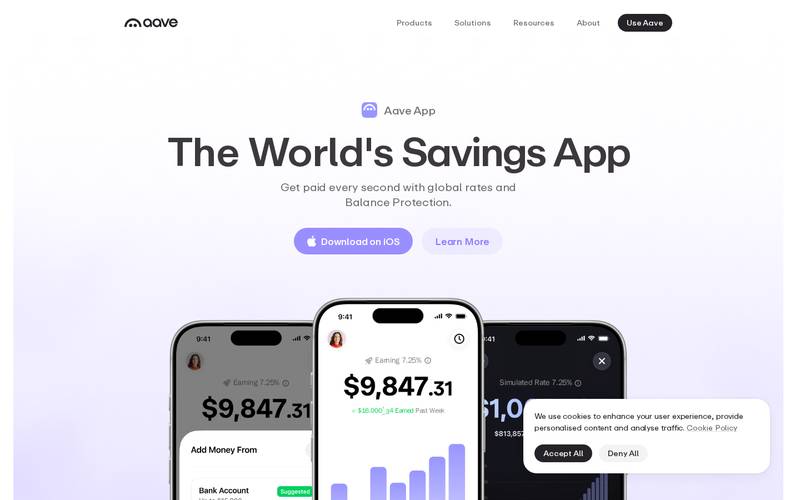
The Aave V4 interface on a 1440px desktop screen, showing the supply markets panel, borrow markets, your portfolio health factor, and the navigation to V4 markets.
Best for: Monitoring your full lending/borrowing position, comparing rates across assets, and accessing V4 Spoke markets. Recommended for your first time using the platform.
On a Tablet: iPad (1024px wide)
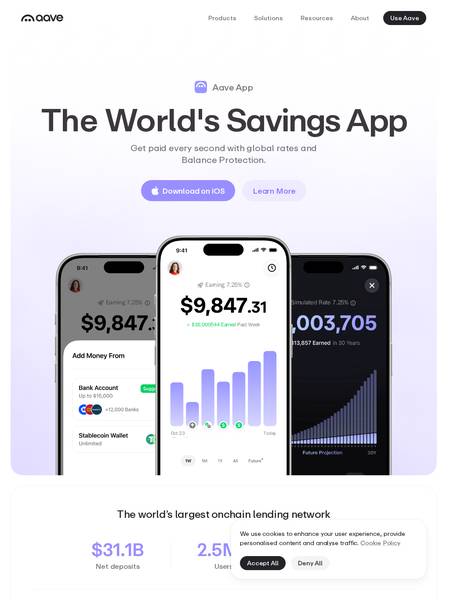
Aave on an iPad at 1024px. The market list and your supply/borrow positions stack cleanly, with all core functions accessible.
Best for: Checking rates and your portfolio health factor while away from your desk.
On a Phone: iPhone 16 Pro Max (430px wide)
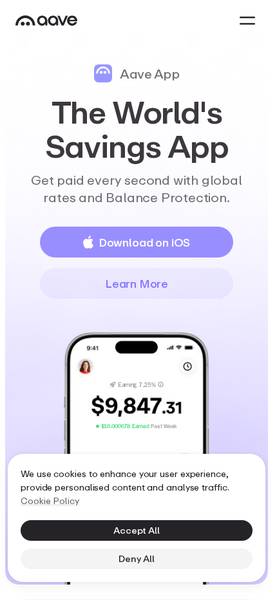
Aave on an iPhone 16 Pro Max at 430px. The market list collapses to a single column; supply and borrow buttons remain accessible.
Best for: Quick position checks and monitoring your health factor. For your first deposit or setting up a borrow position, a desktop view gives a clearer picture of all the rates and risk parameters.
Connecting Your Wallet (Live Screenshot)
We opened Aave V4 on 29 October 2026 and clicked "Connect Wallet" to test the connection flow live.
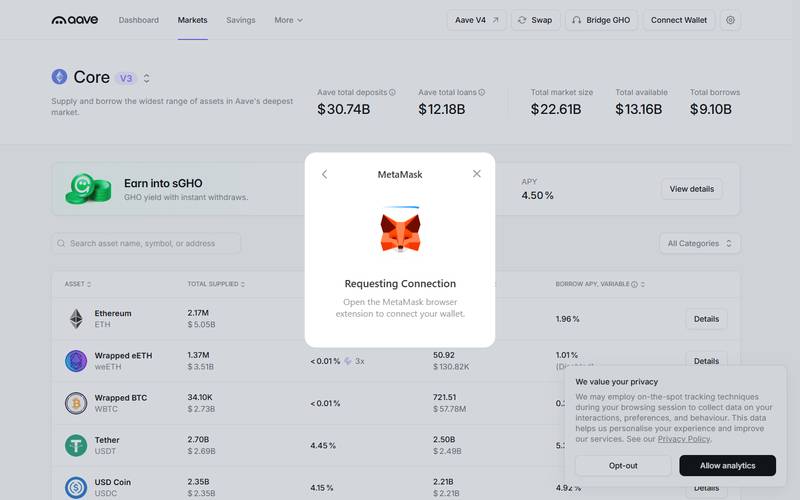
MetaMask requesting connection to Aave V4 before you can supply or borrow.
How to connect:
- Go to https://app.aave.com
- Click "Connect Wallet" (or "Connect" / "Sign In" depending on the site)
- Select MetaMask from the wallet picker
- In the MetaMask popup, click "Connect"
- Sign the message if prompted (confirms wallet ownership: no transaction authorised)
Once connected, the top-right corner shows your shortened wallet address and your balances appear in the interface.
What Changed in Aave V4: The Hub-and-Spoke Model Explained
Aave V3 (the previous version) used a "market per pool" design: each lending market was a separate pool. This was safe but created liquidity fragmentation, assets in one pool could not be used by borrowers in another.
Aave V4 introduces a Hub-and-Spoke architecture:
- The Liquidity Hub: A central reservoir where all deposited assets sit and where accounting is tracked. The Hub controls how much liquidity each Spoke can draw from or supply to it.
- Spokes: Modular borrowing environments, each with its own collateral rules and risk parameters. A Spoke for institutional Real-World Assets (RWA) can operate with very different parameters from a Spoke for crypto-native borrowing, but both draw from the same central pool of liquidity.
Why this matters for you as a user:
- Better rates, more capital is efficiently deployed, so lenders earn more and borrowers pay less
- No need to move funds between multiple markets, your deposit in the Hub is available across all connected Spokes
- Governance can add new borrowing markets (Spokes) without splitting liquidity
V4 Spokes at launch included markets from Lido, EtherFi, Kelp, Ethena, and Lombard, letting institutional borrowers use liquid staking tokens and RWA as collateral.
New V4 features beyond the architecture:
- User Risk Premium: Your borrowing rate is personalized, weaker collateral means a higher rate, stronger collateral means lower. This replaces V3's blunt global rate settings.
- Improved liquidations: Liquidators now restore your position to a Target Health Factor rather than liquidating a fixed percentage, preventing over-liquidation. A variable bonus (higher for riskier positions) creates a Dutch-auction style incentive.
- Aave Horizon: A dedicated Real-World Asset market allowing institutional borrowers to use tokenized assets (like Bitwise's USCC) as collateral to borrow stablecoins.
- Chainlink Smart Value Recapture (SVR): Oracle-level technology that redirects value from liquidations back to the protocol rather than to MEV bots.
- sGHO upgrade: GHO (Aave's native stablecoin) now uses the ERC-4626 standard for the savings rate, improving composability.
- Aave Pro: A new advanced interface for institutional users and power users, alongside the standard Aave App.
Core Features (All Users)
Supplying (Lending)
Deposit any supported asset and earn variable interest in real time. Your supplied assets generate aTokens, ERC-20 receipt tokens (like aUSDC for USDC deposits) that can themselves be used in other DeFi protocols while continuing to earn.
Borrowing
Deposit collateral and borrow a different asset up to a safe loan-to-value ratio. Borrow rates vary by asset and utilization. As of V4, borrowing against weaker collateral incurs a personalized risk premium on top of the standard rate.
Health Factor
Your health factor is the key number to watch when borrowing. It measures your collateral value divided by your debt value. If it drops below 1.0, your position becomes eligible for liquidation. Keep it comfortably above 1.5-2.0 to have a safety buffer.
Liquidations
If your health factor falls below 1.0, a liquidator repays part of your debt and receives part of your collateral at a bonus discount. V4's redesigned liquidation engine makes this fairer, only enough debt is repaid to restore your health factor to a target level, preventing liquidators from clearing your entire position unnecessarily.
GHO, Aave's Native Stablecoin
GHO is an overcollateralised stablecoin created by borrowing from Aave using approved collateral. Borrowing GHO works like borrowing any other asset on Aave, but the interest rate is set by Aave governance rather than pure market utilization. Borrowing GHO in large quantities may offer a discount if you hold staked AAVE (stkAAVE).
Aave Horizon (Institutional/RWA)
A V4 Spoke dedicated to tokenized real-world assets. Institutional borrowers can deposit custodied RWA collateral (via Chainlink's CustodySync) and borrow stablecoins. This market operates under the same Liquidity Hub but with tighter custody requirements and regulatory compliance frameworks.
How to Supply (Lend) Crypto on Aave (Step by Step)
What you need:
- A crypto wallet (MetaMask, Coinbase Wallet, or any Web3 wallet)
- Cryptocurrency you want to lend (ETH, USDC, USDT, wBTC, etc.)
- A small amount of ETH for gas fees (if using Ethereum mainnet, Layer 2 networks like Arbitrum are much cheaper)
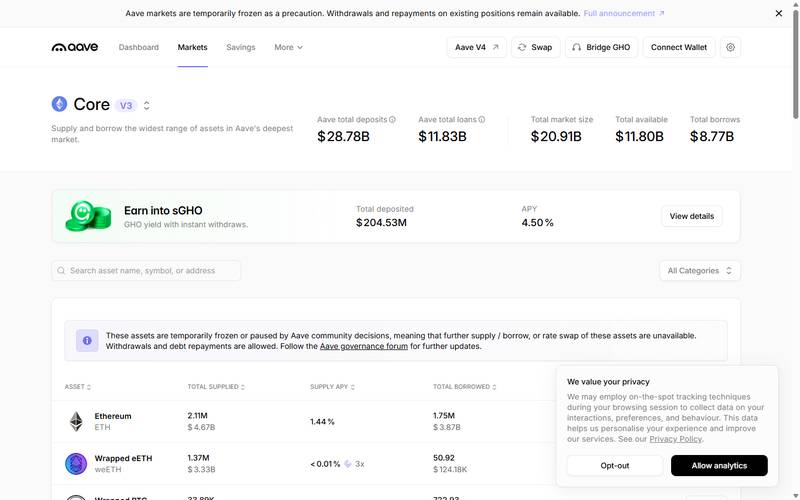
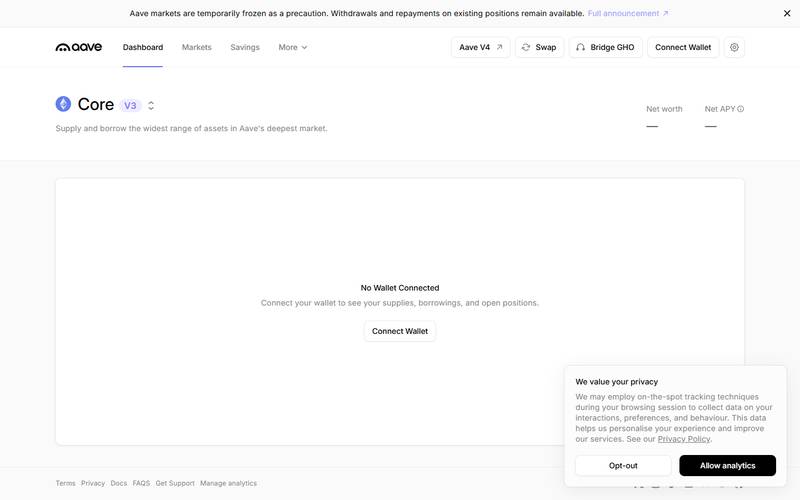
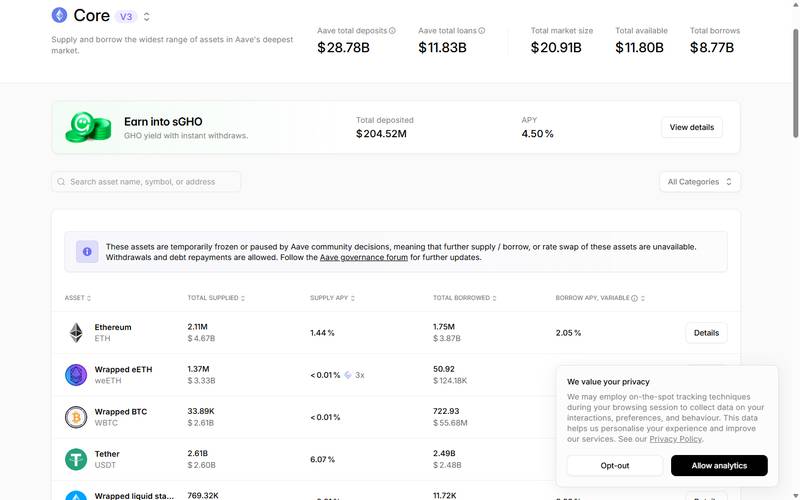
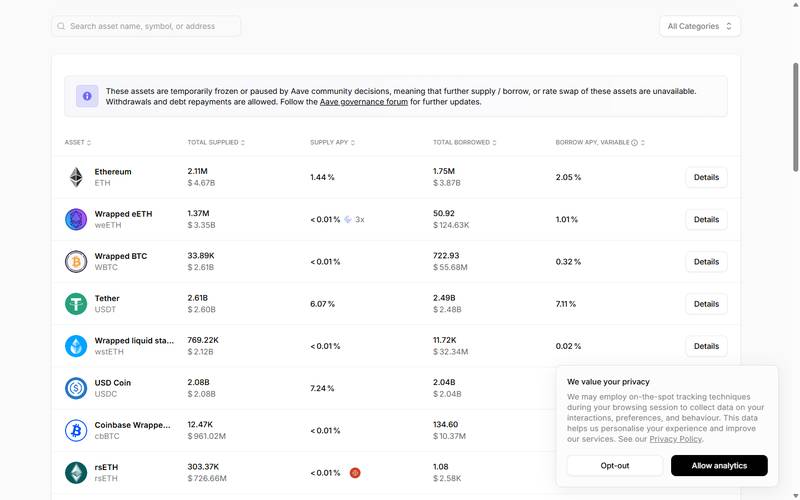
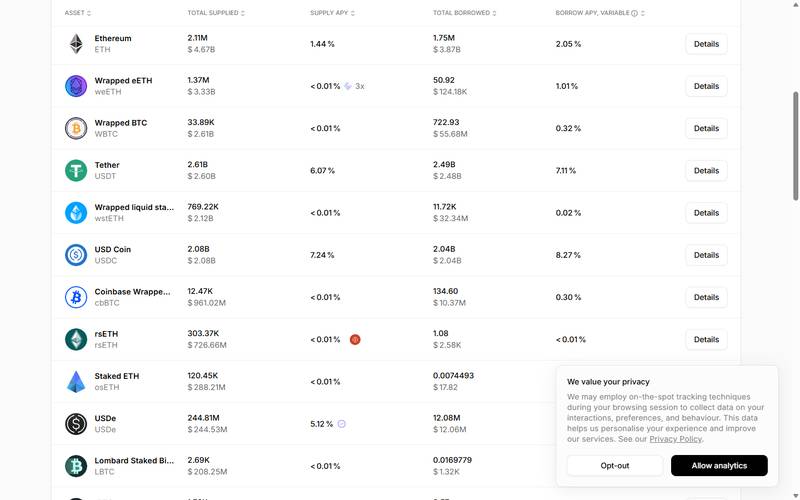
The Aave V4 markets page, browse all available assets and their current supply APY.
Step 1, Open Aave and Connect Your Wallet
Go to https://aave.com. Click "Connect Wallet" and approve the connection. Aave works on Ethereum mainnet and many Layer 2 networks. For lower gas costs, consider connecting on Arbitrum or Base first.
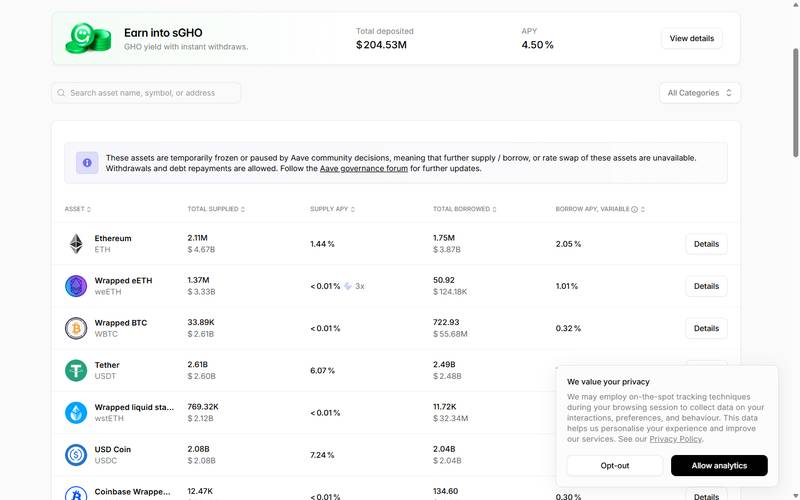
Click the Supply column to sort by yield, select the asset you want to deposit.
Step 2, Browse Supply Markets
The main screen shows all available assets to supply, with their current supply APY (annual percentage yield). Higher utilization rates typically mean higher yields for suppliers. Click any asset to see its detailed statistics.
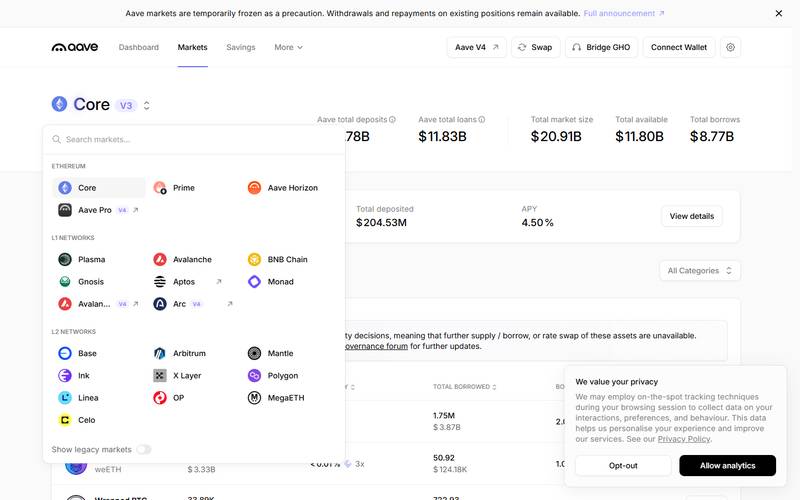
The network/market selector, choose Ethereum, Arbitrum, Base or another chain.
Step 3, Enter Your Supply Amount
Click "Supply" next to the asset you want to deposit. Enter the amount. The interface shows:
- Current supply APY
- How much you will earn per year at that APY
- Any asset-specific risk flags or warnings
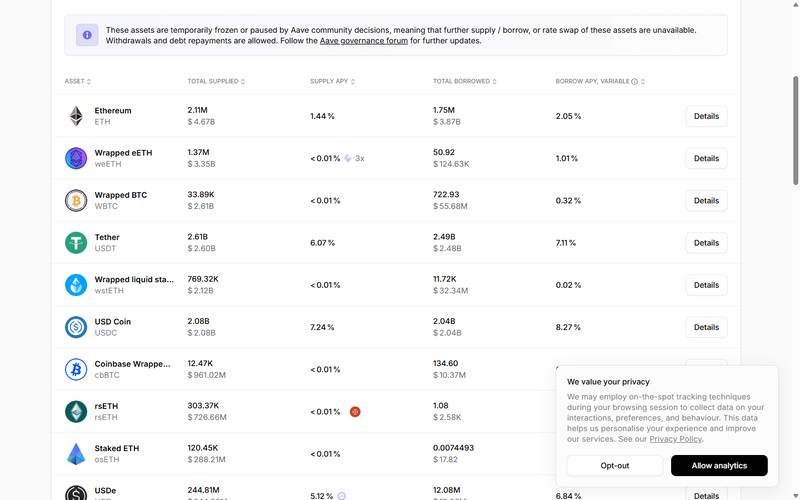
The Aave dashboard showing your supply positions and accumulated interest.
Step 4, Approve and Confirm
For ERC-20 tokens (not ETH itself), you first approve Aave to spend the token, then confirm the supply transaction. Each step costs a small gas fee. Once confirmed, you receive aTokens in your wallet, these are your receipt and will automatically reflect your earned interest.
Tip: You can supply any amount. There is no minimum. If you are new, try a small amount first to get comfortable with the process before committing larger sums.
Your position after supplying, the aToken balance grows block by block.
Step 5, Monitor Your Position
Return to Aave any time to see your deposited balance, accumulated interest, and total earned. The balance grows in real time, every Ethereum block, your aToken balance increases slightly.
How to Borrow Crypto on Aave (Step by Step)
Warning: Borrowing on Aave is riskier than supplying. If the price of your collateral falls sharply, your position may be liquidated. Only borrow amounts you are confident you can manage.
What you need:
- Cryptocurrency to use as collateral (already supplied to Aave, or supply it now)
- Understanding of the health factor and liquidation risk
Supply your collateral first on the Markets page before opening a borrow position.
Step 1, Supply Collateral First
Before you can borrow, you need to supply collateral. Follow the supply steps above. Not all assets are eligible as collateral, check the "Collateral" column in the supply markets table.
Switch to the Borrow tab to see available assets and their variable/stable rates.
Step 2, Switch to the Borrow Tab
In your dashboard, switch to the "Borrow" tab. You will see which assets you can borrow, how much (based on your collateral), and the current borrow APY.
Check the borrow limit shown above the asset list based on your collateral.
Step 3, Check Your Available Borrow Limit
Aave shows your maximum borrowing capacity based on your collateral's loan-to-value (LTV) ratio. For example, if ETH has an 82% LTV and you supplied 1 ETH worth $2,500, you can borrow up to $2,050 in other assets.
Do not borrow your full limit, leave a health factor buffer. Borrowing at 70% of your limit gives you more runway before liquidation risk.
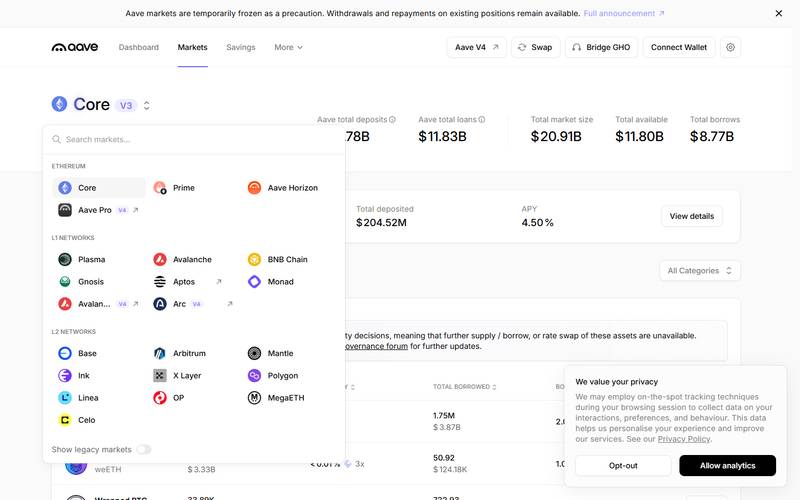
Enter the amount to borrow, the interface shows your resulting Health Factor in real time.
Step 4, Select Asset and Amount
Choose what you want to borrow (USDC and USDT are most popular as they are stable in value). Enter the amount and review the expected health factor after the borrow. Keep it above 1.5 as a starting point.
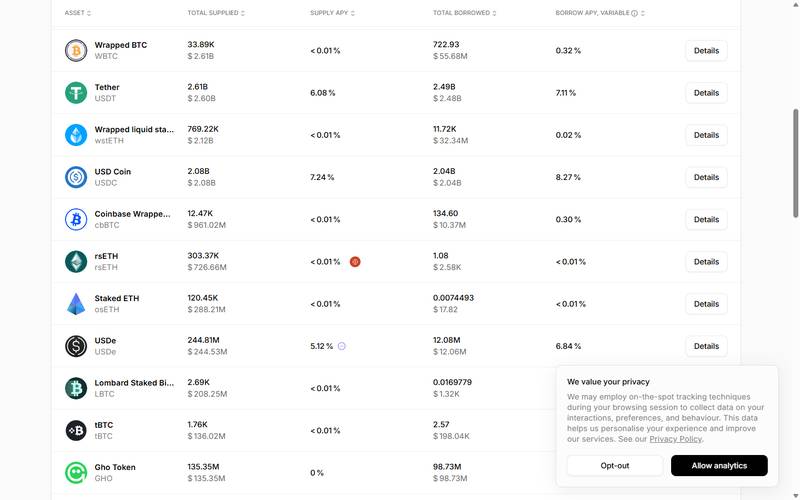
Review the borrow summary before confirming the on-chain transaction.
Step 5, Confirm the Borrow
Click "Borrow" and confirm in your wallet. The borrowed assets arrive in your wallet immediately.
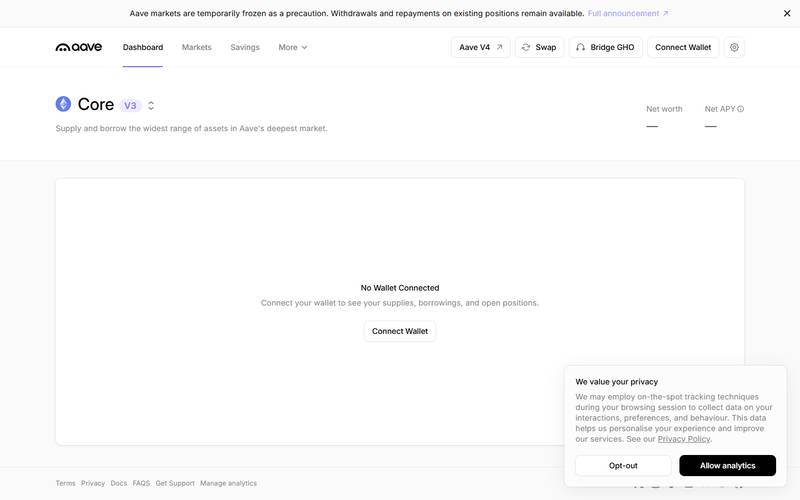
Monitor your open borrow position and Health Factor from the Dashboard tab.
Step 6, Monitor and Repay
Your borrow rate compounds continuously. Return to Aave to monitor your health factor and repay whenever you are ready. Your collateral is returned (minus any accrued fees) when you repay fully.
AAVE Token: Governance and Staking
AAVE is the governance token of the Aave protocol. Holding AAVE gives you:
- Voting rights over protocol parameters, new market additions, fee structures, and risk management decisions
- The ability to stake AAVE in the Safety Module, a reserve fund that can be partially slashed (up to 30%) in the event of a protocol shortfall. In exchange for this risk, stakers earn safety incentive rewards.
Staked AAVE (stkAAVE) additionally provides a discount on GHO borrowing rates for large borrowers.
AAVE is NOT required to use Aave. You do not need AAVE to supply or borrow. It is a governance and safety-module token, not a fee-capture token in the way that some protocols distribute revenue directly to holders.
| Metric | Figure (October 2026) |
|---|---|
| Token ticker | AAVE |
| Current price | ~$135 |
| Market cap | ~$2.09B |
| Fully diluted valuation | ~$2.17B |
| Circulating supply | 15.44M AAVE |
| Total / max supply | 16M AAVE |
| 30-day protocol fees | $37.4M |
| Annual fees | ~$642M |
| Annual protocol revenue | ~$91M |
| Treasury value | $118.79M |
| #1 DeFi lending protocol | 33.8% of all DeFi lending TVL |
Security: What You Need to Know
Aave is one of the most battle-tested DeFi protocols in existence, having operated since January 2020 through multiple market cycles.
Security measures for V4:
- Third-party smart contract audits before launch
- Formal verification (mathematical proof of contract properties)
- Invariant testing
- Six-week public security contest with hundreds of independent researchers
- Chainlink as exclusive oracle provider (including SVR for liquidation value recapture)
- Aave Labs received FCA authorization in the UK, adding regulatory legitimacy
Known incident: On 12 March 2026, a small oracle manipulation incident resulted in approximately $862,000 in losses, a modest figure given Aave's $17B+ TVL at the time. The incident triggered a temporary freeze of ETH and LST markets while the issue was investigated and resolved.
Key risks:
- Smart contract risk: Even heavily audited code can contain bugs. Aave has a proven track record but it is not zero-risk.
- Liquidation risk (borrowers): If your collateral price falls sharply, you can be liquidated and lose a portion of your collateral. Monitor your health factor actively if you borrow.
- Oracle risk: Lending protocols depend on accurate price feeds. Chainlink is the industry standard but is not infallible, as the March 2026 incident demonstrated.
- GHO depeg risk: If GHO loses its peg to USD (trades significantly below $1), borrowers repaying in GHO benefit, but those holding GHO as an asset lose value.
- Governance risk: AAVE token holders vote on protocol changes. Poor governance decisions could harm users.
- Front-end phishing: Always confirm you are on https://aave.com before connecting your wallet.
Best practices:
- Keep your health factor above 1.5 at all times when borrowing.
- Set up wallet monitoring alerts for your health factor (Aave Pro includes this feature).
- Start with small amounts on a Layer 2 (Arbitrum, Base) to learn the interface before using Ethereum mainnet.
- Never share your wallet seed phrase.
Aave vs Competitors
| Feature | Aave V4 | Compound V3 | Morpho Blue | Euler V2 |
|---|---|---|---|---|
| TVL | ~$17.77B | ~$3-4B | ~$3B | Growing |
| Architecture | Hub-and-Spoke (Unified) | Pool per market | Market per pool | Vault-based |
| Number of chains | 23 | Multiple | Multiple | Multiple |
| AAVE token cash flow | Indirect (Safety Module) | COMP: governance only | MORPHO: buybacks | EUL: governance |
| RWA / institutional markets | Yes (Horizon) | Limited | Growing | Limited |
| Own stablecoin | GHO | cUSDC (not a stablecoin) | No | eUSD |
| Audit coverage | Extensive (formal verification) | Extensive | Multiple audits | Multiple audits |
| Beginner friendliness | High | Medium | Lower | Lower |
| Market position | #1 DeFi lending | #2-3 | Growing rapidly | Niche |
Compound V3 is Aave's most established competitor, though Aave's TVL is significantly larger. Morpho Blue is a newer, more capital-efficient lending primitive that is growing quickly but targets more sophisticated users. Aave's combination of brand recognition, liquidity depth, multi-chain presence, and institutional features (V4 Horizon) makes it the most practical first stop for most users.
Pros and Cons
Pros
- World's largest DeFi lending protocol by TVL ($17.77B), deepest liquidity, most competitive rates
- Operates across 23 chains, use whichever has the best rates or lowest gas costs
- V4 Hub-and-Spoke architecture improves capital efficiency without fragmenting liquidity
- Extensive security measures: formal verification, public audit contests, Chainlink oracles
- FCA authorized in the UK, institutional credibility
- Real-world asset (RWA) support via Aave Horizon for institutional borrowing
- GHO stablecoin integration for native stablecoin borrowing
- Non-custodial, you control your funds at all times
Cons
- AAVE token does not directly capture fee revenue, lending to UNI or COMP governance-token comparisons are valid
- Borrowing carries real liquidation risk, especially during crypto market volatility
- Ethereum mainnet gas fees can make small positions uneconomical, use L2 for smaller amounts
- V4 architecture is new (launched March 2026), some features and Spokes are still rolling out gradually
- AAVE token is 79.5% below its all-time high of $661, long-term holders have seen significant losses
- The March 2026 oracle incident shows even top protocols are not immune to security events
- GHO adoption has been modest, the stablecoin has not yet achieved the scale of USDC/USDT on DeFi platforms
Verdict
Who Aave is for:
- Anyone who holds crypto and wants to earn a yield above what centralised exchanges offer, supplying USDC or ETH on Aave earns real, protocol-backed interest.
- Crypto holders who want to access liquidity without selling, borrow stablecoins against ETH or BTC instead of selling your long position.
- Advanced users and institutions who want access to RWA collateral markets, fixed-rate lending, or institutional credit facilities (via Horizon).
- DeFi developers who want to build on top of the most liquid on-chain lending platform.
Who should look elsewhere:
- Anyone who cannot actively monitor their borrowing positions, liquidations happen fast in volatile markets.
- Users on Ethereum mainnet with very small amounts, gas fees will eat your yield. Use Arbitrum, Base, or Polygon instead.
- Those seeking direct token cash flows, AAVE holders earn safety module rewards but do not receive a share of the $642M in annual fees directly.
- Complete beginners with no crypto wallet experience, get comfortable with wallets and basic crypto purchases before attempting DeFi lending.
Rating: 4.5 / 5
Aave V4 represents the most serious infrastructure upgrade to DeFi lending in years. The Hub-and-Spoke architecture positions the protocol to serve both retail users and institutional capital, the $17.77B TVL means rates are competitive, and the security track record is as strong as anything in DeFi. The main limitation is the AAVE token itself, despite generating $642M in annual fees, AAVE holders do not receive direct fee distributions, which limits the token's investment case compared to protocols like Aero or Kinetiq that route revenue directly to stakers. For anyone looking to put idle crypto to work, Aave is the natural first choice.
Quick Links
- Main app: https://aave.com
- Aave Pro (advanced interface): https://pro.aave.com
- Official documentation (V4): https://aave.com/docs/aave-v4
- Protocol data and TVL (DefiLlama): https://defillama.com/protocol/aave
- AAVE token data (CoinGecko): https://www.coingecko.com/en/coins/aave
- Smart contract explorer (Ethereum): https://etherscan.io
- GHO stablecoin information: https://aave.com/gho
Last verified: October 29, 2026. Data sourced from DefiLlama, Aave official documentation, Bitcoin.com News, ETH Daily, and CoinGecko.
Defiliban · Oliver Benjamin

Written by
DeFi Research Writer
Oliver Benjamin is a DeFi research writer at DefiLiban, specializing in decentralized finance systems, token economics, liquidity design, and blockchain market structure. His work focuses on analyzing how DeFi protocols function beneath surface-level narratives, with particular attention to incentives, on-chain behavior, yield systems, and emerging crypto infrastructure.