RISEx Review 2026: The Fully On-Chain Perp DEX on RISE Chain, Complete Beginner's Guide + Ignite Points Airdrop
A complete beginner-friendly review of RISEx, the fully on-chain perpetuals exchange built on RISE Chain. Learn how to trade perps, earn Ignite Points toward a potential airdrop, and understand what makes RISEx different, no crypto trading experience required.


RISEx Review 2026: Complete Beginner's Guide: Trade Perps On-Chain, Earn Ignite Points, and Prepare for the Potential Airdrop
Who this guide is for: Anyone curious about RISEx, whether you want to trade perpetual futures on-chain, earn Ignite Points toward a potential future token distribution, or simply understand what makes RISE Chain and its exchange different from competitors like Hyperliquid or dYdX. You do not need prior trading or DeFi experience.
Important disclaimer: As of October 2026, no RISE or RISEx token trades on any major exchange, and no Token Generation Event (TGE) date has been confirmed. Ignite Points do not guarantee a future airdrop. This guide covers what RISEx is today and how to participate, but participation is not financial advice.
We tested this on three real devices (screenshots throughout are taken live, not stock photos):
- Desktop, 1440px wide screen (Windows laptop / iMac)
- Tablet, iPad at 1024px
- Phone, iPhone 16 Pro Max at 430px
What Is RISEx? (Plain English)
RISEx is a fully on-chain perpetuals exchange, meaning every trade, every position, and every piece of collateral is recorded and settled on a blockchain, not on a centralised company's servers.
It is built on RISE Chain, an Ethereum Layer 2 blockchain engineered specifically for high-frequency trading: 1 millisecond transaction latency, over 50,000 transactions per second, and all secured by Ethereum's mainnet consensus.
What are perpetual futures (perps)? A perpetual future is a derivative contract that lets you bet on whether the price of an asset (like BTC, ETH, or even the S&P 500 index) will go up or down, with leverage (borrowed capital that amplifies both gains and losses). Unlike traditional futures, there is no expiry date, the position stays open until you close it or are liquidated.
In plain terms: RISEx is like a highly efficient online trading platform for leveraged bets on crypto (and traditional assets), but instead of trusting a company with your funds, all your trades and collateral are secured by Ethereum. You control your assets at all times.
Backed by Galaxy Ventures and Vitalik Buterin (Ethereum's co-founder), RISEx generated over $14 billion in cumulative trading volume since its launch and is running the Ignite Season 1 points programme, which distributes points to active users that may count toward a future token distribution.
Key facts (29 October 2026):
- Platform URL: https://risechain.com (RISEx is the exchange product)
- Chain: RISE Chain (Ethereum L2, 1ms latency, 50,000+ TPS)
- Total Value Locked (TVL): approximately $21.16 million (ATH: $21.43M)
- 30-day perpetuals volume: $3.69 billion
- Cumulative perpetuals volume: $14.09 billion
- Open Interest: $40.19 million
- Available markets: 35 perpetual markets (BTC, ETH, SPY, QQQ, XAU, and more)
- Trading fees: 3 basis points (0.03%) taker / 1 basis point (0.01%) maker
- Gas fees: Sponsored, zero gas cost for traders
- Funding round: $7.2M raised; $200M valuation (August 2025 community round)
- Backers: Galaxy Ventures, Vitalik Buterin
- Token status: No live token / No confirmed TGE date
- Ignite Season 1: Live since July 20, 2026; ends no later than Q2 2027
- Security incident: August 3, 2026, $673K lost in access control exploit (resolved)
How RISEx Looks on Your Device
On a Laptop or Desktop Computer (1440px wide)

The RISEx trading interface on a 1440px desktop screen, showing the order book, price chart, position panel, and perpetual markets selector.
Best for: Active trading, the full order book, depth chart, and position management tools are all visible simultaneously. Recommended for placing your first trade and managing open positions.
On a Tablet: iPad (1024px wide)
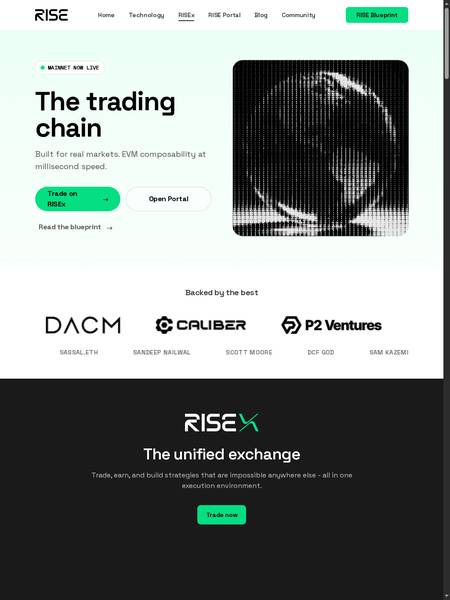
RISEx on an iPad at 1024px. The chart and order panels remain accessible with a slightly condensed layout.
Best for: Monitoring open positions and checking funding rates on the go. Full trading is functional on tablet.
On a Phone: iPhone 16 Pro Max (430px wide)
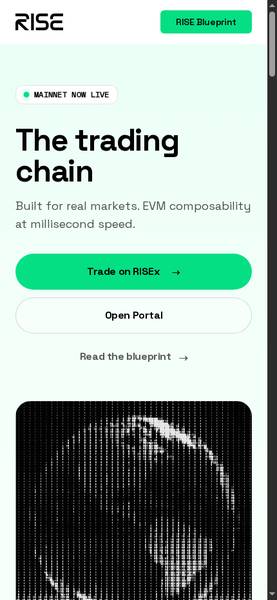
RISEx on an iPhone 16 Pro Max at 430px. The interface switches to a tabbed layout, chart, order entry, and positions in separate views.
Best for: Quick position checks and closing trades. For opening new leveraged positions or reading market depth carefully, a desktop provides more clarity.
What Makes RISEx Different
Everything happens on-chain. Most centralised exchanges (Binance, OKX, Bybit) run their order books on company servers, you trust them with your funds. Many "decentralised" perp DEXes use an off-chain matching engine and only settle on-chain. RISEx runs the entire matching engine on RISE Chain. The state of every order, position, and collateral pool is on-chain and auditable by anyone.
RISE Chain's technical edge. The reason a fully on-chain exchange is possible at RISEx's performance level is RISE Chain's architecture: 1ms transaction latency (vs. hundreds of milliseconds on most blockchains) and 50,000+ TPS. The chain was specifically designed to support high-frequency trading workloads.
Cross-asset trading from a single account. RISEx supports 35 markets including not just crypto perpetuals (BTC, ETH, SOL) but also traditional market trackers (SPY = S&P 500, QQQ = Nasdaq 100, XAU = Gold). You can trade all of these from a single portfolio-margined account. Traditional finance traders will recognize this as similar to multi-asset portfolio margin at a prime broker.
AutoYield. Your idle collateral earns yield automatically while you hold positions. Rather than having capital sit dormant waiting for you to trade, the protocol deploys it into yield strategies in the background.
100% of RISE Chain points go to RISEx users. Because RISE Chain is specifically an exchange chain, all ecosystem incentives flow to RISEx participants, not split across dozens of unrelated applications.
Gas sponsored. You pay zero gas fees for trading. All transaction costs on RISE Chain are covered by the protocol.
Connecting Your Wallet (Live Screenshot)
We opened RISEx on 29 October 2026 and clicked "Connect Wallet" to test the connection flow live.
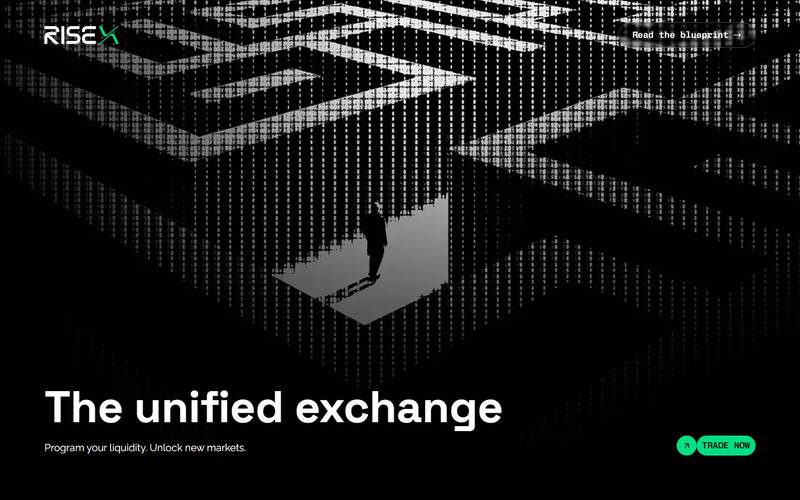
the RISEx homepage at rise.trade: click Trade Now to access the perp trading interface.
How to connect:
- Go to https://www.rise.trade/en
- Click "Connect Wallet" (or "Connect" / "Sign In" depending on the site)
- Select MetaMask from the wallet picker
- In the MetaMask popup, click "Connect"
- Sign the message if prompted (confirms wallet ownership: no transaction authorised)
Once connected, the top-right corner shows your shortened wallet address and your balances appear in the interface.
Core Features
Perpetual Futures Trading
The core product. Choose any of 35 available markets, select leverage (up to platform-set limits), set your position size, and submit your order. RISEx supports market orders, limit orders, stop-losses, and reduce-only orders (orders that only close existing positions, never open new ones).
Portfolio Margin
RISEx uses cross-asset netted margining, your positions across different markets are netted together for margin calculations. If you are long BTC and short ETH and the two positions partially hedge each other, the margin required is less than if they were calculated independently. This is more capital-efficient than isolated margin systems.
AutoYield
Idle collateral earns yield passively. The protocol routes unused margin into yield-generating strategies automatically. This means your capital is always working, even between trades.
RWA and Equity Markets
Beyond crypto, RISEx offers perpetual exposure to real-world assets including S&P 500 (SPY), Nasdaq 100 (QQQ), and Gold (XAU). This is one of the few on-chain venues offering this kind of traditional asset exposure.
MarketCore (Coming)
RISE Chain's shared orderbook infrastructure, currently planned for permissionless deployment. Developers will be able to launch new markets on top of RISEx's liquidity, essentially building their own trading products on the same liquidity base.
Ignite Season 1: How to Earn Points for a Potential Airdrop
What are Ignite Points?
Ignite Points are RISEx's loyalty reward system. They measure your contribution to the protocol, through trading, providing liquidity, or building on the platform, and are expected to convert into something of value when RISEx eventually launches a token (if it does).
No airdrop is guaranteed. The programme explicitly states that points represent loyalty and activity tracking, not a guaranteed token allocation. However, protocols that run pre-TGE points programmes almost always use those points in some form when they do tokenise. Season 0 retroactive points were already distributed to closed beta participants.
How points are distributed:
- 200,000 points per week distributed every Tuesday
- Allocated across three groups: traders, liquidity providers (LPs), and builder code integrators
- Points are proportional to your contribution within each group
How to earn trading points:
- Volume, the more notional value you trade, the more points you earn
- Consistency, trading regularly across weeks counts more than one-off volume spikes
- Referrals, using your referral code and inviting others adds to your points total
How to earn LP points:
Provide liquidity to RISEx's pools. The protocol pays makers 1 basis point per trade, if you consistently provide tight two-sided quotes, you earn both trading rebates and points.
Ignite Season 1 timeline:
- Started: Monday, July 20, 2026, 00:00 UTC
- Weekly distribution: Every Tuesday at 14:00 UTC
- Expected end: No later than Q2 2027
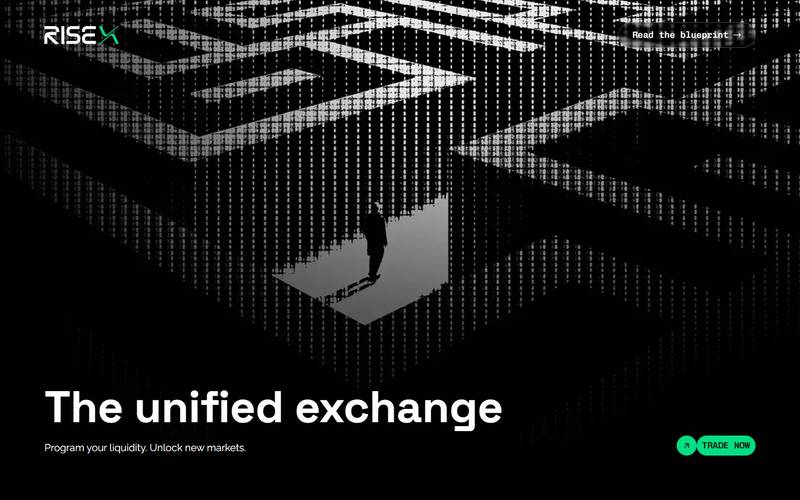
The RISEx homepage at rise.trade, click Trade Now to enter the perp DEX.
How to Start Trading on RISEx (Step by Step)
What you need:
- A crypto wallet compatible with Ethereum (MetaMask, Coinbase Wallet, or a RISE Chain-compatible wallet)
- USDC on RISE Chain (the primary collateral asset, you can bridge USDC from Ethereum via LayerZero)
- No ETH needed for gas (gas is sponsored)
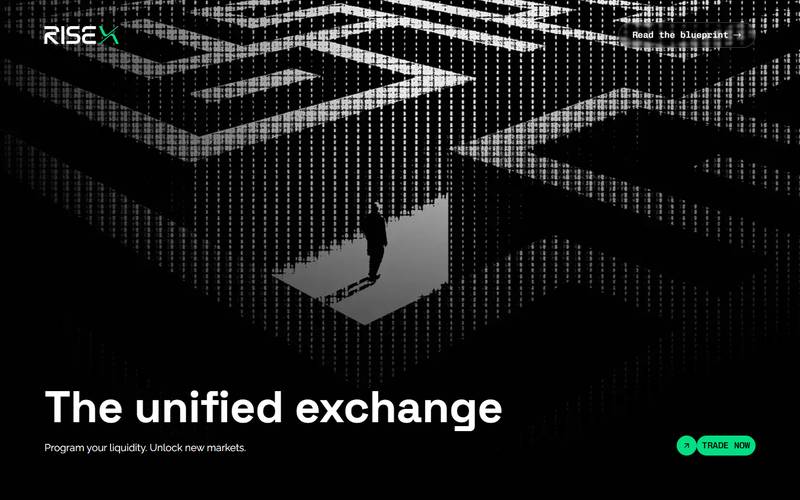
The RISEx homepage at rise.trade, click Trade Now to enter the perp DEX.
Step 1, Bridge USDC to RISE Chain
RISE Chain is currently bridged from Ethereum. Use the bridge at https://risechain.com to send USDC from Ethereum mainnet or another chain to RISE Chain. The bridge uses LayerZero, transactions confirm in a few minutes.
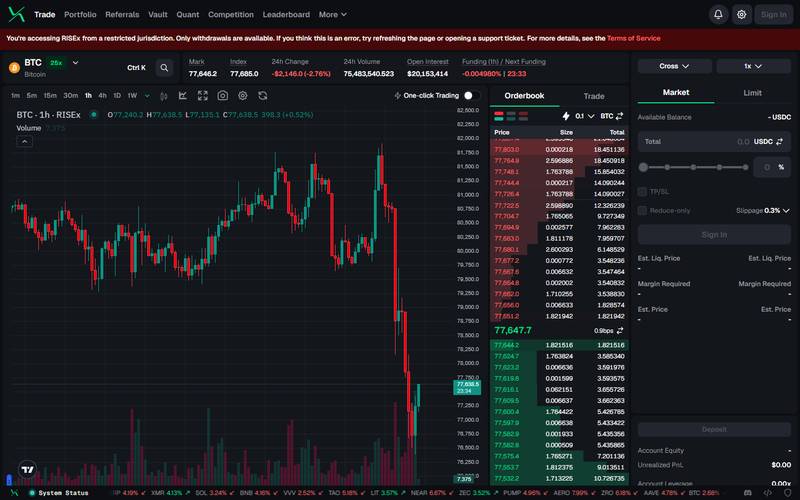
The RISEx trading interface, select your market (BTC, ETH, SOL perps) from the left panel.
Step 2, Connect Your Wallet to RISEx
Go to the RISEx trading interface at https://risechain.com. Click "Connect Wallet" and approve the connection. Your USDC balance on RISE Chain will appear as available collateral.
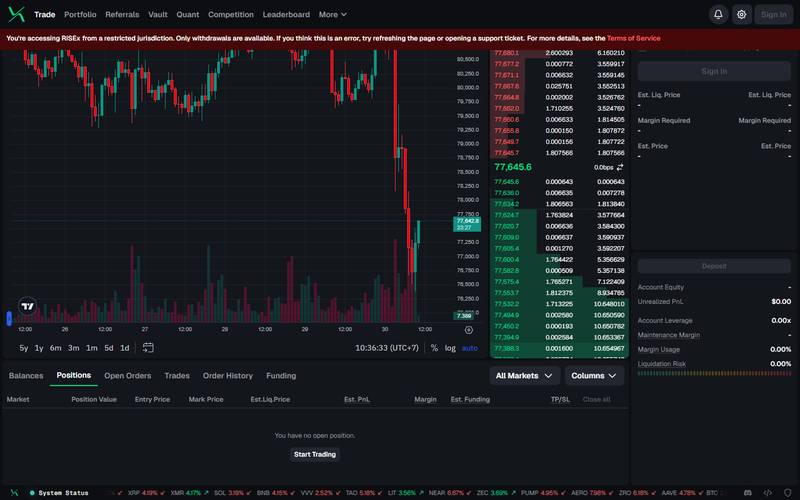
Choose Long or Short and set your leverage, the liquidation price updates instantly.
Step 3, Select a Market
Use the market selector to choose what you want to trade. The available options include BTC-PERP, ETH-PERP, SOL-PERP, SPY-PERP, QQQ-PERP, XAU-PERP, and more. Each market shows the current mark price, 24-hour volume, and funding rate.
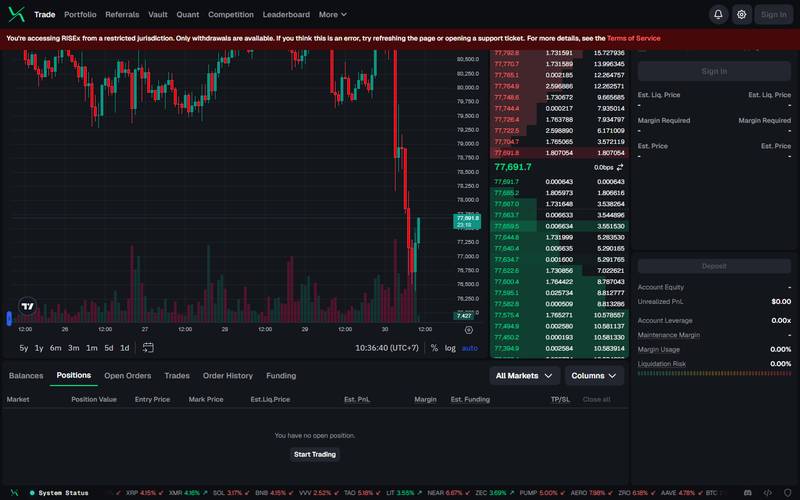
Enter the margin amount and review: opening fee, position size, and health score.
Step 4, Set Your Position
Choose:
- Direction: Long (betting price goes up) or Short (betting price goes down)
- Leverage: How much leverage to apply (lower is safer, start with 1x-2x until you are comfortable)
- Order type: Market (fills immediately at current price) or Limit (fills when price reaches your target)
- Size: The notional value of your position
Review the estimated liquidation price shown in the interface. This is the price at which your collateral would be fully consumed and your position automatically closed.
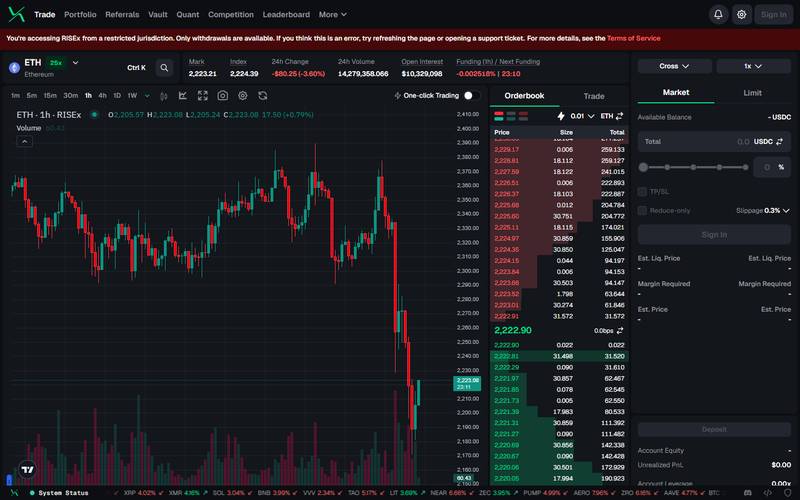
Confirm in your wallet, your position opens at the current on-chain price with 1ms updates.
Step 5, Confirm the Trade
Click "Buy/Long" or "Sell/Short" and confirm in your wallet. Because gas is sponsored, you only sign the transaction, no ETH is needed. The trade executes within 1ms on RISE Chain.
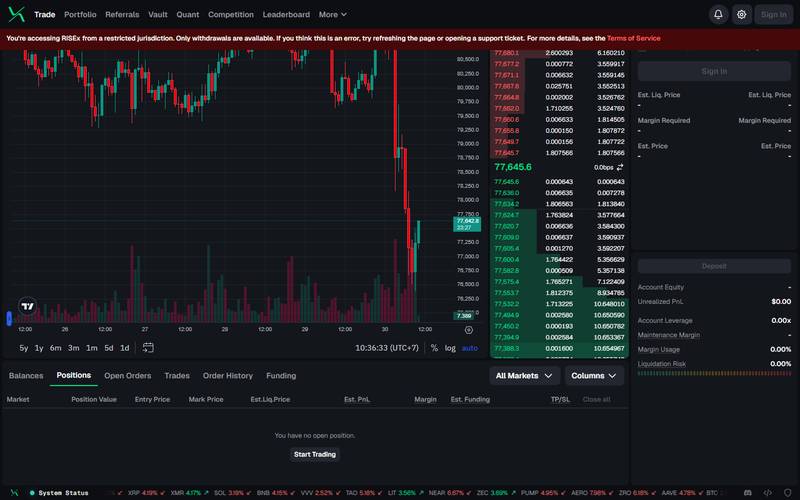
Monitor your position in the Positions panel, add margin or close anytime.
Step 6, Monitor and Manage
Your open position appears in the positions panel. Monitor:
- Unrealised PnL, your current gain or loss
- Health factor, how close you are to liquidation
- Funding rate, a periodic payment between longs and shorts (positive rate = longs pay shorts; negative = shorts pay longs)
To close, click your position and select "Close" or set a take-profit/stop-loss order.
Security: What You Need to Know
Fully on-chain architecture means your collateral is in smart contracts, not a company's bank account. However, this also means smart contract risk is the primary security surface.
Known incident: On August 3, 2026, an access control exploit on RISE Chain resulted in approximately $673,012 in losses. The exploit was classified as a chain-level issue rather than a RISEx-specific vulnerability. RISEx has not disclosed whether affected users were reimbursed.
Key risks:
- Smart contract risk: On-chain perp DEXes are complex. Bugs in position accounting, liquidation engines, or collateral management can result in losses.
- Leverage risk: This is the biggest practical risk. Trading with 5x leverage means a 20% adverse price move wipes out your entire margin. Start with 1x-2x until you fully understand liquidation mechanics.
- Funding rate risk: If you hold a leveraged position open for days or weeks, funding rates compound. A consistently positive funding rate on a long position will drain your margin over time.
- Liquidity risk (new protocol): RISEx's $40M open interest is small compared to Hyperliquid or dYdX. Large trades may have more price impact, and market makers may widen spreads during volatile periods.
- Chain centralization risk: RISE Chain is a newer L2 with a smaller validator set than Ethereum mainnet. Sequencer centralization is an active risk for all Ethereum L2s.
- No token / airdrop uncertainty: Points may or may not convert to a token. Do not make financial decisions based on a potential future airdrop.
Best practices:
- Never use leverage above what you can afford to lose entirely
- Set stop-loss orders on every leveraged position
- Check the funding rate before opening a long-term position
- Start with small positions until you understand RISEx's specific liquidation behaviour
RISEx vs Competitors
| Feature | RISEx (RISE Chain) | Hyperliquid | dYdX V4 | GMX V2 |
|---|---|---|---|---|
| Chain | RISE Chain (Ethereum L2) | Hyperliquid L1 | dYdX Chain (Cosmos) | Arbitrum, Avalanche |
| Order book type | Fully on-chain | Fully on-chain (HyperCore) | Fully on-chain | AMM / Vault-based |
| Latency | 1ms | Sub-second | Sub-second | Block time (~12s Arbitrum) |
| TVL | $21M | $250M+ | Growing | $500M+ |
| 30-day volume | $3.69B | $200B+ | Multi-billion | Tens of billions |
| Traditional assets (SPY, etc.) | Yes (35 markets) | Limited | No | No |
| Gas costs | Sponsored (free) | Low | Low | Low (Arbitrum) |
| Token status | No token (points program) | HYPE (live) | DYDX (live) | GMX (live) |
| Backers | Galaxy, Vitalik Buterin | Community-funded | a16z, Paradigm | Community |
| Security incident | $673K (Aug 2026) | None confirmed | None confirmed | Multiple historical |
RISEx's volume ($3.69B/30 days) is meaningful for a protocol with only $21M TVL, indicating high capital turnover. However, it is significantly smaller than Hyperliquid and dYdX, which have established user bases and live tokens. RISEx's differentiation is the traditional asset markets (SPY, QQQ, XAU) and the pure on-chain architecture on a purpose-built chain.
Pros and Cons
Pros
- Fully on-chain order book, self-custody, no company holds your funds
- RISE Chain's 1ms latency delivers a near-CEX trading experience
- 35 markets including equities (SPY, QQQ) and commodities (XAU), unique in DeFi
- Zero gas costs, sponsored by the protocol
- AutoYield on idle collateral
- 100% of RISE Chain ecosystem points go to RISEx users (no dilution across other apps)
- Strong backers: Galaxy Ventures, Vitalik Buterin
- Ignite Season 1 points program with potential future token value
- Competitive fees: 3bps taker / 1bps maker
Cons
- No live token, all points participation is speculative
- $21M TVL and $40M OI are small vs. Hyperliquid / dYdX, thinner liquidity on many markets
- Access control exploit in August 2026 ($673K), raises smart contract reliability questions
- RISE Chain is new and relatively unproven vs. established L2s
- No confirmed TGE date, potential airdrop could be months or years away
- Traditional asset markets (SPY, QQQ) are less actively traded than crypto pairs, wider spreads expected
- Leverage trading is inherently high-risk; inappropriate for most retail users
Verdict
Who RISEx is for:
- Experienced perp traders who want self-custody over their collateral without giving up performance, RISE Chain's 1ms latency matches CEX speed.
- Crypto-native traders curious about trading S&P 500 or Gold as on-chain perpetuals from a single margin account.
- Airdrop and points hunters who have the risk tolerance to participate in a pre-TGE protocol with meaningful volume ($14B cumulative) and credible backers.
- Builders who want to deploy new trading markets on RISE Chain's shared orderbook infrastructure.
Who should look elsewhere:
- Beginners who have never traded leveraged products, leverage is extremely dangerous without experience. Start with Aave or Morpho to learn DeFi basics first.
- Traders who need maximum liquidity depth, Hyperliquid's $200B+ monthly volume is an order of magnitude larger than RISEx's $3.7B.
- Anyone who needs a live, tradeable governance token, RISEx has no token today.
- Risk-averse users who cannot stomach the uncertainty of a pre-TGE points programme.
Rating: 3.8 / 5
RISEx has built impressive real traction, $14 billion in cumulative volume on a protocol less than six months old, with credible backers and genuinely differentiated technology. The fully on-chain architecture on RISE Chain's 1ms latency is technically compelling, and the traditional asset markets (SPY, QQQ, XAU) fill a gap in the DeFi derivatives space. The rating reflects the protocol's early stage: the August 2026 security incident, the small TVL relative to volume, and the speculative nature of the pre-TGE points programme all warrant caution. For active perp traders comfortable with these risks, RISEx is worth trying today.
Quick Links
- Main platform: https://risechain.com
- Protocol data (DefiLlama): https://defillama.com/protocol/risex
- RISE Chain documentation: https://docs.risechain.com
- Ignite Points information: https://docs.risechain.com/docs/risex/rewards/points
- Bridge to RISE Chain: https://risechain.com (bridge tab)
Last verified: October 29, 2026. Data sourced from DefiLlama, TradingView/Chainwire, FinanceFeeds, and RISE Chain official documentation.
Defiliban · Oliver Benjamin

Written by
DeFi Research Writer
Oliver Benjamin is a DeFi research writer at DefiLiban, specializing in decentralized finance systems, token economics, liquidity design, and blockchain market structure. His work focuses on analyzing how DeFi protocols function beneath surface-level narratives, with particular attention to incentives, on-chain behavior, yield systems, and emerging crypto infrastructure.