How to Check a DeFi Protocol Before You Deposit: Five Checks, Run on Aave V3
NewsA beginner guide to checking a DeFi protocol before depositing: admin keys, audits, oracles, TVL and incident history, each run on Aave V3 with dated on-chain and DefiLlama data.


Depositing into a DeFi protocol means trusting code instead of a company. That is fine when the code is sound and the people who can change it are limited. It is a problem when neither is true, and a brand name does not tell you which case you are in. This guide gives five checks a non-programmer can run, then runs them on one large protocol, Aave V3, using data read on 23 November 2026. We chose Aave because it is big and well documented, not because we recommend it. The point is the method, so you can repeat it on any protocol.
What to know first
- Smart contract risk is the chance that a bug or an attack lets someone take funds from a protocol.
- Admin keys are the permissions that let someone change the protocol's code or settings. Who holds them, and how fast they can act, matters as much as the code.
- An audit is a security review of the code by an outside firm. It lowers risk. It does not remove it.
- An oracle is the service that tells a protocol the price of an asset. A wrong price can trigger wrong liquidations or let a borrower take too much.
- TVL (total value locked) shows how much money sits in a protocol. It shows popularity, not safety.
- On 23 November 2026, DefiLlama listed 316 of 584 protocols with at least $10 million of TVL as having no audit listed. That does not mean they have none, but it shows how often you need to check.
Our reading: no single check proves a protocol is safe. The aim is to find red flags early and to know what you are trusting.
How we chose what to cover
Our search tool returned nothing in this session, so we used primary data. We read DefiLlama's public API for protocol records (TVL, audits, oracle, incident history) on 23 November 2026. We read the Aave audits folder on GitHub through the GitHub API. We read the Aave address book on GitHub to match contract addresses to their roles. And we queried Ethereum through a public node (block 26,477,305) to read who owns the main Aave V3 contract and what code revision the pool runs. We did not deposit funds or sign any transaction. Etherscan was behind a bot check, so the on-chain reads were done through the node, not the explorer pages. Our own captures cover DefiLlama, Aave's security page and the GitHub audit folder.
Terms used in this guide
| Term | Plain meaning |
|---|---|
| Smart contract | Code on a blockchain that holds funds and applies rules without a company in the middle |
| Proxy contract | A contract that forwards calls to another contract, so the logic can be swapped without changing the address |
| Admin key or owner | The address allowed to change settings or upgrade the code |
| Timelock | A delay between a change being approved and taking effect, so users can react |
| Multisig | A wallet that needs several people to approve a transaction |
| Audit | A review of code by an outside security firm, published as a report |
| Oracle | A price feed that a protocol reads |
| TVL | Total value locked: the dollar value of assets deposited in a protocol |
| Liquidation | Forced sale of a borrower's collateral when its value falls too far |
| E-Mode | An Aave setting that allows higher borrowing between closely related assets |
Check 1: who can change the code
Most large DeFi protocols can be upgraded. That is useful for fixing bugs, and risky if one wallet can do it. Ask three questions: who holds the upgrade power, how many people must agree, and is there a delay?
We ran this on Aave V3 on Ethereum. The main address registry, called the Pool Addresses Provider (0x2f39d218133AFaB8F2B819B1066c7E434Ad94E9e), returned an owner of 0x5300A1a15135EA4dc7aD5a167152C01EFc9b192A. Three facts follow from our reads:
- The owner is a contract, not an ordinary wallet. It holds 1,808 bytes of code.
- Aave's address book on GitHub labels that same address as the ACL admin, the account that controls permissions in the protocol.
- The main pool (0x87870Bca3F3fD6335C3F4ce8392D69350B4fA4E2) points to an implementation contract, and the pool reported code revision 12.
What we could not establish: who can trigger actions through the owner contract and what delay applies. We tried common read functions for delays and guardians and they were not available at the address, and we did not trace the governance path through documentation. A reader doing this properly would open the protocol's governance docs and look for the timelock length. We list that gap in the section on what we did not check.
Our reading: a contract owner is a better sign than a single wallet, but it is not an answer. You still need to know who controls that contract.
Check 2: audits, and how to read them
An audit report is a document, not a stamp. Look for four things:
- Does the report cover the code that is live? Reports name a version. A report for an older version says little about a newer one.
- Who audited? Several independent firms give more confidence than one.
- What did they find? Reports list issues by severity and say whether each was fixed. Unfixed high-severity issues are a red flag.
- When was it done? An audit from years ago may predate later changes.
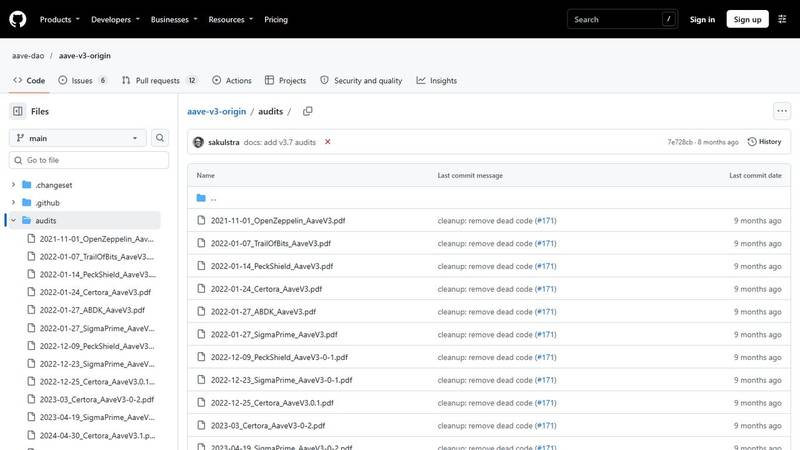
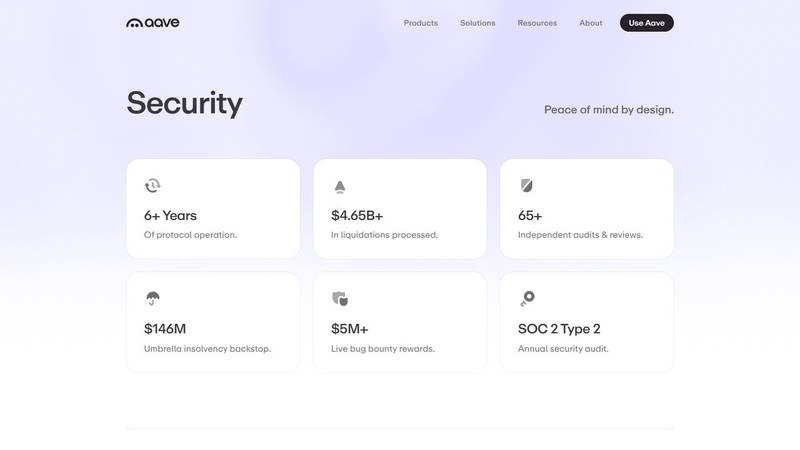
On Aave V3, the public GitHub audit folder lists 47 distinct reports from November 2021 to March 2026, written by about 15 reviewers. Certora appears 14 times and MixBytes five. For the v3.7 release there are six reports dated 26 to 31 March 2026, from MixBytes, Sherlock, Pashov, Certora, Savant and Enigma. Aave's own security page claims 65 or more independent audits and reviews, a $5 million or more live bug bounty and a $146 million backstop. Those are Aave's claims. We counted only what is in the GitHub folder, and we did not read the reports themselves.
We did not map the live pool's code revision (12) to a version number or to a specific report. That is the step to take if you want to be sure the audit covers what is deployed.
Across the wider market, DefiLlama's own audit flag is a weak signal. For 584 protocols above $10 million TVL, 316 show zero audits listed. That can mean no audit, or that nobody has filled in the field. Treat it as a prompt to look, not a verdict.
Check 3: the oracle
A lending protocol must know prices to decide who is safe and who is liquidated. If the price feed is wrong, healthy users can be liquidated or bad loans can be opened. Ask which oracle is used, whether the price has safeguards, and whether the asset is liquid enough that its price is hard to push around.
On Aave V3, DefiLlama lists Chainlink as the primary oracle. On chain, the address registry returns 0x54586bE62E3c3580375aE3723C145253060Ca0C2 as its price oracle, and Aave's address book labels the same address as the protocol's oracle contract. DefiLlama's latest token breakdown shows the largest deposits are Wrapped Bitcoin (about $2.45 billion), wstETH (about $2.36 billion) and USDC (about $1.05 billion). Those are assets whose prices must be tracked closely, and wstETH is a token whose price depends on an exchange rate with staked Ether.
That is the kind of detail that went wrong in March 2026. DefiLlama records an incident on 12 March 2026 classed as oracle manipulation (technique: oracle misconfiguration), with $862,000 lost. Its description says a price-cap system reported wstETH at 1.1939 instead of 1.228, which triggered liquidations of 34 otherwise healthy E-Mode positions, and that the funds were returned. We read this only from DefiLlama's record. We did not read Aave's own post-mortem.
Our reading: even mature protocols can lose money from a price configuration error, not just from a hack. When you check the oracle, look at how the price is built, not only who provides it.
Check 4: TVL and liquidity
TVL tells you how much others have deposited. A big number can reassure, but it can fall fast, and it can be inflated by tokens whose value only exists inside the protocol. Look at three things:
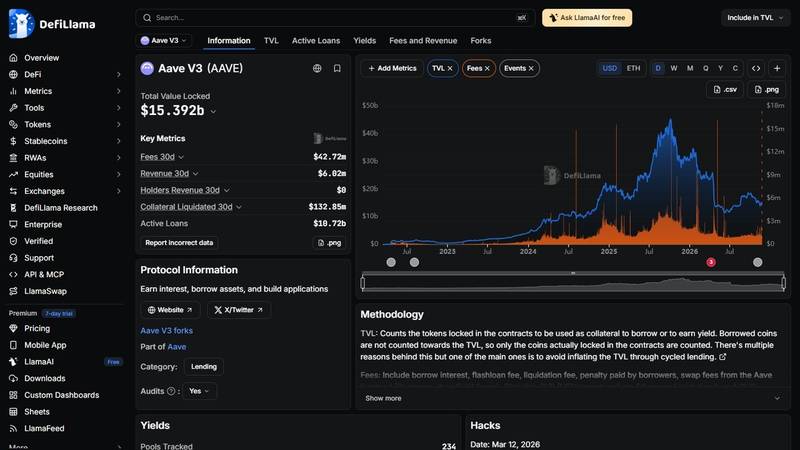
- Size and trend. On 23 November 2026, DefiLlama showed Aave V3 at about $15.39 billion of TVL, with about $13.2 billion of it on Ethereum, and $10.7 billion of active loans.
- Where the money is. A protocol spread across many chains is exposed to the risk of each chain and each bridge.
- Can you get out? In a lending pool, withdrawal depends on free liquidity. If most deposits are lent out, you may not be able to withdraw all at once. In the same DefiLlama panel, Aave's 30-day figures were $132.85 million of collateral liquidated and $42.72 million of fees, so there is active use.
Our reading: TVL is a popularity measure. A high TVL on a young protocol with few audits is more of a warning than a comfort.
Check 5: history and ongoing signals
Look at the incident record and how the team responded. DefiLlama keeps a hacks list for each protocol. For Aave V3 it shows one entry, the March 2026 event above, with funds returned. A clean record is not proof of safety, and an incident is not proof of danger. What matters is how large, how fast it was handled and whether users were made whole.
Then check what the team says about security. Aave's security page lists its audits, a bug bounty and an insurance-style backstop. Treat every number on a project's own page as a claim. Compare it with something you can open yourself, such as the audit folder or a bounty listing.
A one-page checklist
- Find who can upgrade or change the protocol, and whether there is a timelock.
- Open the audit list, check dates, firms and the version covered.
- Find which oracle feeds prices and how prices are protected.
- Check TVL size, trend and the chains involved.
- Check the incident history and how it was handled.
- Start with an amount you could lose entirely, and withdraw a small test first.
Our reading
- The five checks reduce unknowns but do not remove risk. Large, audited protocols have still lost money.
- On Aave V3 we could confirm a contract owner, a list of reports and a Chainlink-based oracle. We could not confirm who controls the owner contract or what delay applies.
- A project's own security page is a starting point. The audit reports and the on-chain data are the evidence.
- A missing audit on a new protocol with large TVL is a bigger red flag than a missing audit on a tiny one.
What we did not check
- We did not read any audit report in full, or map the live revision 12 to a version number.
- We did not trace who controls the Aave owner contract, or any timelock length. The governance docs are the place to find that.
- We did not read Aave's own post-mortem of the March 2026 event, so the details come from DefiLlama's record.
- We did not check the DefiLlama marker labelled "KelpDAO hack" that appears on the Aave chart in April 2026, so we do not say how it relates to Aave.
- We did not deposit or sign a transaction.
- We could not use Etherscan pages because of a bot check.
- We did not run the checks on any other protocol. DefiLlama's audit field is community maintained, so the 316 of 584 figure may include protocols that are audited but not listed.
FAQ
How do I know if a DeFi protocol is safe?
You cannot be sure. You can lower the risk by checking who can change the code, the audits, the oracle, the TVL and the incident history, and by starting small.
Is an audited protocol safe?
No. An audit is a review at a point in time. Bugs can survive, code can change afterwards, and other risks such as oracle errors still apply.
What is an admin key in DeFi?
It is the permission to change a protocol's code or settings. It is safer when held by a contract with several approvers and a delay than by one wallet.
What is a timelock?
A timelock forces a delay between a change being approved and taking effect, so users have time to withdraw if they dislike it.
Does a high TVL mean a protocol is safe?
No. TVL shows how much is deposited, not whether the code or the controls are sound.
What happened to Aave in March 2026?
DefiLlama records an oracle-related event on 12 March 2026 with $862,000 lost and funds returned. It says a price-cap setting reported a wrong wstETH rate and triggered liquidations. We did not verify this with Aave's own report.
Can I check this without coding?
Yes. Block explorers have a "read contract" tab, and DefiLlama, GitHub and a protocol's docs cover the rest. We used a public node for some reads, but the same facts are visible on an explorer.
Should I deposit into Aave because it was used here?
No. It was used as a worked example. This is not a recommendation.
This article is for information only and is not financial or investment advice. Data comes from DefiLlama, GitHub and a public Ethereum node as of 23 November 2026, and may have changed since.
Defiliban · Oliver Benjamin

Written by
DeFi Research Writer
Oliver Benjamin is a DeFi research writer at DefiLiban, specializing in decentralized finance systems, token economics, liquidity design, and blockchain market structure. His work focuses on analyzing how DeFi protocols function beneath surface-level narratives, with particular attention to incentives, on-chain behavior, yield systems, and emerging crypto infrastructure.