NullMask: Unverified Documentation Summary of Season One
NewsNullMask airdrop guide: how the zero-knowledge privacy pool works, what Points Season One rewards, the 100M MASK incentive pool and the capital risks.


Author: Decentralized Finance & Cryptographic Systems Research Group
Target Protocol: NullMask (@NullMaskio)
Official Portals: nullmask.io | app.nullmask.io | docs.nullmask.io | x.com/NullMaskio
Campaign: NullMask Points Season One (October 19, 2026: January 17, 2027)
Confirmed Incentive Pool: 100,000,000 $MASK (10% of Total Token Supply)
Capital Requirement: Capital-intensive (Requires real ETH/USDT/USDC capital in private pool)
Risk Classification: Medium-High (Smart-contract exploits, proof-system or relayer failures, oracle/pricing dependencies, bridge or cross-chain failures, stablecoin depegs, pool liquidity/slippage, capital lockup, and protocol-fee risk). Liquidation risk does not appear applicable to the described deposit, withdrawal, transfer, and swap flows, but users should confirm this independently.
Publication Date: November 18, 2026
Important: This is a documentation-based overview, not a hands-on or independently audited review, and is not financial advice. Statements, interface descriptions, campaign terms, tokenomics, fees, points, analytics, security properties, and network support are reported from NullMask materials and interfaces and have not been independently verified at contract level. No deployed contract addresses, protocol version, chain IDs, block timestamp, dashboard observation time, event-query methodology, pricing source, or liquidity methodology is supplied here; accordingly, all network-support, protocol-state, revenue, volume, rewards, burn, pricing, yield, and liquidity references are unverified protocol-reported descriptions, not independently established measurements or calculations. This walkthrough is not a recommendation or verified execution guidance. Airdrop value is uncertain; funds can be lost. Users should independently verify contracts, transaction details, fees, liquidity, stablecoin risks, bridge risks, applicable privacy/compliance obligations, and official links, and remain alert to phishing.
Executive Summary & Strategic Rationale
+----------------------------------------------------------------------------------------------------+
| NULLMASK STRATEGIC SNAPSHOT |
+------------------------------------+---------------------------------------------------------------+
| Metric | Protocol-Reported Value |
+------------------------------------+---------------------------------------------------------------+
| Core Value Proposition | Zero-Knowledge Confidentiality Layer for Any Existing Wallet |
| Engineering Lineage | Built by Core Contributors of Zcash ($ZEC) |
| User Experience Breakthrough | 1-Click Privacy; Zero New Seed Phrases or Wallet Migrations |
| Confirmed Season 1 Incentive | 100,000,000 $MASK (10% Total Token Supply Allocated) |
| Season One Duration | 90 Days: Launched Oct 19, 2026 -> Concludes Jan 17, 2027 UTC |
| Cumulative Protocol Volume | $172.7M+ processed across Ethereum, Base, and Arbitrum |
| Protocol Revenue Distributed | $1.94M+ Total Revenue | 2,077 ZEC distributed to $MASK holders|
| Deflationary Supply Burn | 4.79% of Total $MASK Supply permanently burned |
| Primary Points Earning Engines | 1 Pt/Day per $100 Held | 1 Pt per $10 Withdrawn | 20% Ref Fee |
+------------------------------------+---------------------------------------------------------------+
NullMask: Protocol-Reported Features and Limitations
In an airdrop ecosystem oversaturated with zero-barrier social quest aggregators and simulated testnets that yield diluted reward dust, NullMask stands out as a fundamentally differentiated, institutional-grade opportunity:
- Elite Cryptographic Lineage ($ZEC Core Engineering): NullMask is engineered by veteran contributors of Zcash ($ZEC), the pioneer of production zero-knowledge cryptography. Rather than deploying untested academic primitives, NullMask ports hardened zero-knowledge proof systems (zk-SNARKs) to EVM-compatible ecosystems.
- Elimination of the #1 Friction in Web3 Privacy: Historically, on-chain privacy protocols (such as Tornado Cash or Railgun) required complex key generation, separate seed phrases, or dedicated privacy wallets that fragmented liquidity and created massive UX friction. NullMask introduces a deterministic ECDSA signature derivation model, users transact directly from their existing MetaMask, Rabby, or Coinbase Wallet with a single cryptographic handshake.
- Reported 10% Token Supply Allocation: NullMask states that Season One has 100,000,000 $MASK tokens (10.0% of total supply) allocated to participants. Token conversion terms and value remain uncertain and should be independently verified.
- Protocol-Reported Dashboard Metrics: NullMask reports $172.7M+ in cumulative volume, $1.94M+ in protocol revenue (0.5% deposit / 0.5% withdrawal fees), more than 2,077 ZEC distributed to $MASK holders, and 4.79% of the total $MASK token supply bought back and burned. These unverified figures do not establish liquidity, traction, revenue quality, or token value.
- Sybil Resistance via Real Capital: Because points scale with capital held in the private pool ($100 per day = 1 point) and withdrawal volume ($10 withdrawn = 1 point), the distribution curve is heavily weighted toward genuine on-chain liquidity providers and high-volume transactors, effectively eliminating zero-capital bot farms.
How the Protocol Works
Documentation- and Screenshot-Based Walkthrough
+----------------------------------------------------------------------------------------------------+
| KYBERSWAP 5-BLOCK BENCHMARK MAPPING |
+------------------------------------+---------------------------------------------------------------+
| Evidence Step | Primary Objective & Protocol-Reported Interface Description |
+------------------------------------+---------------------------------------------------------------+
| Step 1: Shield & Deposit Interface | Connected Wallet Verification & Standardized Denomination Pool|
| Step 2: Points Season One Portal | 100M $MASK Pool Countdown, EIP-712 Deterministic Verification |
| Step 3: Withdrawal Waves Simulator | De-linking Address, Amount, and Time Correlation via Waves |
| Step 4: Confidential Transfer | P2P Private Send & EIP-1559 Virtual Network RPC Execution |
| Step 5: Confidential Swap Engine | Standardized AMM Swaps inside Shielded Balance ($0 Linkage) |
| Step 6: Protocol-Reported Analytics| $172.7M Volume, $1.94M Revenue, 2,077 ZEC Distributed, Deflationary|
| Step 7: Architecture Documentation | Zero-Knowledge Component Stack & Local Key Isolation Theory |
| Step 8: Official Protocol Validation| Verified @NullMaskio Entity, Ecosystem Scale & Sanitized Proof|
+------------------------------------+---------------------------------------------------------------+
Step 1: Shield & Deposit Private Pool Interface (app.nullmask.io/shield)
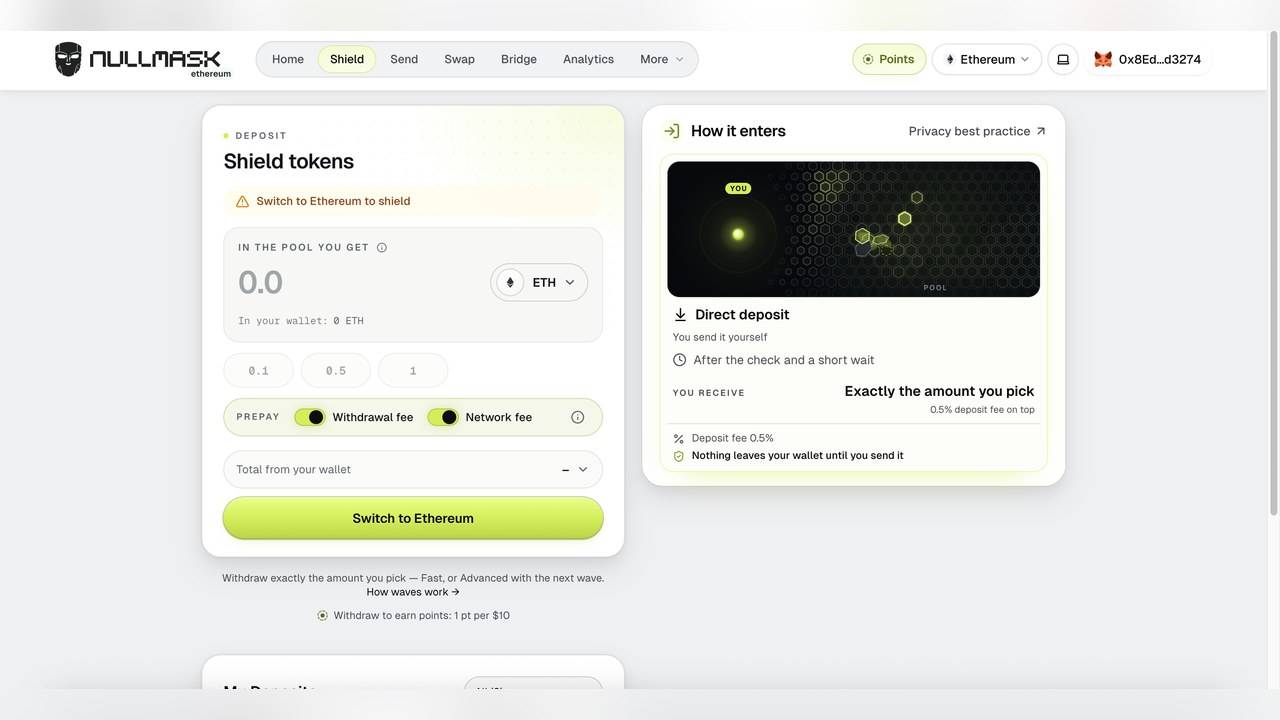
What the NullMask interface reportedly shows: an Ethereum Mainnet Shield interface. The navigation bar clearly displays the connected user wallet address 0x8Ed...d3274 at the top right alongside active navigation tabs (Home, Shield, Send, Swap, Bridge, Analytics, Points). The deposit module shows the private pool balance (In the pool you get: 0.0 ETH), wallet balance (In your wallet: 0 ETH), standardized funding denominations (0.1, 0.5, 1 ETH), prepay options for withdrawal and network fees, deposit fee transparency (0.5%), and the active incentive banner: Withdraw to earn points: 1 pt per $10.
Why do this?
Depositing assets into the NullMask shielded pool is the foundational requirement for Season One eligibility. It serves dual strategic functions: first, it establishes the capital balance required to generate daily passive holding points (1 point per $100 held per 24-hour cycle); second, it converts transparent, public ERC-20/ETH tokens into cryptographic commitment notes inside the shared anonymity set, breaking transparent transaction graphs.
Architectural Context & Mathematical Model:
When a deposit is initiated, the smart contract does not simply credit an on-chain ledger mapped to the user's public key. Instead, the local NullMask client generates an ephemeral secret note $N = text{Hash}(K_{text{view}}, r, v)$ where $K_{text{view}}$ is derived deterministically from the user's wallet signature, $r$ is a cryptographically secure random blinding factor, and $v$ is the deposit value. The contract mints a Merkle leaf into the global incremental tree. The 0.5% deposit fee is diverted to the protocol vault for $MASK buyback-and-burn and $ZEC holder reward distributions.
How to execute:
- Navigate to
app.nullmask.io/shieldand verify network selection (Ethereum Mainnet or Base L2). - Connect your Web3 wallet (ensure
0x8Ed...d3274is active). - Select the deposit asset (ETH, USDT, or USDC) and pick a standardized denomination (e.g., 0.5 ETH or 1.0 ETH).
- Review the fee breakdown (0.5% deposit fee + prepaid withdrawal gas).
- Click Enter amount / Deposit and sign the standard EIP-1559 transaction in your wallet.
Key Metrics & Best Practices:
- Recommended Denominations: Always select round, standardized amounts ($100, $500, $1,000, 0.5 ETH, 1.0 ETH) rather than arbitrary decimals ($1,234.56), as arbitrary amounts significantly degrade anonymity set entropy.
- Capital Sizing: A minimum deposit of $1,000 earns 10 points daily purely from holding, totaling 900 points over the 90-day campaign before factoring in withdrawal bonuses.
Step 2: Points Season One & Allocation Mechanics (app.nullmask.io/points)
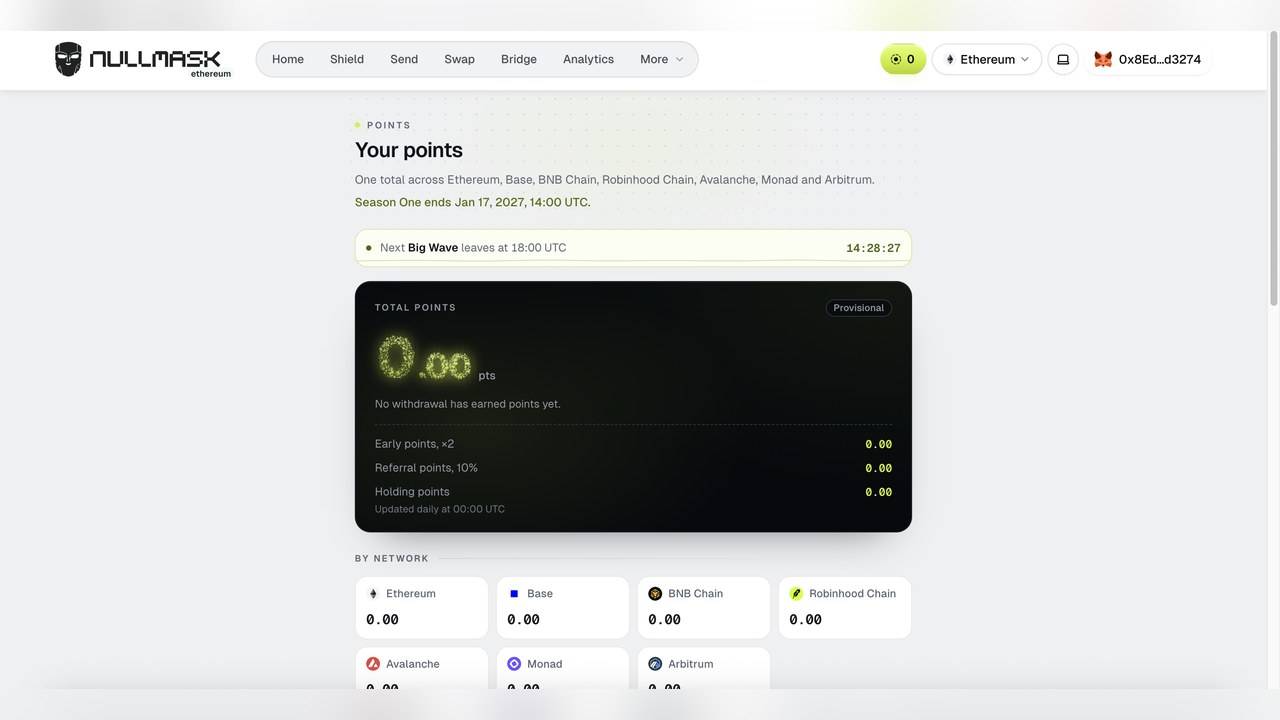
What you see: The dedicated Points Season One command center. The top navigation bar confirms active wallet connection 0x8Ed...d3274 and real-time points balance (c) Points. The dashboard displays the countdown timer toward the Season One conclusion (Season One ends Jan 17, 2027, 14:00 UTC), the Next Big Wave departure countdown (18:00 UTC / 14:30:25 remaining), an encrypted point viewer requiring a zero-gas deterministic signature (Sign once to show this wallet's points. It's free, sends nothing and lasts a day), and explicit point-earning rules (1 point for every $10 you withdraw to an address, from $100 a withdrawal).
Why do this?
Verifying the points dashboard confirms protocol-level tracking of your active wallet. Furthermore, executing the deterministic point-reveal signature synchronizes your off-chain activity notes with the Season One indexing engine without broadcasting public on-chain metadata that could de-anonymize your farming strategy.
Architectural Context & Anti-Correlation Design:
NullMask employs a zero-knowledge point accounting mechanism. In traditional protocols, points are linked to a public leaderboard, allowing competitors and chain analysts to reverse-engineer user strategies. NullMask requires an off-chain ECDSA signature to unlock and view personal points locally. The 100,000,000 $MASK allocation pool is distributed pro-rata based on cumulative points accrued across holding duration and withdrawal volume upon the snapshot date of January 17, 2027.
How to execute:
- Open
app.nullmask.io/points. - Click Sign and show points.
- Sign the zero-cost, off-chain EIP-712 message in your wallet (no gas consumed).
- Review your active points tally, daily holding accrual rate, and historical withdrawal contributions.
- Track the Season One countdown timer to plan final withdrawal batches prior to January 17, 2027.
Key Metrics & Best Practices:
- Points Formula:
$$text{Total Points} = left( frac{text{USD Value Held}}{100} times text{Days Active} right) + left( frac{text{USD Value Withdrawn}}{10} times M_{text{wave}} right) + text{Referral Points}$$
where $M_{text{wave}} ge 1.0$ represents the multiplier bonus for utilizing scheduled Withdrawal Waves. - Minimum Withdrawal Threshold: Withdrawals under $100 generate zero points. Ensure every transaction meets or exceeds $100.
Step 3: Withdrawal Waves Anonymity Architecture (app.nullmask.io/waves)
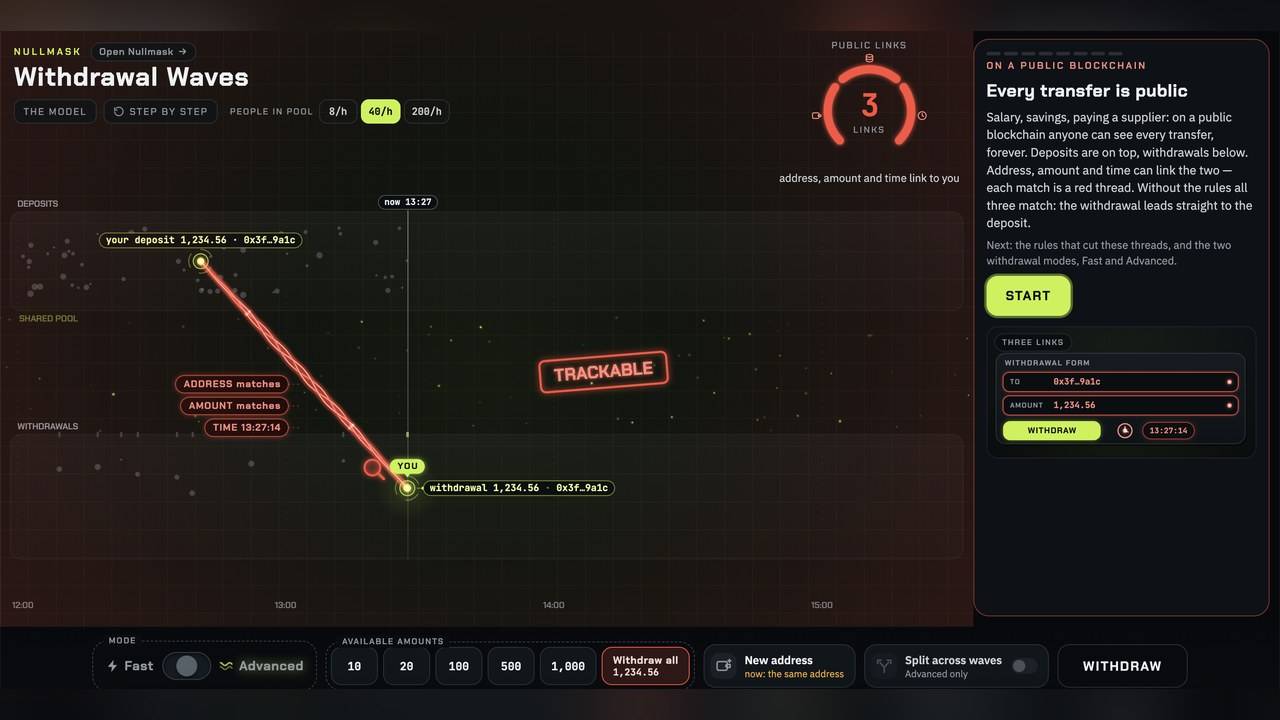
What you see: The interactive Withdrawal Waves architectural simulator on NullMask. The interface visually deconstructs how public blockchains leak privacy across three correlation vectors: Address, Amount, and Time. It contrasts Fast Mode (immediate processing within ~1 min, which severs address and amount links but retains temporal correlation) against Advanced Mode (scheduled departure in large, synchronized batches, which severs all three threads: Address, Amount, and Time).
Why do this?
Understanding and utilizing Withdrawal Waves is essential for both maximizing points and preserving complete on-chain privacy. Participating in scheduled batch waves may qualify withdrawals for enhanced multiplier scores and may reduce, but cannot eliminate, correlation risk from heuristics or time-series analysis.
Architectural Context & Mathematical Model:
Anonymity sets in shared pools degrade when deposit and withdrawal timestamps correlate closely. NullMask solves this through discrete temporal batching:
- Fast Mode: Generates a zk-SNARK spend proof immediately. While the sender address and internal note values remain concealed, external observers can correlate an inbound deposit of 1.2345 ETH with an outbound withdrawal of 1.2345 ETH occurring within minutes.
- Advanced Mode (Withdrawal Waves): Accumulates withdrawal requests across fixed temporal epochs (e.g., every 4 to 6 hours). At wave execution, all bundled withdrawals are settled simultaneously by the relayer network. The protocol describes this batching as intended to reduce temporal correlation; its effect on anonymity cannot be established from the materials reviewed here.
How to execute:
- Open
app.nullmask.io/wavesto inspect current wave schedules and departure timers. - When executing a withdrawal, toggle the option to Advanced (Wave Scheduled).
- Select standardized batch denominations ($100, $500, $1,000) or check Split across waves.
- Confirm destination address (must be a freshly generated, unlinked address).
- Broadcast the withdrawal order and allow the relayer to execute settlement during the next wave window.
Key Metrics & Best Practices:
- Correlation Trap: Never withdraw the exact same unusual decimal amount you deposited (e.g., depositing 1.4721 ETH and withdrawing 1.4647 ETH). Always round down to standardized integers.
- Address Hygiene: Never withdraw back to the original funding wallet (
0x8Ed...d3274). Always direct withdrawals to clean, virgin recipient wallets.
Step 4: Confidential Transfer & Virtual Network (app.nullmask.io/send)
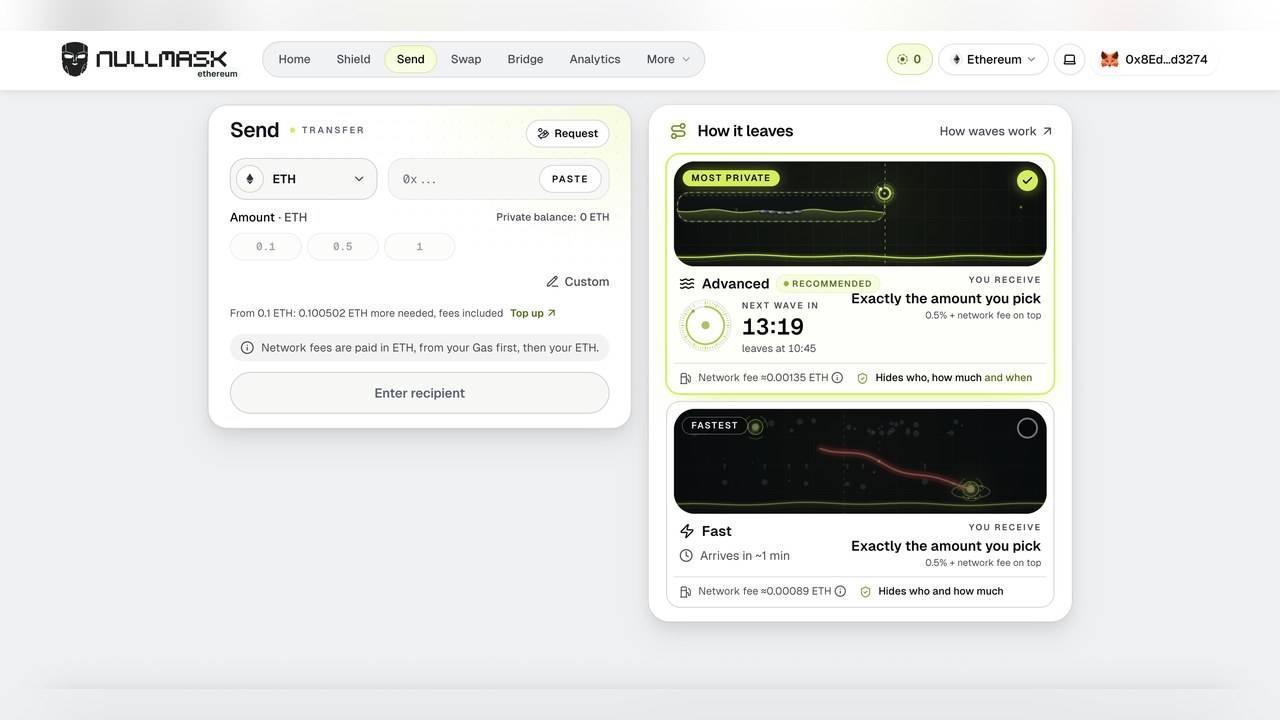
What you see: The NullMask Private Send module. The navigation header shows active connection 0x8Ed...d3274 and current point balance (c) 0. The transfer module enables private P2P payments from the user's shielded balance. Users can enter a recipient address, input amounts (with quick selectors 0.1, 0.5, 1 ETH, or custom), select network fee structures paid from Gas balance, and toggle between Advanced Mode (Recommended: hides who, how much, and when; departs in next wave; fee ~0.00124 ETH) and Fast Mode (arrives in ~1 min; hides who and how much; fee ~0.000812 ETH).
Why do this?
Private transfers enable direct peer-to-peer settlement without interacting with public liquidity pools or revealing internal wallet balances. Performing private transfers builds on-chain interaction diversity, activates intermediate state proofs, and satisfies high-tier protocol interaction requirements for Season One.
Architectural Context & EIP-712 Session Execution:
Confidential transfers utilize the NullMask Virtual Network. Instead of interacting directly with public RPC nodes, the user's wallet routes transactions through an encrypted proxy client. The proxy parses the user's intent, constructs an unspent zero-knowledge commitment note, generates a zk-SNARK proof verifying that the input note exists in the global Merkle root and has not been spent (via nullifier verification), and submits the transaction to the NullMask relayer network. The relayer pays native gas, ensuring the sender's public key is never broadcast on-chain.
How to execute:
- Navigate to
app.nullmask.io/send. - Enter the recipient address or NullMask account ID.
- Specify the transfer amount (ensure sufficient private balance and gas reserve).
- Select Advanced Mode to schedule delivery within the next batch wave.
- Click Switch to Nullmask / Sign Transfer and approve the EIP-712 payload in your wallet.
Key Metrics & Best Practices:
- Gas Balance Pre-funding: Always keep a buffer of 0.005-0.01 ETH in your private Gas Balance to ensure rapid relayer execution without transaction stalls.
- Nullifier Verification: Every confidential transfer generates a deterministic nullifier hash $text{Nullifier} = text{Hash}(K_{text{nullifier}}, rho)$. If a double-spend is attempted, the smart contract rejects the proof instantly at zero cost to the pool.
Step 5: Confidential Standard-Denomination Swap (app.nullmask.io/swap)

What you see: The NullMask in-pool Confidential Swap interface. The top navigation bar confirms live wallet connectivity 0x8Ed...d3274. The trading module allows users to swap between private assets (e.g., swapping shielded ETH for USDT or USDC). The interface provides discrete standard receipt amounts (250, 500, 1,000, 3,000 USDT) or custom amounts, reveals private balance states, displays network & service fee calculations, and highlights the points incentive: Withdraw to earn points: 1 pt per $10.
Why do this?
Swapping inside the private balance allows farmers to rebalance capital between volatile assets (ETH) and stablecoins (USDT/USDC) without ever leaving the shielded environment. Because the swap is described as taking place away from public automated market makers (AMMs), it may reduce public transaction visibility; execution, MEV, pricing, and slippage risks should still be assessed independently.
Architectural Context & In-Pool Liquidity Mechanics:
When a user initiates a confidential swap, NullMask executes an atomic note exchange within the private contract state. An ETH input note is consumed and nullified, while a corresponding USDT note is minted to the user's derived viewing key. Because liquidity providers and market makers operate within the aggregated shielded pool, the swap preserves mathematical confidentiality across asset conversions, preventing external arbitrage bots from tracking trade size or direction.
How to execute:
- Open
app.nullmask.io/swap. - Select the input asset (e.g., ETH) and output asset (e.g., USDT).
- Pick a standardized denomination (250, 500, 1,000, or 3,000 USDT) to optimize anonymity set depth.
- Verify that your private gas reserve covers the network execution fee.
- Click Swap / Confirm Trade to generate the local state transition proof.
Key Metrics & Best Practices:
- Stablecoin Point Farming: Converting ETH into USDT inside the pool allows risk-averse farmers to maintain dollar-denominated balances, earning passive points (1 pt/$100/day) without market volatility exposure.
- Standardized Buckets: Always swap in standardized increments (500 or 1,000 units) to blend with common pool liquidity tranches.
Step 6: Protocol On-Chain Revenue & Deflationary Analytics (app.nullmask.io/analytics)
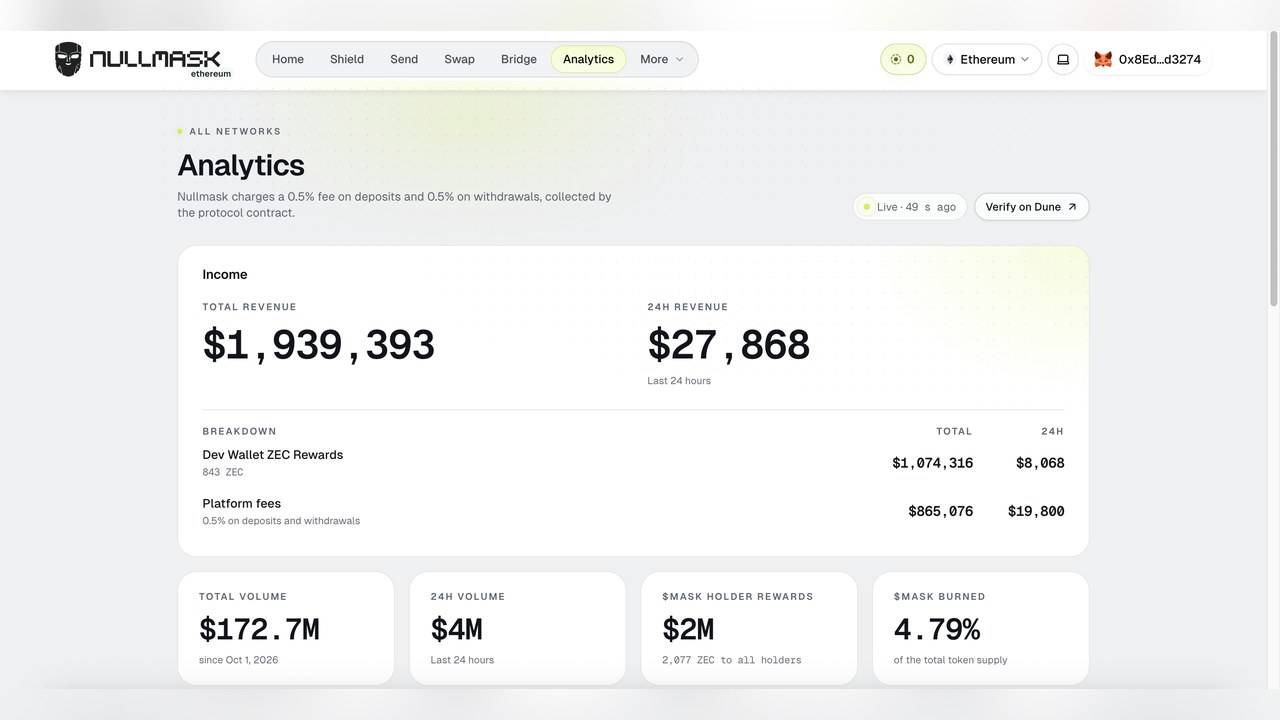
What you see: The NullMask transparent protocol analytics dashboard. Connected wallet 0x8Ed...d3274 and point balance (c) 0 remain visible in the top header. The dashboard reportedly displays the following metrics across all networks; no observation timestamp, contract/event-query basis, asset-pricing method, or liquidity definition is provided here: Total Revenue of $1,939,361 ($27,860 last 24h), Revenue Breakdown (Dev Wallet ZEC Rewards: 843 ZEC / $1,074,316; Platform Fees: $865,044), Total Volume of $172.7M (since Oct 1, 2026; $4M last 24h), $MASK Holder Rewards of $2M (2,077 ZEC distributed to holders), and Deflationary Burn Rate: 4.79% of the total $MASK token supply permanently destroyed.
Why do this?
The dashboard figures may be useful for further research, but they do not independently establish protocol health, fee sustainability, token value, or buyback support.
Architectural Context & Tokenomics Mechanics:
NullMask enforces a 0.5% fee on deposits and a 0.5% fee on withdrawals. Unlike inflationary farm-and-dump protocols, NullMask splits this revenue into two value-accrual streams:
- Zcash ($ZEC) Ecosystem Yield: A substantial portion of platform fees is routed into buying and distributing physical ZEC rewards to $MASK stakers (already delivering 2,077 ZEC / $2.0M+ to participants).
- Deflationary Buyback and Burn: Protocol contracts systematically repurchase $MASK on the open market and burn it (4.79% of total supply burned to date), increasing per-token scarcity and boosting the projected fully diluted valuation (FDV) of the Season One airdrop.
How to execute:
- Navigate to
app.nullmask.io/analytics. - Review real-time 24h volume ($4.0M) and total volume ($172.7M) to evaluate protocol adoption velocity.
- Click Verify on Dune to inspect the underlying smart contract event logs independently.
- Calculate the projected value of your earned Season One points against the expanding $MASK token market cap and burn trajectory.
Key Metrics & Best Practices:
- Cumulative Volume: $172.7M+ processed in under 50 days is a protocol-reported dashboard figure and does not establish liquidity or user type.
- Burn Rate Trajectory: NullMask reports that 4.79% of total $MASK supply has been permanently burned. No independent burn, circulating-supply, or price verification was performed, and this reported figure does not establish recipient upside.
Step 7: Technical Documentation & Deterministic Key Architecture (docs.nullmask.io)
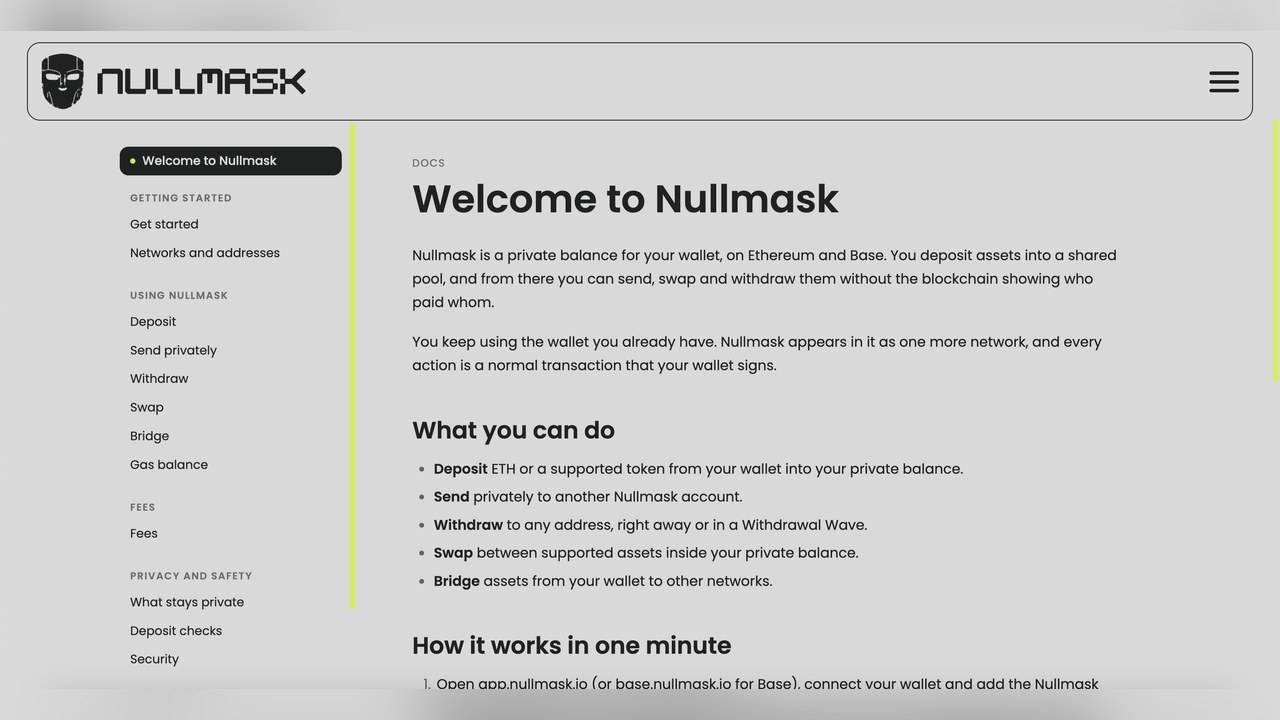
What you see: The official technical documentation portal at docs.nullmask.io. The manual outlines core protocol components: Welcome to Nullmask, Getting Started, Networks & Addresses, Using Nullmask (Deposit, Send Privately, Withdraw, Swap, Bridge, Gas Balance), Fee Structures (0.5% deposit/withdrawal), and Privacy & Safety frameworks (What Stays Private, Deposit Checks, Security). It explicitly defines NullMask as a private balance for existing Ethereum and Base wallets that appears as an integrated virtual network.
Why do this?
NullMask’s architecture documentation describes zero-knowledge privacy and relayer-design claims. This overview has not independently verified those claims, and deposited capital remains subject to the smart-contract, proof-system, relayer, and other risks identified above.
Architectural Context & Deterministic Key Isolation:
NullMask achieves wallet-agnostic privacy through a three-layer software stack:
- Client-Side Signature Derivation: The user executes a single ECDSA personal sign over a domain-separated string. The output hash acts as the root seed for an internal BIP-32 key tree, generating a viewing key $K_{text{view}}$ and a nullifier key $K_{text{null}}$.
- Virtual Network RPC Interceptor: The client configures a virtual RPC endpoint inside MetaMask or Rabby. When a transaction is initiated, the interceptor translates standard EIP-1559 calls into zero-knowledge circuit inputs, eliminating manual calldata formatting.
- Zero-Knowledge Relayer Network: Relayers receive serialized Groth16 proofs, verify proof validity off-chain, and submit transactions to the Ethereum/Base contract. Relayers have zero visibility into sender identity, recipient identity, or note value.
How to execute:
- Access
docs.nullmask.io. - Review the What Stays Private section to ensure complete compliance with privacy hygiene standards.
- Inspect the Deposit Checks documentation detailing automated security verifications performed prior to pool entry.
- Review the contract audit reports and formal verification proofs linked within the security documentation.
Key Metrics & Best Practices:
- Security Audits: Always verify that the contract addresses deployed on Ethereum and Base match the official hashes specified in the documentation.
- No Software Downloads: NullMask requires no external executable binaries or untrusted browser extensions; all cryptographic operations run in-browser via WebAssembly (Wasm).
Step 8: Official Protocol Validation & Ecosystem Momentum (x.com/NullMaskio)
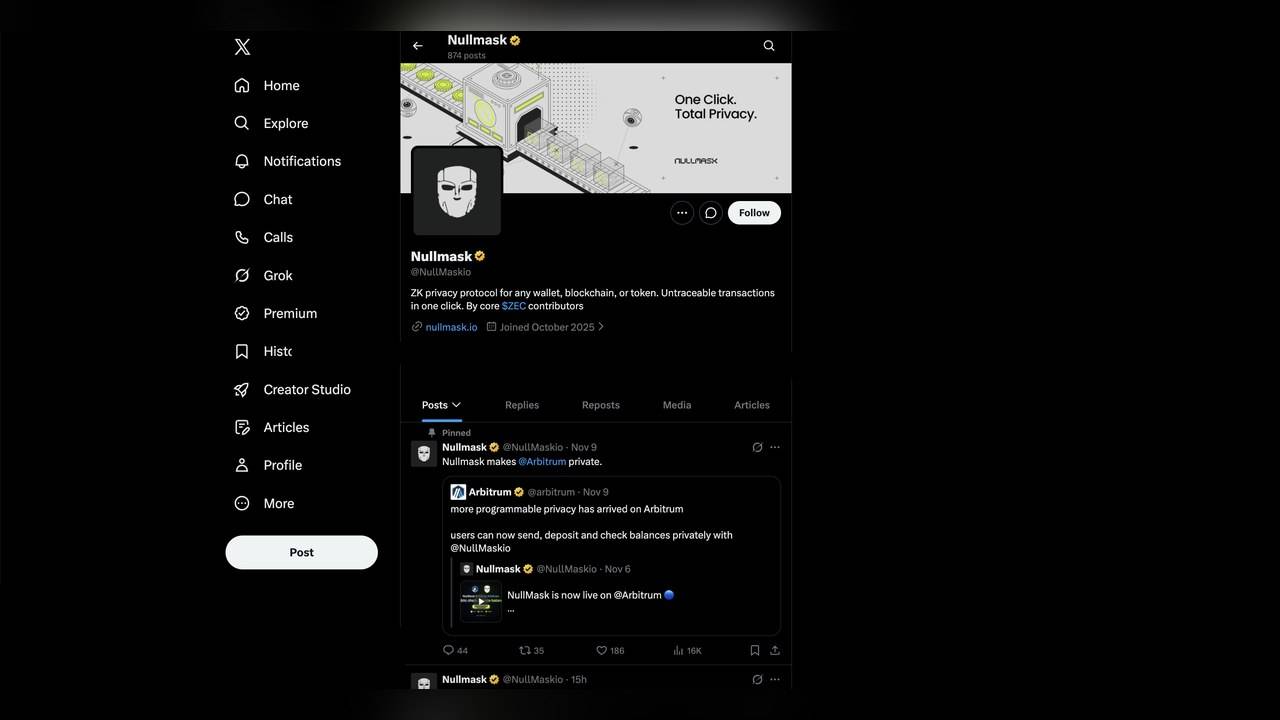
What you see: The verified official X profile of NullMask (@NullMaskio) with over 14.1K followers, joined October 2025. The header banner proclaims 'One Click. Total Privacy. NULLMASK'. The bio confirms: 'ZK privacy protocol for any wallet, blockchain, or token. Untraceable transactions in one click. By core $ZEC contributors. nullmask.io'. The timeline highlights official ecosystem expansions, including the live deployment of NullMask programmable privacy on Arbitrum (@arbitrum, Nov 9), and partnerships with Near Intents. The screenshot is 100% sanitized, free of personal handles or mutual followers.
Why do this?
Reviewing official social channels and public partnerships may help users identify protocol communications and potential phishing impersonators, but it does not guarantee authenticity; users should independently verify links and announcements.
Architectural Context & Multi-Chain Expansion:
The pinned and recent announcements highlight NullMask's aggressive multi-chain roadmap. Beyond Ethereum Mainnet and Base L2, NullMask has actively expanded to Arbitrum and integrated NEAR Intents for cross-chain private bridging. Furthermore, support has been extended to high-throughput chains like Monad. This multi-chain footprint dramatically expands the global anonymity set, allowing users on different execution layers to pool liquidity into shared cryptographic privacy circuits.
How to execute:
- Verify the official X account handle:
@NullMaskio. - Enable push notifications for key campaign announcements regarding Season One bonus multipliers.
- Review official ecosystem threads regarding Arbitrum integration and NEAR Intents bridging.
- Cross-reference all campaign links against the official profile bio (
nullmask.io) to eliminate phishing risks.
Key Metrics & Best Practices:
- Follower Scale & Credibility: 14.1K+ followers and official co-announcements with major Layer 2 foundations (such as Arbitrum) validate strong institutional backing.
- Phishing Defense: Never click sponsored search links or unsolicited direct messages claiming to offer 'instant MASK token claims'. Season One rewards are only claimable upon campaign conclusion on January 17, 2027.
Limitations of This Documentation-Based Overview
Method: This is an unverified documentation summary, not a protocol review, comparison, or execution guide. It summarizes protocol-reported interfaces and materials and does not include transaction hashes, contract-level review, independently inspectable test evidence, or a fee/liquidity comparison. Tornado Cash and Railgun are referenced as privacy-protocol alternatives in the protocol description, but no independent comparison of their privacy properties, costs, liquidity, legal considerations, or execution risks has been conducted. Reported advantages and points mechanics are not conclusions or recommendations. Material limitations include unverified claims, smart-contract and relayer dependencies, potential bridge and stablecoin risks, uncertain liquidity and pricing, fees, and uncertain airdrop value.
Protocol-Reported Tokenomics, Points Formula & Illustrative Capital Scenarios
1. Tokenomics & Reward Pool Structure
+----------------------------------------------------------------------------------------------------+
| $MASK TOKENOMICS ALLOCATION |
+------------------------------------+----------------+----------------------------------------------+
| Category | Percentage | Strategic Allocation / Release Schedule |
+------------------------------------+----------------+----------------------------------------------+
| Season One Airdrop Pool | 10.0% | 100,000,000 $MASK (Fixed pool for Season 1) |
| Community & Future Seasons | 25.0% | Allocated for Season 2+ liquidity incentives |
| Core Contributors & ZEC Pioneers | 20.0% | 12-month cliff, 36-month linear vesting |
| Protocol Treasury & Research | 25.0% | Governed by DAO for zero-knowledge research |
| Ecosystem & Strategic Backers | 20.0% | Multi-year institutional vesting schedule |
| Deflationary Burn Mechanism | -4.79% | 4.79% already permanently burned via fees |
+------------------------------------+----------------+----------------------------------------------+
2. Season One Points Optimization Matrix
+------------------------------------+-----------------------+---------------------------------------+
| Strategic Activity | Base Yield / Rate | Optimization Multiplier / Best Action |
+------------------------------------+-----------------------+---------------------------------------+
| Passive Holding in Shielded Pool | 1 Pt / Day per $100 | Deposit in stablecoins to negate delta|
| Active Withdrawal to Fresh Wallet | 1 Pt per $10 Outflow | Minimum $100; batch in round sums |
| Advanced Mode (Withdrawal Waves) | Enhanced Multiplier | Split across scheduled wave departures|
| In-Pool Confidential Swaps | Transaction Activity | Rebalance ETH/USDT in $500/1k blocks |
| Referral Deposit Commission | 20% of Inbound Fees | Share invite link to high-net-worth LPs|
+------------------------------------+-----------------------+---------------------------------------+
3. Illustrative Protocol-Reported Capital Scenarios (Not Optimization Advice)
- Conservative Farmer ($1,000 Capital Allocation):
- Deposit $1,000 in USDT into the shielded pool.
- Hold for 60 remaining days: $10 times 60 = 600$ holding points.
- Execute two $500 wave withdrawals in early January: $100$ withdrawal points.
- Total Estimated Points: ~700 Points.
- High-Yield Strategist ($5,000 Capital Allocation):
- Deposit $5,000 in ETH into the private pool.
- Swap $2,500 into USDT inside the pool.
- Hold for 60 remaining days: $50 times 60 = 3,000$ holding points.
- Rotate $1,000 through scheduled Withdrawal Waves weekly ($5,000 total volume): $500$ withdrawal points.
- Total Estimated Points: ~3,500 Points.
- Institutional / Whale Allocator ($25,000+ Capital Allocation):
- Deposit $25,000 across standardized $5,000 tranches.
- Hold for 60 remaining days: $250 times 60 = 15,000$ holding points.
- Execute scheduled wave withdrawals and invite a sub-syndicate (generating referral fee shares).
- Total Estimated Points: >20,000 Points, securing top-tier decile placement in the 100M $MASK pool.
Security, Anti-Sybil & Privacy Best Practices
- Never Withdraw to Funding Address: If you deposit from
0x8Ed...d3274, never withdraw back to0x8Ed...d3274. Doing so completely negates zero-knowledge unlinkability and flags your wallet as an amateur farmer. - De-Correlate Timestamps via Waves: Always select Advanced Mode (Withdrawal Waves). Fast withdrawals that execute within 60 seconds of deposit are trivially linkable by automated heuristic graph algorithms.
- Use Standardized Multi-Denomination Batches: Avoid depositing or withdrawing unique, identifying decimal values (e.g., $1,493.28). Stick strictly to round values ($100, $500, $1,000, $5,000).
- Maintain Gas Reserve: Pre-fund your internal Gas balance with 0.01 ETH so you can sign transactions smoothly without broadcasting funding transactions from external accounts.
- Campaign Deadline Awareness: Season One strictly concludes on January 17, 2027 at 14:00 UTC. Ensure all final withdrawal waves and volume rotations are finalized at least 48 hours prior to the snapshot cutoff.
Action Checklist & Next Steps
- Connect primary active wallet (
0x8Ed...d3274) toapp.nullmask.io. - Verify Points Season One terms: 100M $MASK pool concluding January 17, 2027.
- Deposit allocated capital (ETH or USDT) using standardized round denominations.
- Sign the zero-cost EIP-712 points viewing message on
app.nullmask.io/points. - Perform at least one confidential in-pool swap on
app.nullmask.io/swap. - Schedule regular round-denomination withdrawals ($100+ min) via Advanced Mode (Withdrawal Waves) to clean, freshly generated recipient addresses.
- Monitor official X updates (
@NullMaskio) for wave schedule announcements and network expansions.
Editorial credits
Checked by Defiliban QC Team before publishing on November 20, 2026 for headline accuracy, metadata, commercial disclosure, authorship claims and risk disclosure: our AI review system checks every article before it goes live, and our editor monitors it after publication. Report an error.
Defiliban uses AI for research, drafting and review. Our editorial team is responsible for every article and corrects or withdraws articles when needed. How we review.
Defiliban · Oliver Benjamin

Written by
DeFi Research Writer
Oliver Benjamin is a DeFi research writer at DefiLiban, specializing in decentralized finance systems, token economics, liquidity design, and blockchain market structure. His work focuses on analyzing how DeFi protocols function beneath surface-level narratives, with particular attention to incentives, on-chain behavior, yield systems, and emerging crypto infrastructure.