Kamino Finance Review 2026: Hands-On Look at Earn Vaults, Borrow Markets, Multiply and Swap
ReviewA screenshot-based walkthrough of app.kamino.finance on November 5, 2026: 33 Earn vaults, 44 borrow markets, Multiply loops, liquidity vaults and the zero-fee swap, plus DeFiLlama and CoinMarketCap numbers. No wallet connected.


Who this is for
- Solana users looking for lending yield, borrowing or leveraged "loop" strategies.
- Readers who want to see how Kamino presents risk, vault curators and rates before connecting a wallet.
- People tracking the KMNO token.
Financial information notice
This article is for informational purposes only and is not financial, investment, legal or tax advice. Lending, borrowing, leverage, tokens and liquidity strategies can result in loss of funds through market, liquidation, smart-contract, oracle, liquidity and counterparty risks.
What we tested
On November 5, 2026 we opened these pages and captured them at desktop (1440×900), tablet (1024×1366) and phone (430×932) sizes:
Network and deployment note: Kamino is presented here as a Solana app. We did not record or independently verify program addresses, protocol version or deployment state, governance proposals, a Solana slot, or a block timestamp; this review therefore does not make deployment-specific claims.
kamino.financeandapp.kamino.finance(Earn, Borrow, Multiply, Liquidity, Swap)docs.kamino.finance- DeFiLlama and CoinMarketCap pages for Kamino and KMNO
What we did NOT test
- No wallet was connected and no funds were deposited. We did not borrow, loop, swap or provide liquidity.
- Rates move constantly. The APY values below are app-displayed snapshots from the November 5, 2026 capture date, but the exact observation time and corresponding Solana slot or block time were not recorded. We did not independently calculate the yields: Earn and supply APYs are displayed app rates, Earn can include KMNO incentives when its toggle is enabled, Multiply figures are labeled as max APY or fixed-term rates where shown, and Liquidity figures are labeled 7D fees APY. The app itself shows slightly different numbers between loads (for example Allez USDC at 5.09% in one load and 5.17% in another).
- The Portfolio page loaded blank without a wallet, so it is not covered.
- We did not audit the code or the vault curators.
What Kamino is, in plain English
Kamino is a lending and yield app on Solana. You can deposit into curated Earn vaults run by outside managers, borrow against collateral, use Multiply to loop a position for leverage, add liquidity to automated vaults, or use a built-in swap aggregator. DeFiLlama describes it as "Solana's lending, liquidity & leverage venue".
Background: how Kamino became Solana's big lending hub
Historical background was not independently re-checked and is omitted from this review.
The docs split the audience into three: users (Docs), developers (Buildkit) and curators who design vaults and markets. That curator model is the most important idea in the 2026 version of Kamino, because it changes who is responsible for your risk.
The plain-English analogy
Think of Kamino as a money market with fund managers inside it. The base layer is a pool where people deposit assets and others borrow against collateral. On top of that, "curators" such as Steakhouse, Allez Labs, RockawayX or Gauntlet build vaults that allocate deposits across markets according to a stated risk profile (Conservative, Balanced, Aggressive). You pick a manager and a style, similar to picking a fund, but everything is on-chain.
How lending and borrowing work (and what LTV means)
- You deposit an asset, for example USDC. Borrowers pay interest, and you receive a share as supply APY.
- A borrower posts collateral (for example SOL) and borrows another asset. The rule that limits this is the LTV, loan-to-value. A "Liq LTV" of 80% on the AUTO row of the Borrow page means that if the loan reaches 80% of the collateral value, it can be liquidated.
- If the collateral price falls so that the loan crosses the limit, anyone can repay part of the debt and take collateral at a discount. That is liquidation, and the borrower pays the penalty.
What Multiply does, with a made-up example
The numbers below are illustrative only, not live data. Say you deposit $1,000 of a token that earns 8% and can borrow another asset at 5%. A loop deposits, borrows, buys more of the token, and deposits again, several times. At 3x exposure you hold $3,000 of the token, owe $2,000, and the earnings are roughly 8% of $3,000 minus 5% of $2,000 = $140, or 14% on your $1,000. That is why Multiply headlines such as "23.68% max APY" on AUTO Loop look high. The catch is the same leverage works backwards: a 15% drop in the token can wipe out a large part of your $1,000 and trigger liquidation. Always look at the leverage setting, the max leverage (the app shows loops up to 4.5x) and the available liquidity, which was $0.00 on several rows.
Live numbers (captured November 5, 2026)
| Metric | Value | Source |
|---|---|---|
| Lending market size | about $2.11B ($2,114,464,906 on one load) | Earn page |
| Earn vault deposits | about $293.3M | Earn page |
| Number of Earn vaults | 33 | Earn page |
| Borrow markets | 44 (31 shown) | Borrow page |
| Active borrows | $821,418,291 | Borrow page |
| Multiply total deposits | $415,885,365 | Multiply page |
| Multiply active borrows | $293,487,485 | Multiply page |
| Liquidity total deposits | $70,234,549 | Liquidity page |
| Liquidity fees generated | $43,084,612 | Liquidity page |
| DeFiLlama TVL | $1.314b | DeFiLlama |
| Fees 30d / Revenue 30d | $4.6m / $597,342 | DeFiLlama |
| Holders revenue 30d | $0 | DeFiLlama |
| Active loans | $836.83m | DeFiLlama |
| KMNO price / market cap | $0.037 / $219.35m (DeFiLlama); $0.03675 / $217.44M (CoinMarketCap) | DeFiLlama, CoinMarketCap |
| KMNO rank / holders | #121 / 55.52K | CoinMarketCap |
| KMNO supply | 5.91B circulating, 9.99B total, 10B max | CoinMarketCap |
Device views
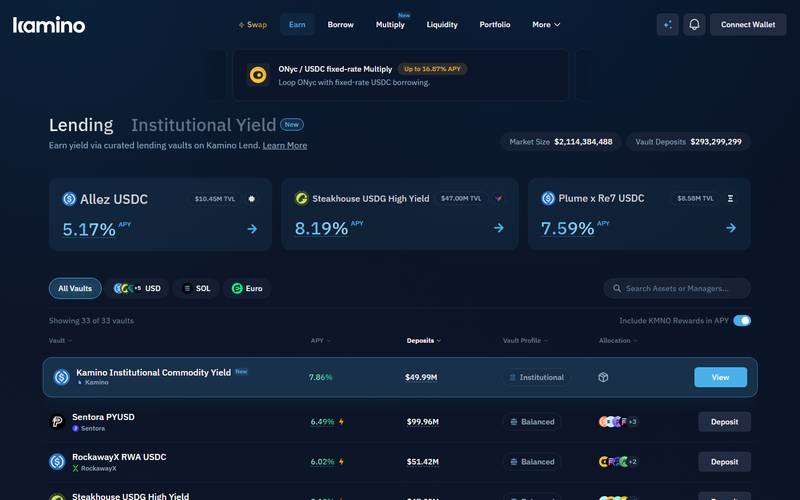
Kamino on desktop.
What you see: Desktop: kamino.finance opens straight into the app on the Earn tab. A top menu has Swap, Earn, Borrow, Multiply, Liquidity, Portfolio and More, with a Connect Wallet button.
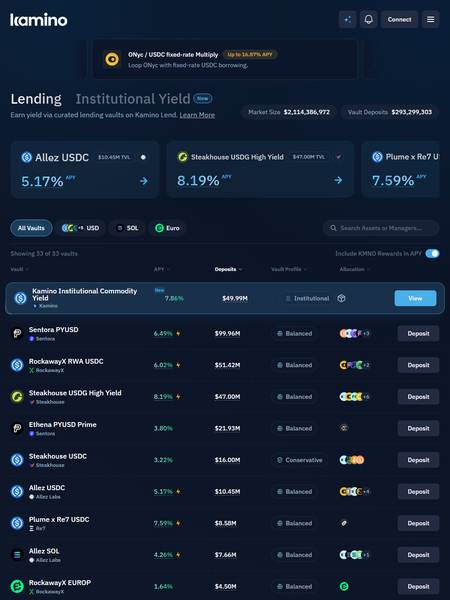
Kamino on tablet.
What you see: Tablet: menu collapses to a hamburger, the vault table keeps all columns (APY, Deposits, Vault Profile, Allocation).
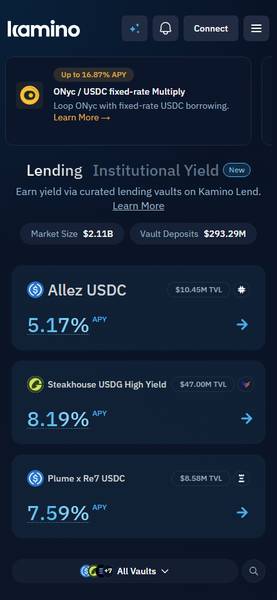
Kamino on phone.
What you see: Phone: three featured vaults are stacked as cards. The Earn view uses a compact vault selector.
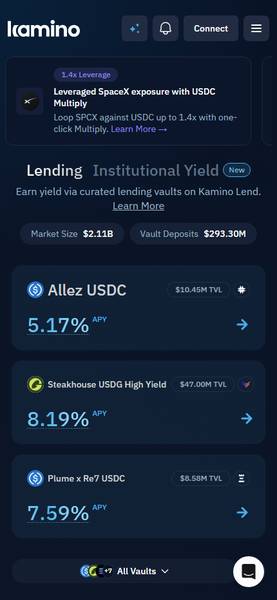
Earn on phone.
What you see: The Earn page on phone matches the homepage view, with a chat bubble ("Need help?") at the bottom right.
Core pages
Earn (curated lending vaults)
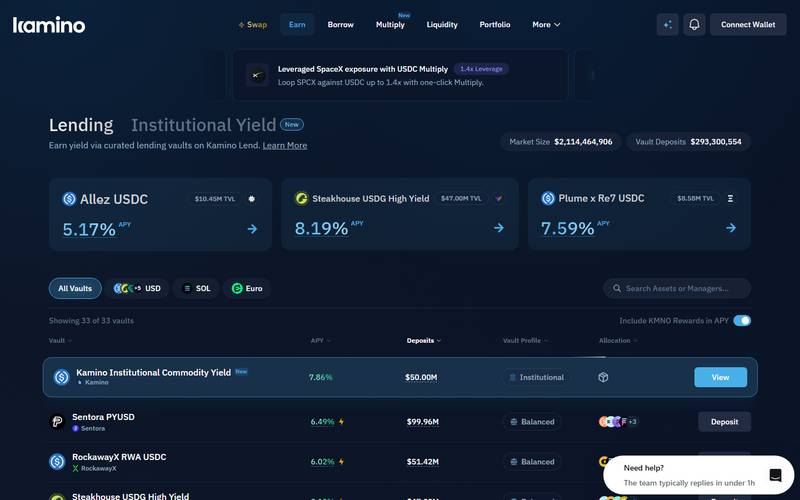
Earn: "Lending" and "Institutional Yield" tabs.
What you see: Earn: "Lending" and "Institutional Yield" tabs, three featured vaults, filters for USD, SOL and Euro, and a toggle to include KMNO rewards in APY.
| Featured vault | APY | TVL |
|---|---|---|
| Allez USDC | 5.17% | $10.45M |
| Steakhouse USDG High Yield | 8.19% | $47.00M |
| Plume x Re7 USDC | 7.59% | $8.58M |
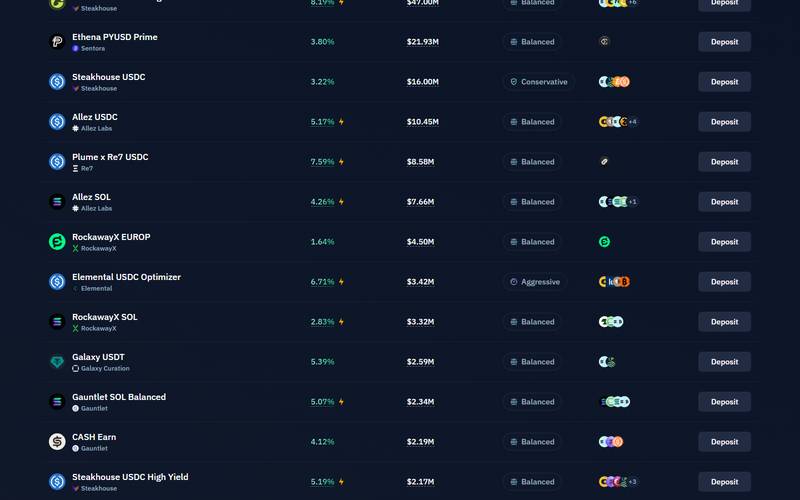
Vault list, part 1.
What you see: The list shows each vault with a risk profile tag (Balanced, Conservative, Aggressive), the curator and the asset allocation.
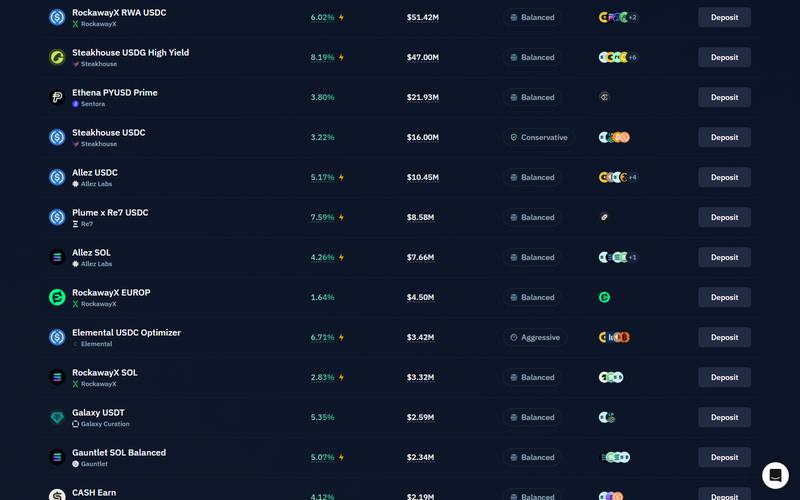
Vault list, part 2.
What you see: Larger vaults at the top of the list: RockawayX RWA USDC (6.02%, $51.42M), Steakhouse USDG High Yield (8.19%, $47.00M), Ethena PYUSD Prime (3.80%, $21.93M), Steakhouse USDC (3.22%, $16.00M).
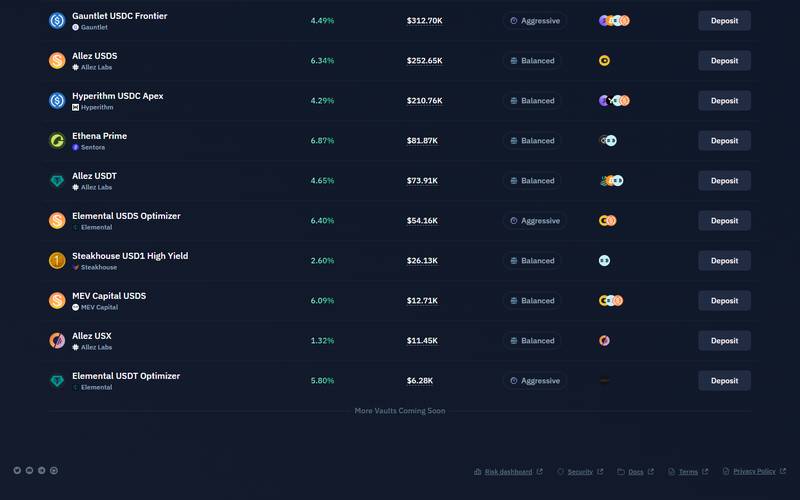
Vault list, end.
What you see: The tail of the list has small vaults (for example Elemental USDT Optimizer with $6.28K) and a "More Vaults Coming Soon" note. Footer links go to Risk dashboard, Security, Docs, Terms and Privacy Policy.
The top row, "Kamino Institutional Commodity Yield", is tagged New and Institutional with 7.86% and $49.99M deposits. Note the very wide range in vault size, from about $100M down to a few thousand dollars.
Borrow
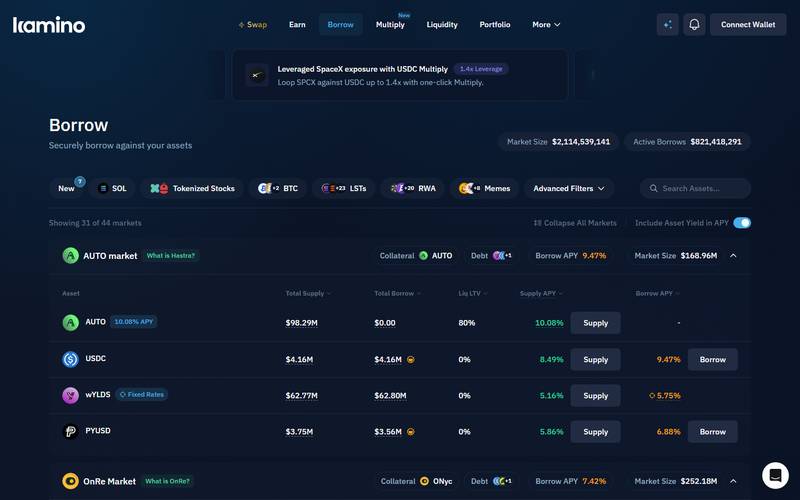
Borrow: filters for New, SOL, Tokenized Stocks.
What you see: Borrow: filters for New, SOL, Tokenized Stocks, BTC, LSTs, RWA and Memes, and a toggle to include asset yield in APY. Markets are grouped, for example the AUTO market and OnRe market.
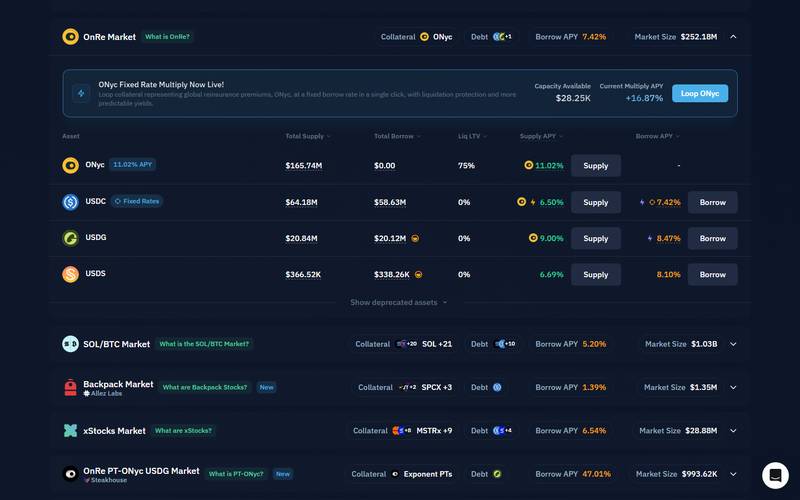
Borrow markets, OnRe.
What you see: The OnRe market promotes an ONyc fixed-rate Multiply loop (11.02% APY on ONyc supply, 16.87% current Multiply APY). Other market headers show borrow APY: SOL/BTC 5.20% ($1.03B), Backpack 1.39%, xStocks 6.54%, OnRe PT-ONyc USDG 47.01%.
| Example (AUTO market) | Total supply | Total borrow | Liq LTV | Supply APY | Borrow APY |
|---|---|---|---|---|---|
| USDC | $4.16M | $4.16M | 0% | 8.49% | 9.47% |
| PYUSD | $3.75M | $3.56M | 0% | 5.86% | 6.88% |
| AUTO | $98.29M | $0.00 | 80% | 10.08% | not shown |
Borrow APYs differ a lot between markets (1.39% to 47.01% in the headers we saw), so read each market, not only the headline.
Multiply
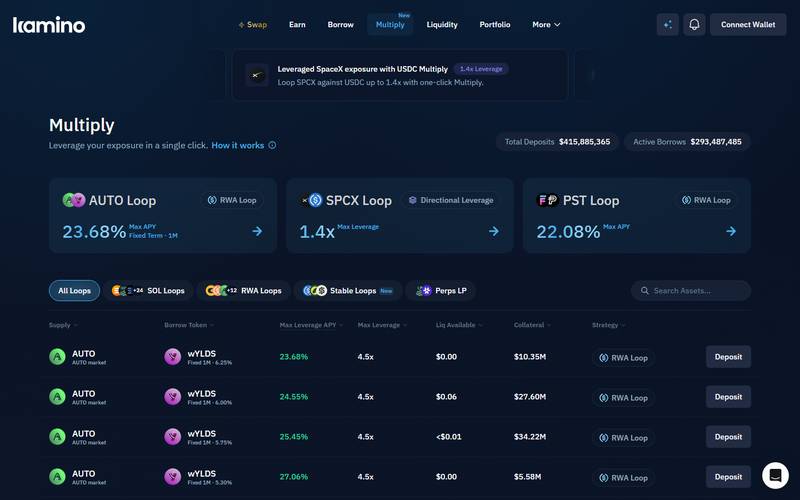
Multiply: "Leverage your exposure in a single click".
What you see: Featured loops are AUTO Loop (23.68% max APY, fixed term 1M), SPCX Loop (1.4x leverage) and PST Loop (22.08% max APY). Tabs: All, SOL, RWA, Stable Loops and Perps LP.
The table lists max leverage (4.5x on the AUTO rows shown), liquidity available (often $0.00 or less than $0.01 in our capture) and collateral. Low available liquidity means you may not be able to open the position at the headline rate. High leverage also raises liquidation risk.
Liquidity
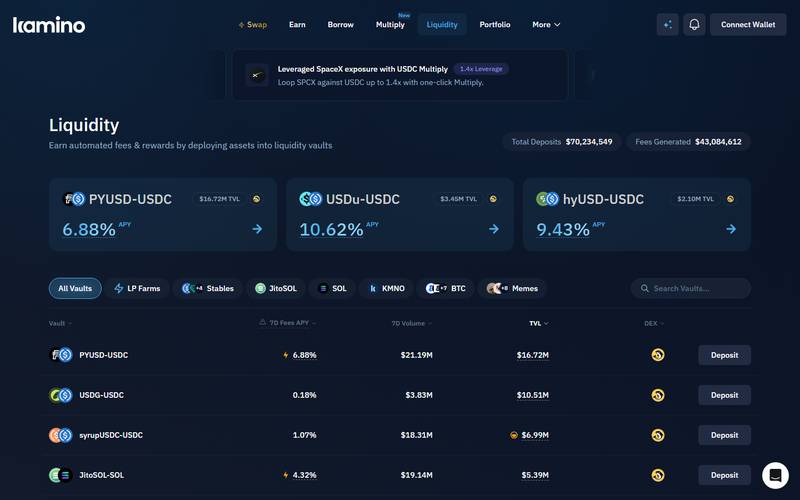
Liquidity vaults: automated fee-earning positions.
What you see: Featured: PYUSD-USDC (6.88%, $16.72M TVL), USDu-USDC (10.62%, $3.45M) and hyUSD-USDC (9.43%, $2.10M).
| Vault | 7D fees APY | 7D volume | TVL |
|---|---|---|---|
| PYUSD-USDC | 6.88% | $21.19M | $16.72M |
| USDG-USDC | 0.18% | $3.83M | $10.51M |
| syrupUSDC-USDC | 1.07% | $18.31M | $6.99M |
| JitoSOL-SOL | 4.32% | $19.14M | $5.39M |
Swap
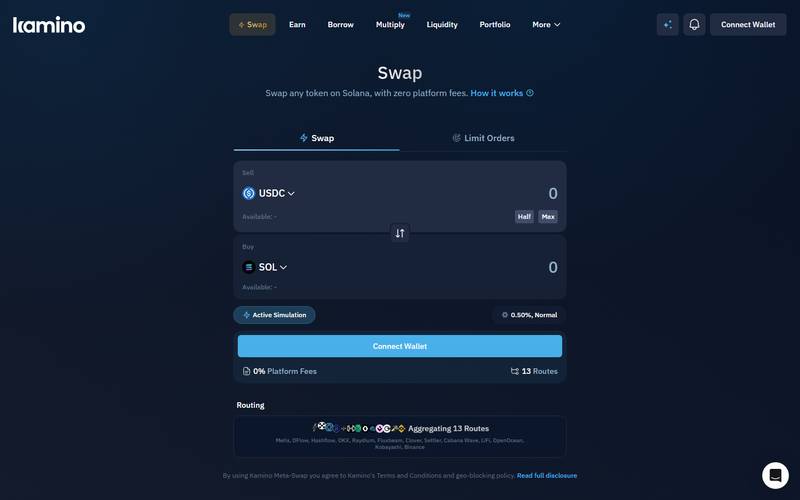
Swap: Swap and Limit Orders tabs.
What you see: Swap: Swap and Limit Orders tabs, USDC to SOL by default, slippage 0.50% (Normal), "0% Platform Fees" and "13 Routes".
The routing panel says it aggregates 13 routes, naming venues such as Metis, DFlow, Hashflow, OKX, Raydium, Fluxbeam, Clover, Settler, Cabana Wave, LiFi, OpenOcean, Kobayashi and Binance. The page states "zero platform fees", but the underlying venues and network fees still apply (not tested).
Docs
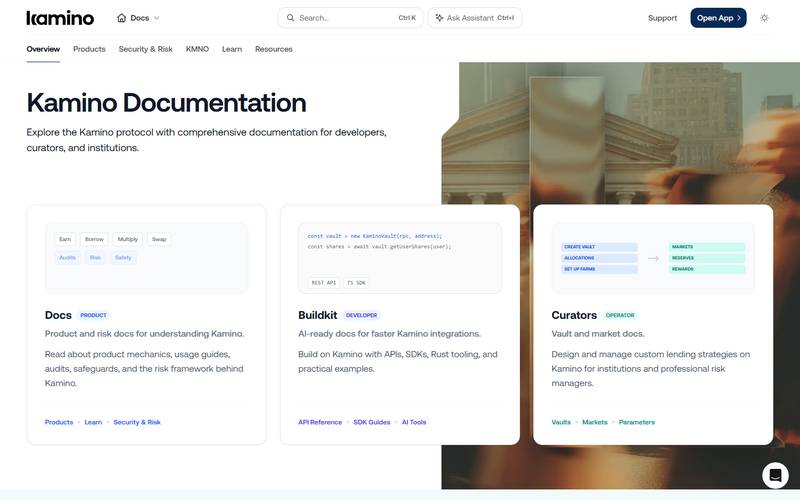
Docs overview: three audiences.
What you see: Docs (product and risk), Buildkit (APIs, SDKs, Rust tooling) and Curators (vault and market design). The top menu includes Security & Risk, KMNO and Learn.
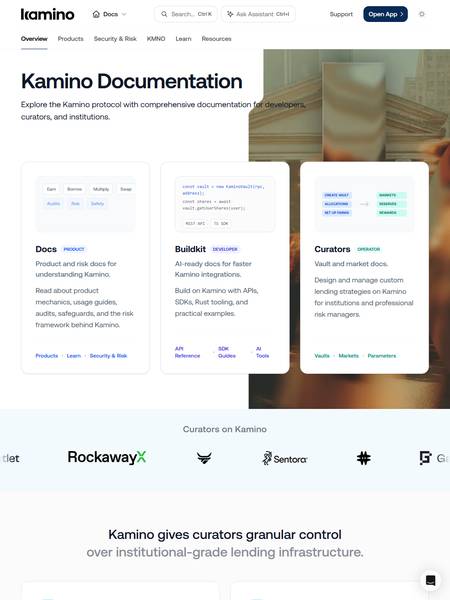
Docs on tablet.
What you see: Tablet view of the docs adds a "Curators on Kamino" strip, with RockawayX, Sentora and others visible.
Market data
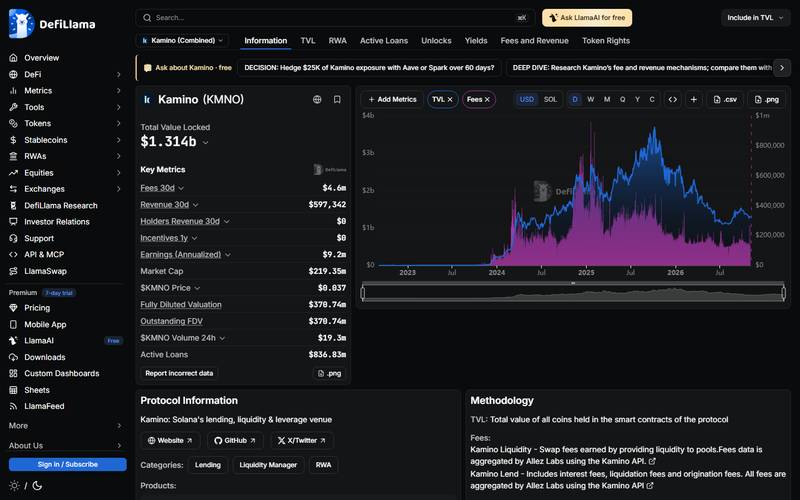
DeFiLlama (Kamino combined).
What you see: DeFiLlama (Kamino combined): TVL $1.314b, fees 30d $4.6m, revenue 30d $597,342, holders revenue $0, earnings annualized $9.2m. Categories: Lending, Liquidity Manager, RWA.
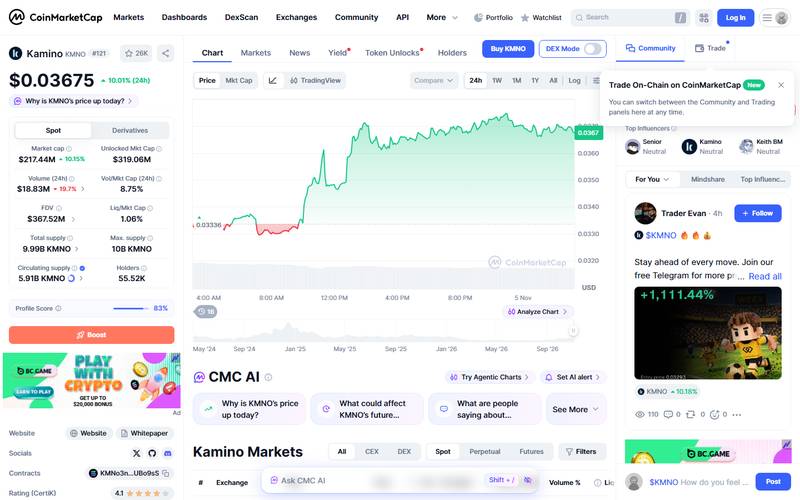
CoinMarketCap: KMNO $0.03675, up 10.01% in 24h, rank #121, FDV $367.52M, 55.52K holders.
What you see: On CoinMarketCap I read the token facts in one place: KMNO at $0.03675, up 10.01% in 24 hours, rank #121, FDV $367.52M and 55.52K holders. I use these as a quick market check, not as a reason to buy.
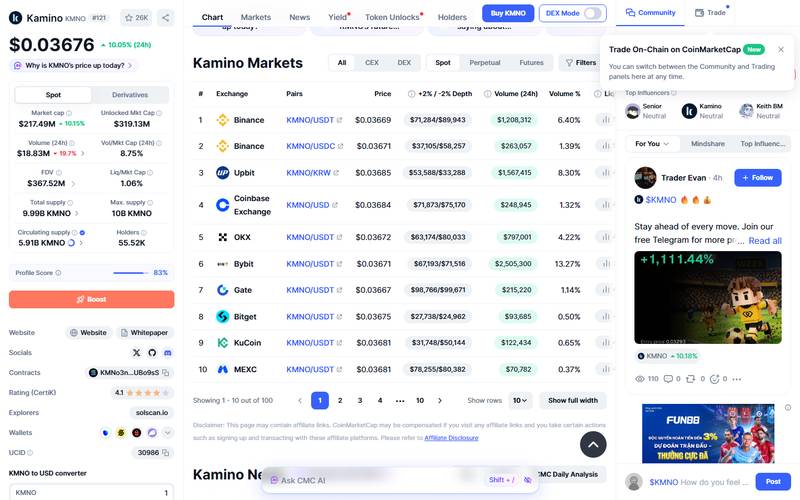
Top markets: Binance (KMNO/USDT, 6.40% of volume).
What you see: Top markets: Binance (KMNO/USDT, 6.40% of volume), Bybit (13.27%), Upbit (KMNO/KRW, 8.30%) and OKX (4.22%).
How to pick a vault: a beginner checklist
The Earn page lists 33 vaults. Use these questions to narrow down.
| Question | Where to look | What good looks like |
|---|---|---|
| Which asset do I hold? | Filter buttons for USD, SOL and Euro | Match the vault asset to what you want to keep |
| Who runs it? | Curator name in the list | A name you can research, with a track record |
| How risky is the style? | Risk tag (Conservative, Balanced, Aggressive) | Start with Conservative or Balanced |
| How big is it? | TVL column | Larger vaults such as RockawayX RWA USDC ($51.42M) are easier to enter and exit than a $6.28K vault |
| What drives the APY? | The KMNO rewards toggle | Switch it off to see the base yield without token incentives |
| Where does the money go? | Allocation column | Understand if it is lending only, RWA, or other strategies |
Example from our capture: Steakhouse USDG High Yield showed 8.19% on $47.00M, while Steakhouse USDC showed 3.22% on $16.00M. A higher APY is not a free lunch; open the allocation to see why it is higher.
KMNO tokenomics
From CoinMarketCap: 5.91B circulating, 9.99B total and 10B max supply, price $0.03675, market cap about $217M and FDV $367.52M, with 55.52K holders. The gap between market cap and FDV means about 4B tokens are not yet circulating; ask the docs team or the KMNO docs section about unlock timing. DeFiLlama shows holders revenue of $0 over the period, so as of this capture KMNO holders do not receive protocol fees directly. The token's value therefore rests on governance and expectations, not on a visible cash flow.
Fees
| Fee | What we saw |
|---|---|
| Swap platform fee | 0% (swap page) |
| Slippage setting | 0.50% Normal (swap page) |
| Protocol revenue | $597,342 over 30 days (DeFiLlama) |
| Deposit, borrow, liquidation and vault/curator-management fees | (Not verified) |
No full fee schedule was verified for deposits, borrowing, liquidations, vault or curator management, or the underlying swap-routing venues. DeFiLlama notes that Kamino Lend fees include interest, liquidation and origination fees. Vault curators may charge their own fees, which we did not check.
How to use Kamino: step-by-step tutorial
I opened the live Kamino app in a clean browser on 5 November 2026 and clicked through Earn, Borrow, Multiply, Swap and Liquidity. I did not connect a wallet and did not deposit, so every step that needs a wallet is marked (Not verified). This tutorial refers to kamino.finance and app.kamino.finance, the sites reviewed above.
Step 1: Start on the Earn page and read the list
First, I go to kamino.finance and press Earn. This is the calmest place to begin because it only asks you to lend one asset and watch it grow.
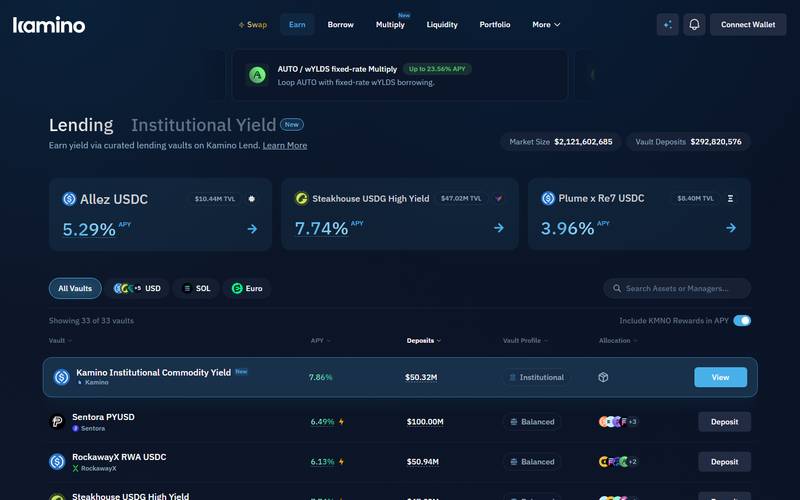
Kamino Earn page with the vault list.
What you see: The Earn page, "Lending" tab. Three highlighted vaults sit on top: Allez USDC at 5.29%, Steakhouse USDG High Yield at 7.74% and Plume x Re7 USDC at 3.96%. Below is a table of 33 vaults with APY, deposits, vault profile (Balanced or Institutional) and a Deposit button. Market size is about $2.12B.
I sort my eye along two columns: APY and Vault Profile. A higher APY usually comes with a riskier profile, so I do not chase the top number.
Step 2: Open one vault and read what it does
Next, I click on Steakhouse USDG High Yield to see the details.
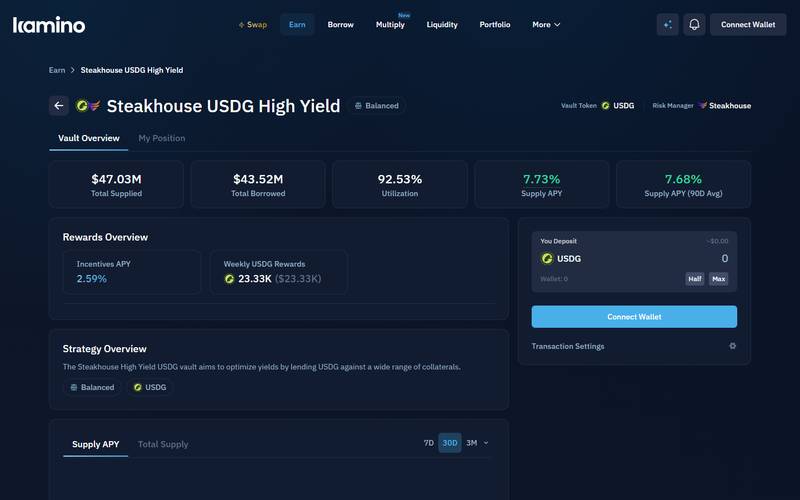
Kamino vault detail page for Steakhouse USDG High Yield.
What you see: The vault page. Top cards: $47.03M supplied, $43.52M borrowed, 92.53% utilization, 7.73% supply APY and a 90-day average of 7.68%. Left: "Rewards Overview" with a 2.59% incentive APY and "Strategy Overview" saying the vault lends USDG against a range of collaterals. Right: a "You Deposit" box for USDG with Half and Max buttons and a Connect Wallet button.
The number I watch here is utilization. At 92.53%, most deposited money is already lent out, so a sudden wave of withdrawals could take longer. The 90-day average shows me whether today's APY is normal or a spike.
Which option should I pick? For a first try, pick a vault with the "Balanced" label and a stablecoin you already hold. Skip anything marked Institutional unless you meet its rules.
Step 3: Browse the Borrow markets
Then I switch to Borrow, where Kamino works like a money market.
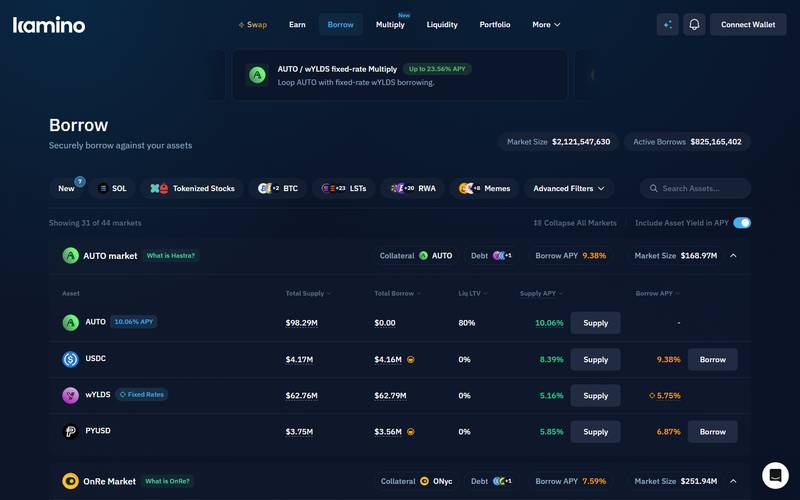
Kamino Borrow page with market list.
What you see: The Borrow page. Filters on top: New, SOL, Tokenized Stocks, BTC, LSTs, RWA and Memes. Below, the "AUTO market" lists AUTO, USDC, wYLDS and PYUSD with Total Supply, Total Borrow, Liq LTV, Supply APY and Borrow APY, each with Supply and Borrow buttons.
Each market is its own box with its own collateral and debt. I check Liq LTV first. It tells me how far the collateral can fall before the position can be liquidated.
Step 4: Open the Supply window
Now I press Supply next to USDC.
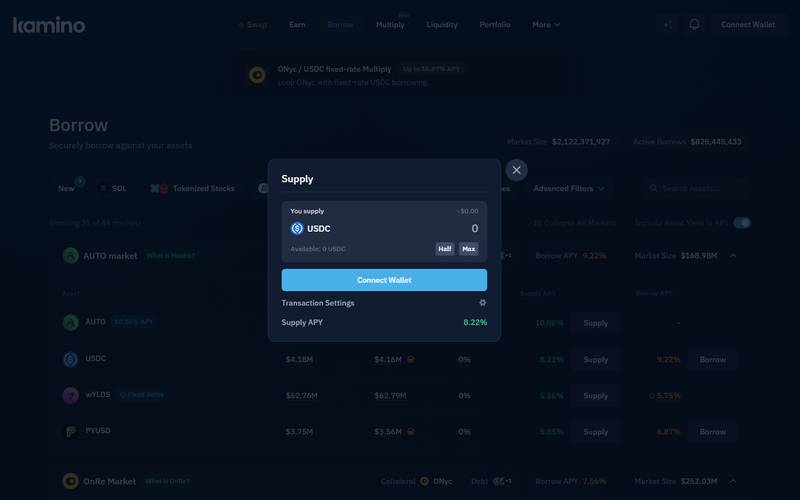
Kamino Supply window over the Borrow page.
What you see: A "Supply" window opens over the page. It has a "You supply" box for USDC (0, "Available: 0 USDC"), Half and Max buttons, a Connect Wallet button, "Transaction Settings" and a Supply APY of 8.22%.
- Type the amount in the USDC box.
- Press Connect Wallet and approve in your wallet.
- Confirm the supply transaction. (Not verified)
- To borrow, go back to the list and press Borrow on the asset you want, then check the health factor before you confirm.
Which option should I pick? Borrow well below the limit. Price drops on volatile collateral can move a position close to liquidation very fast.
Step 5: Look at Multiply (leveraged looping)
After that, I open Multiply, which is the most advanced product on the site.
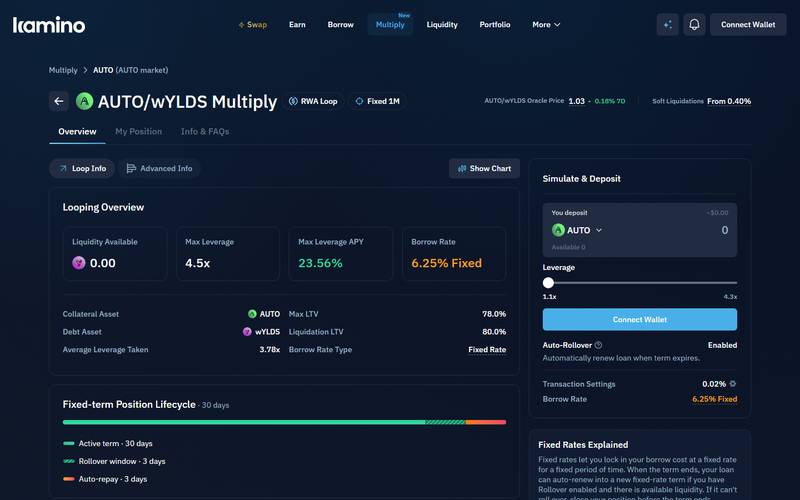
Kamino Multiply page for AUTO/wYLDS.
What you see: The AUTO/wYLDS Multiply page. "Looping Overview" shows Max Leverage 4.5x, Max Leverage APY 23.56% and a fixed Borrow Rate of 6.25%. On the right is a "Simulate & Deposit" box with a leverage slider from 1.1x to 4.3x. Below, "Fixed-term Position Lifecycle" shows a 30-day term with a 3-day rollover window.
I read the lifecycle bar slowly. A fixed-term loop ends, and the position either rolls over or has to be repaid. The 23.56% headline only applies at maximum leverage, which is also where the liquidation risk is highest.
Step 6: Try the Swap page
I also open Swap, because it needs no account to get a quote.
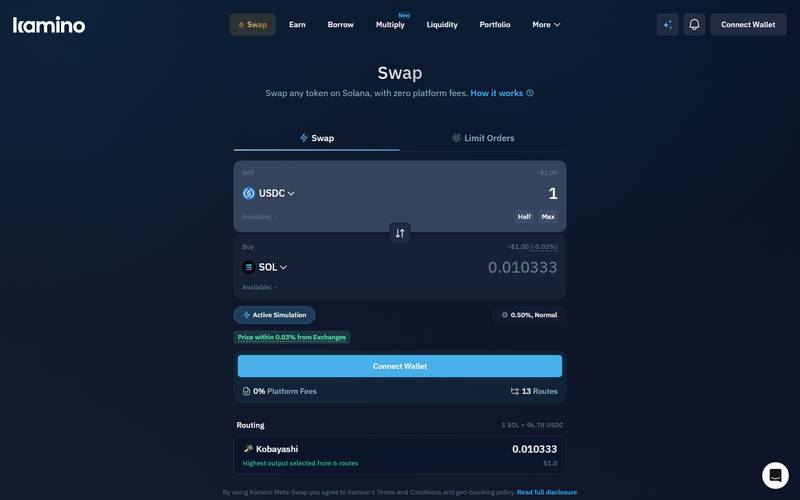
Kamino Swap page with a 1 USDC quote.
What you see: The Swap page with 1 USDC typed in the Sell box. The Buy box shows 0.010333 SOL. A badge says "Price within 0.03% from Exchanges", platform fees are 0%, and the routing list shows Kobayashi as the best of 6 routes.
The quote is a live preview. I can compare it with another aggregator before I go further, and I note that there is also a Limit Orders tab.
Step 7: Check a liquidity vault
Last, I open Liquidity and pick the PYUSD-USDC vault.
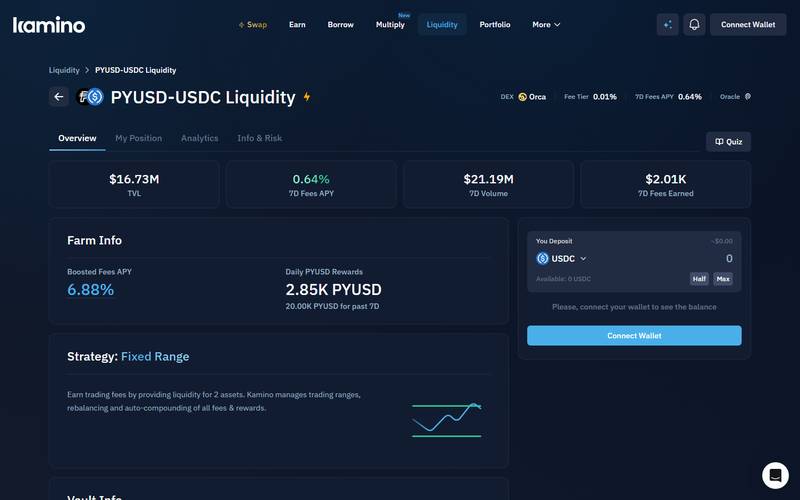
Kamino PYUSD-USDC liquidity vault.
What you see: The PYUSD-USDC Liquidity vault on Orca with a 0.01% fee tier. Cards show $16.73M TVL, 0.64% 7-day fees APY, $21.19M 7-day volume and $2.01K 7-day fees earned. "Farm Info" shows a boosted 6.88% APY and the strategy is labeled "Fixed Range". A deposit box with Connect Wallet is on the right.
The base fee yield is only 0.64%. Most of the headline APY comes from extra PYUSD rewards, and those can change at any time. I would treat the reward part as a bonus, not as income.
(Not verified) Depositing in this vault, withdrawing from it and any claim of rewards.
Older research (not re-checked)
Earlier versions of this review covered Kamino's history, the KMNO token launch and past security audits. We did not re-verify them in this session, so they are background only. The app footer links to a Risk dashboard and a Security page for anyone who wants the current list.
Security and risks
- Curator and strategy risk: Earn vaults are run by outside managers (Steakhouse, Allez Labs, RockawayX, Gauntlet and others). Strategy quality, allocation choices and risk controls vary, and the risk tag is the curator's profile, not a guarantee.
- Liquidation risk: Multiply loops of up to 4.5x can be liquidated when prices move.
- Liquidity limits: several Multiply rows showed $0.00 available liquidity.
- Rate volatility: headline APYs are snapshots and some include KMNO rewards (the toggle is on by default).
- Exotic collateral: markets for tokenized stocks, RWAs and PT tokens add pricing and redemption risk.
- Token value capture: DeFiLlama shows $0 holders revenue and $0 incentives for KMNO over the period shown.
- Smart-contract risk: vulnerabilities or failures in Kamino, vault, liquidity or routing contracts could cause losses. We did not audit any code.
- Oracle risk: liquidation depends on collateral and debt prices, but we did not verify the price feeds or oracle configuration. Incorrect or stale prices can affect borrowing limits and liquidations.
- Bridge and cross-chain risk: we did not independently verify whether individual vault allocations use bridges or cross-chain positions. Where they do, bridge, messaging and destination-chain failures can add risk.
Competitors
General knowledge, not re-checked.
| Protocol | Style | Strength |
|---|---|---|
| Kamino | Curated vaults plus lending, leverage, liquidity and swap | Widest product set on Solana |
| Marginfi | Lending and borrowing | Simple lending markets |
| Save (formerly Solend) | Lending and borrowing | One of the early Solana money markets |
| Jupiter Lend | Lending integrated with the Jupiter ecosystem | Convenient for Jupiter users |
| Drift | Perps and borrow | Trading focus |
Kamino's edge is that you can lend, loop and swap without leaving the site; the trade-off is that more features mean more places where mistakes happen.
FAQ
Is Kamino safe? There is a Security and Risk section in the docs and a Risk dashboard link in the footer. We did not audit anything. Smart contract and curator risk remain.
What does a curator do? An outside team defines a vault's strategy and which markets it can use. You trust their risk judgment, so choose one carefully.
Why do the APYs change between loads? Rates are live. Allez USDC appeared at 5.09% on one load and 5.17% on another.
What is "Include KMNO rewards in APY"? A toggle that adds token incentives to the displayed yield. Turn it off for the base rate.
Is swapping free? The swap page says "0% Platform Fees" and routes through 13 options, but you still pay network fees and pool fees.
Can I lose money in Multiply? Yes. If prices move against your loop, positions can be liquidated.
Does KMNO pay fees to holders? DeFiLlama showed $0 holders revenue in the captured period.
Pros and cons
Pros
- Very wide product set on one site: Earn, Borrow, Multiply, Liquidity and Swap.
- Clear tables with APY, TVL, risk profile and allocation.
- Zero platform fee on swaps and 13 aggregated routes.
- Docs aimed at users, developers and curators.
- Real size: $1.3B TVL per DeFiLlama.
Cons
- Many vaults and markets make comparison tiring.
- Some very small vaults and low-liquidity loops.
- Fees for deposit and borrow are not obvious on the pages we saw.
- Portfolio and wallet flows are untested here.
- No holder revenue for KMNO.
Verdict
Kamino is a deep and polished Solana money market, and its pages are clear about APY, TVL and curator risk before you connect anything. The caution is complexity: rates change fast, leverage products have thin liquidity at times, and risk depends on the curator you pick.
Rating: 4.1 / 5 for the interface and transparency as seen without a wallet. Execution was not tested.
Quick links
Not financial advice. Do your own research and never deposit more than you can afford to lose.
Defiliban · Oliver Benjamin

Written by
DeFi Research Writer
Oliver Benjamin is a DeFi research writer at DefiLiban, specializing in decentralized finance systems, token economics, liquidity design, and blockchain market structure. His work focuses on analyzing how DeFi protocols function beneath surface-level narratives, with particular attention to incentives, on-chain behavior, yield systems, and emerging crypto infrastructure.