Bittensor Review 2026: Hands-On Look at the TAO Network, Subnets, Validators and Market Data
ReviewA screenshot-based walkthrough of Bittensor in November 2026: the official site, docs and whitepaper, the TaoMarketCap subnet table, heatmap, validator list and TAO market data from DeFiLlama and CoinMarketCap. No wallet was connected.


Who this guide is for: People who want to see what Bittensor looks like in practice, where to find subnet and validator data, and what the TAO market numbers were on 5 November 2026.
What we tested (5 November 2026):
- bittensor.com (home, About, Whitepaper) and the docs site on desktop, tablet and phone.
- TaoMarketCap: the subnet table, heatmap, bubble view, two subnet pages and the validator page, with the guest swap panel.
- TAO market data on DeFiLlama and CoinMarketCap.
What we did NOT test:
- We did not connect a wallet, stake, swap, register a subnet, mine or validate.
- Taostats (taostats.io) showed a Cloudflare "Verify you are human" check in our automated browser, so we saw only a blurred page and did not use it.
- We did not install the SDK or CLI.
- We did not measure subnet revenue, so we make no claim about whether subnets earn more than they receive in emissions.
What Bittensor Is, in Plain English
The official docs describe Bittensor as an open network where independent "subnets" produce digital commodities such as compute, inference, storage and prediction, and the chain pays participants in its token, TAO, in proportion to the value they contribute. The docs split the roles: miners produce the commodity, validators score the miners, subnet creators define the incentive mechanism, and stakers back validators with TAO.
The whitepaper title is "Bittensor: A Peer-to-Peer Intelligence Market", by Yuma Rao.
Background: how Bittensor is built
The supply figures below are from CoinMarketCap on 5 Nov 2026; the role descriptions follow the official docs.
The TAO token has a maximum supply of 21 million, the same number as Bitcoin. CoinMarketCap showed 21M max supply and 11.69M circulating on our capture. The idea is simple to state: instead of paying machines to burn electricity on puzzles, pay them to produce useful machine intelligence.
The plain-English analogy
Imagine a talent show with many different categories (the subnets). In each category, contestants (miners) perform tasks such as running a language model, renting out GPUs, or predicting prices. Judges (validators) score the results. The prize money (new TAO issued every day) is shared according to the scores, and token holders (stakers) can back a judge they trust and share the judge's earnings. A separate organizer (the subnet owner) sets the rules for each category.
The four roles
| Role | What they do | How they earn |
|---|---|---|
| Miner | Produce the AI work the subnet asks for | A share of the subnet's emissions based on quality |
| Validator | Score the miners' work | Emissions plus a fee on stakers |
| Subnet owner | Designs the competition and incentives | A share of the subnet emission (the lium.io page shows an 18% / 41% / 41% split, which we read as owner, miners and validators) |
| Staker | Delegates TAO to a validator | The validator's reward, minus its fee |
Emissions, the halving and dTAO
Like Bitcoin, TAO issuance halves over time; according to the Bittensor emissions documentation, the first halving occurred in December 2025 and emission is now 0.5 TAO per block, roughly 3,600 TAO per day (half of the earlier 1 TAO per block, about 7,200 TAO per day). We did not verify this on chain. Under the "dTAO" (Dynamic TAO) system, each subnet has its own alpha token with its own market, which we could see on TaoMarketCap. The result, as seen on TaoMarketCap, is that subnets compete for emission share based on how the market values their token. Today's heatmap shows this: lium.io (SN 51) captures 16.35% of emissions, Chutes (SN 64) 9.36% and Targon (SN 4) 8.04%. A large share goes to subnets that sell compute, which suggests the market is rewarding practical services.
Live Numbers (5 November 2026)
Each figure is a dated, untimestamped snapshot from our browsing session on 5 November 2026. Prices, APYs and emission shares change continuously, so these are not time-specific observations; check the linked sources for current values. Validator APYs are estimates displayed by the pages, not returns we measured; we did not verify the APY period, compounding assumptions, fee treatment or provider methodology.
| Metric | Value | Source |
|---|---|---|
| TAO price | $234.95 (+2.66% 24h) | CoinMarketCap |
| TAO price | $236.78 | DeFiLlama |
| TAO price | $234.65 (+2.66% 1d) | TaoMarketCap |
| Rank | #32 | CoinMarketCap |
| Market cap | $2.74B | CoinMarketCap |
| Market cap | $2.769b | DeFiLlama |
| Fully diluted value | $4.93B | CoinMarketCap |
| Outstanding FDV | $4.97b | DeFiLlama |
| 24h volume | about $128M | CoinMarketCap (value is cut off) |
| 24h volume | $117.06m | DeFiLlama |
| Vol / market cap (24h) | 4.67% | CoinMarketCap |
| Circulating supply | 11.69M TAO | CoinMarketCap |
| Total / max supply | 21M TAO | CoinMarketCap |
| Holders | 16.04K | CoinMarketCap |
| Total subnets | 128 | TaoMarketCap |
| Daily revenue | 904.33 TAO | TaoMarketCap |
| Registration price | 324.43 TAO | TaoMarketCap |
| Block number | 9,438,429 | TaoMarketCap |
| Global stake (validator page) | 7.46M TAO | TaoMarketCap |
| Incentives, 1y | $0 | DeFiLlama |
Sources differ slightly in price and volume because they were captured at different moments and use different venue sets.
How Bittensor Looks on Your Device
Desktop (1440×900)
Bittensor home on desktop.
What you see: The home page is almost empty: a "T" logo, a slowly moving network graphic and a nav with ABOUT, WHITEPAPER, DOCS, DISCORD, WALLET and EXPLORE. There is no headline, price or call to action on the first screen.
Tablet (1024×1366)
Bittensor home on tablet.
What you see: On tablet the same network graphic is shown with the nav bar kept in one line.
Phone (430×932)
Bittensor home on phone.
What you see: On phone the nav is replaced by a menu icon. The page is still only the graphic.
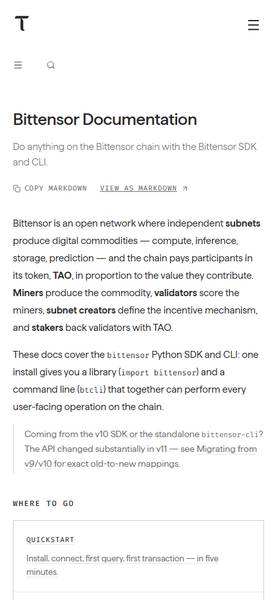
Docs on phone.
What you see: The docs on phone: "Bittensor Documentation", with copy and view-as-markdown links and a "Where to go" section starting with Quickstart.
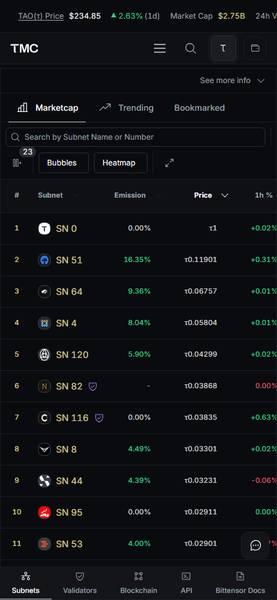
TaoMarketCap on phone.
What you see: TaoMarketCap on phone (shown as "TMC"): a ticker with TAO price $234.85, tabs Marketcap, Trending and Bookmarked, a subnet table with Emission and Price columns, and a bottom bar with Subnets, Validators, Blockchain, API and Bittensor Docs.
We scrolled the home page and every frame showed only the animated graphic, so we kept a single capture.
Official Pages
About
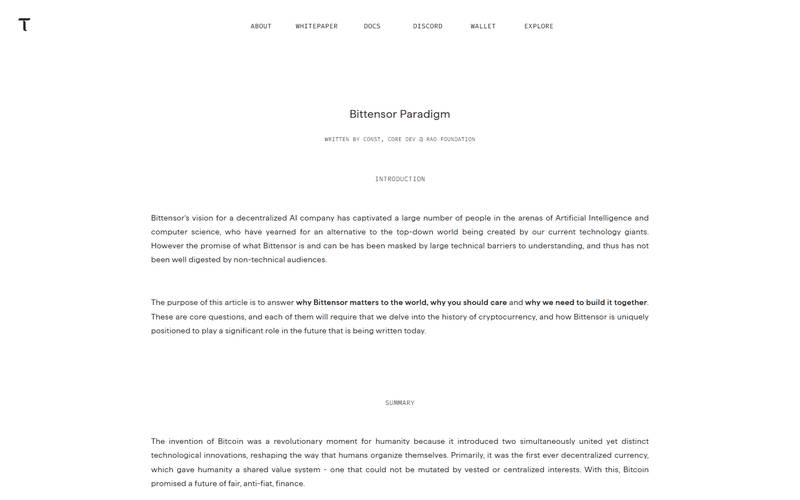
The About page is an essay titled "Bittensor Paradigm".
What you see: The About page is an essay titled "Bittensor Paradigm", written by Const, core dev at Rao Foundation. It says the purpose is to explain why Bittensor matters, why you should care and why it should be built together. This is project-authored material.
Whitepaper
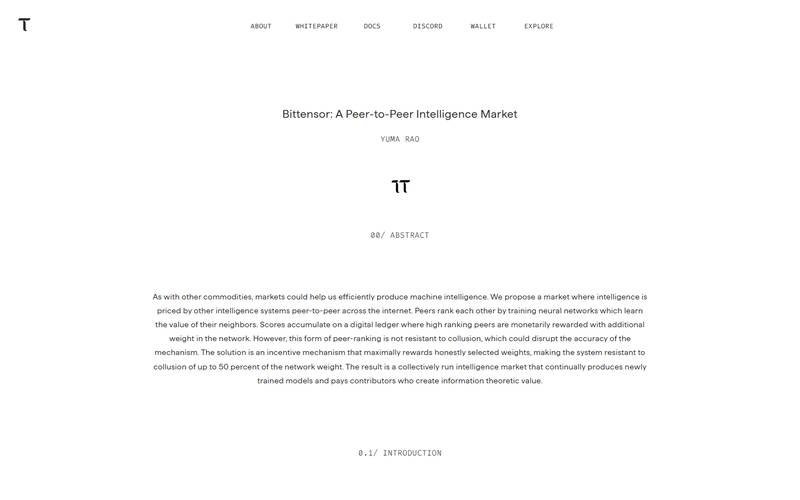
"Bittensor: A Peer-to-Peer Intelligence Market" by Yuma Rao.
What you see: The abstract proposes a market where intelligence is priced by other intelligence systems peer-to-peer, and says the incentive design aims to resist collusion of up to 50 percent of network weight.
Docs
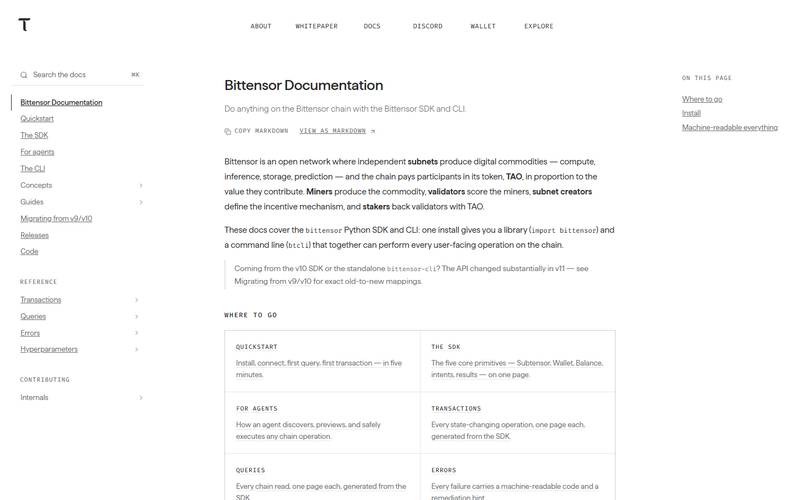
"Do anything on the Bittensor chain.
What you see: "Do anything on the Bittensor chain with the Bittensor SDK and CLI." The sidebar lists Quickstart, The SDK, For agents, The CLI, Concepts, Guides, Migrating from v9/v10, Releases and Code, plus reference sections for Transactions, Queries, Errors and Hyperparameters. The Python library is bittensor and the command line tool is btcli. A note says the API changed substantially in v11.
Typing deeper docs URLs directly (concepts, quickstart, staking) loaded the same top page, so we did not capture them that way. Clicking Quickstart in the docs navigation did open the Quickstart page, which we captured in Step 3 below.
Core Pages: TaoMarketCap
TaoMarketCap is a third-party site that shows subnet markets. We used it because Taostats was blocked.
Subnet table
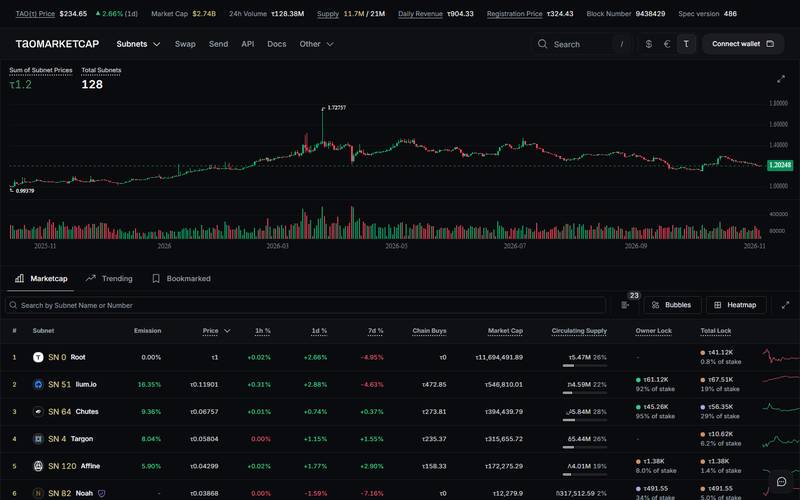
Top bar: TAO price $234.65, market cap $2.74B.
What you see: Top bar: TAO price $234.65, market cap $2.74B, 24h volume 128.38M TAO, supply 11.7M / 21M, daily revenue 904.33, TAOregistration price 324.43, TAOblock 9438429, spec version 486. Header stats: Sum of Subnet Prices 1.2, TAOTotal Subnets 128.
| Rank | Subnet | Emission | Price | Market cap |
|---|---|---|---|---|
| 1 | SN 0 Root | 0.00% | 1 TAO | 11,694,491.89 TAO |
| 2 | SN 51 lium.io | 16.35% | 0.11901 TAO | 546,810.01 TAO |
| 3 | SN 64 Chutes | 9.36% | 0.06757 TAO | 394,439.79 TAO |
| 4 | SN 4 Targon | 8.04% | 0.05804 TAO | 315,655.72 TAO |
| 5 | SN 120 Affine | 5.90% | 0.04299 TAO | 172,275.29 TAO |
| 6 | SN 82 Noah | none shown | 0.03868 TAO | 12,279.9 TAO |
The table has tabs Marketcap, Trending and Bookmarked, and columns for 1h, 1d and 7d change, chain buys, circulating supply, owner lock and total lock.
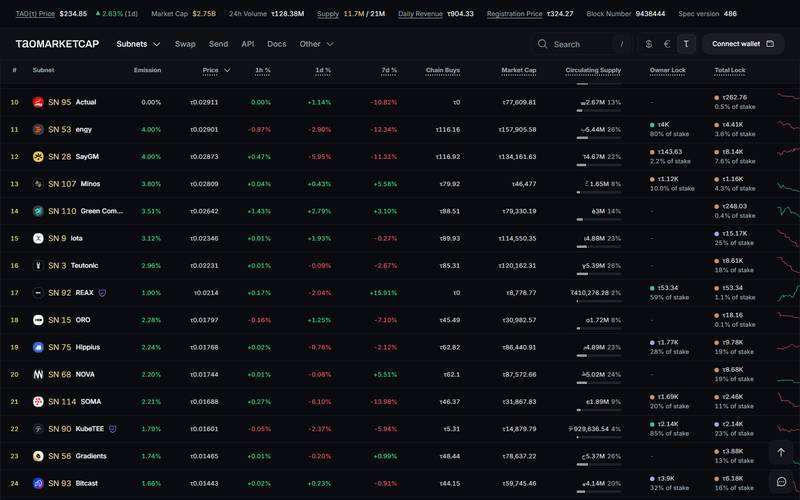
Rows 10 to 24.
What you see: Rows 10 to 24: SN 95 Actual, SN 53 engy (4.00% emission), SN 28 SayGM (4.00%), SN 107 Minos (3.80%), SN 110 Green Compute (3.51%), SN 9 iota (3.12%), SN 3 Teutonic, SN 92 REAX, SN 15 ORO, SN 75 Hippius, SN 68 NOVA, SN 114 SOMA, SN 90 KubeTEE, SN 56 Gradients, SN 93 Bitcast. Several subnets show 0.00% emission.
Subnets are very uneven: the top few take most of the emission, and many have small market caps in TAO.
Heatmap and bubbles
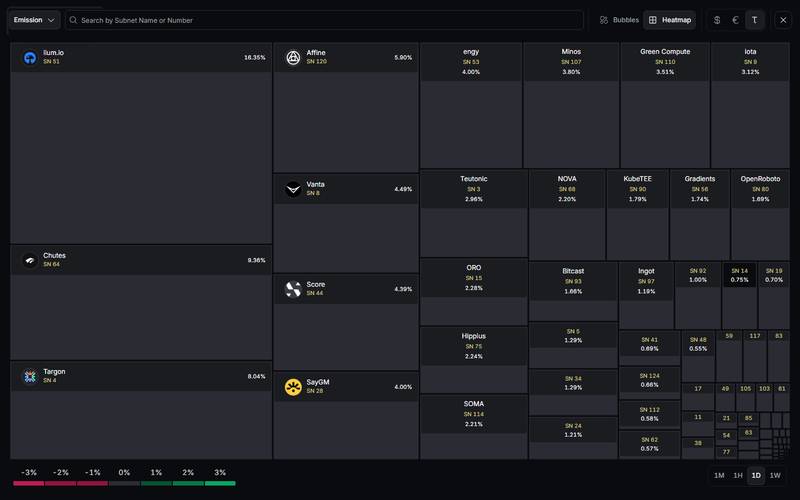
Heatmap of emission share (1D view).
What you see: Heatmap of emission share (1D view): lium.io SN 51 16.35%, Chutes SN 64 9.36%, Targon SN 4 8.04%, Affine SN 120 5.90%, Vanta SN 8 4.49%, Score SN 44 4.39%, SayGM SN 28 4.00%, engy SN 53 4.00%.
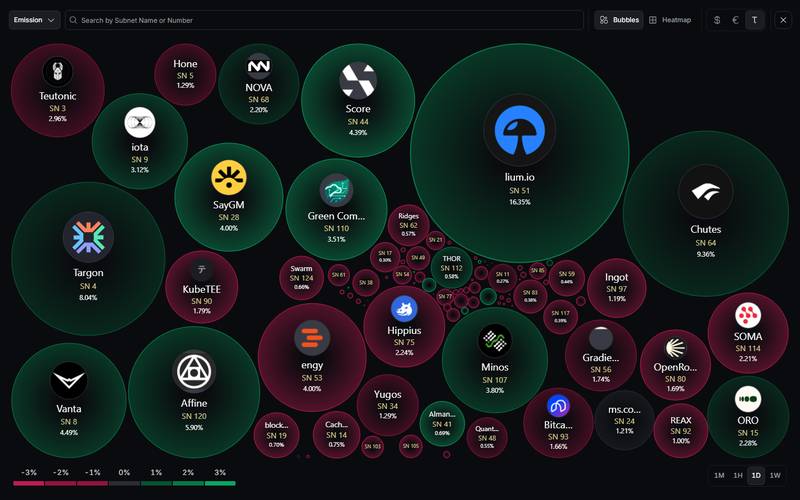
The same data as bubbles, colored from red (-3%) to green (+3%)..
What you see: The same data as bubbles, colored from red (-3%) to green (+3%). lium.io is the largest, followed by Chutes and Targon, and the long tail of small subnets is hard to read.
Subnet page: SN 51 lium.io
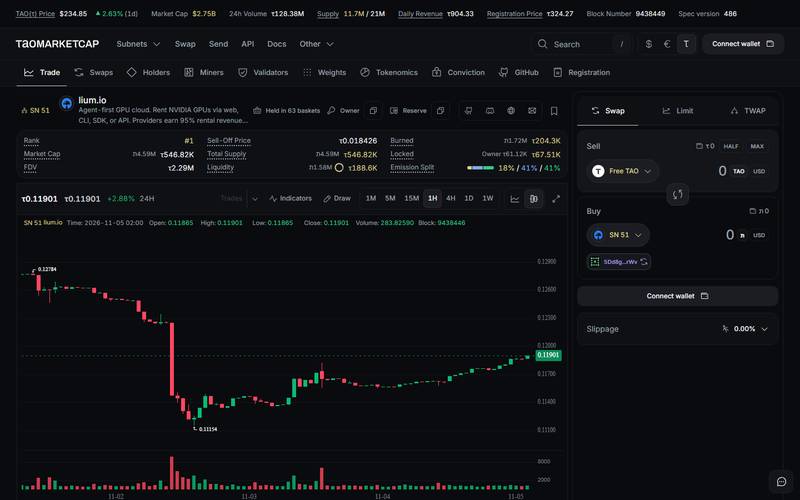
SN 51 lium.io.
What you see: Tabs: Trade, Swaps, Holders, Miners, Validators, Weights, Tokenomics, Conviction, GitHub, Registration. The description says "Agent-first GPU cloud", with providers earning 95% of rental revenue.
| Item | Value |
|---|---|
| Rank | #1 |
| Price | 0.11901 TAO(+2.88% 24H) |
| Market cap | 546.82K TAO |
| FDV | 2.29M TAO |
| Sell-off price | 0.018426 TAO |
| Burned | 204.3K TAO |
| Locked (owner) | 67.51K TAO |
| Emission split | 18% / 41% / 41% |
| Held in | 63 baskets |
On the right is a Swap / Limit / TWAP panel with a "Connect wallet" button and 0.00% slippage. We did not connect a wallet.
Subnet page: SN 64 Chutes
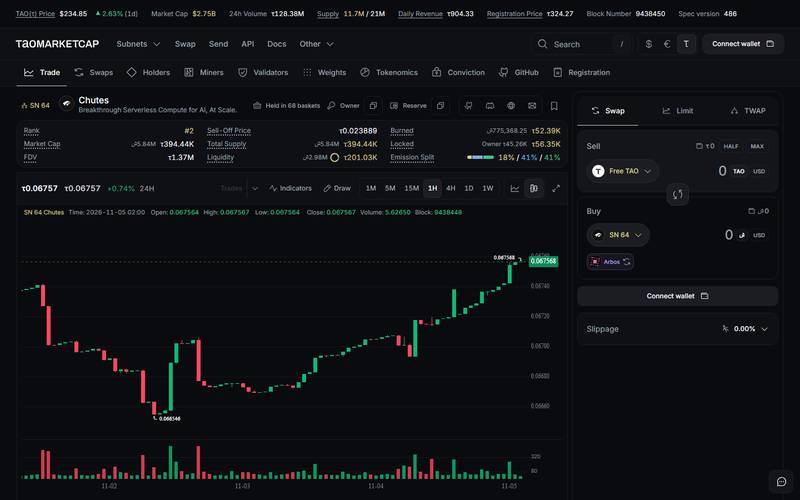
SN 64 Chutes.
What you see: Chutes: "Breakthrough Serverless Compute for AI, At Scale." Rank #2, price 0.06757 TAO(+0.74%), market cap 394.44K TAO, FDV 1.37M TAO, burned 52.39K TAO, locked 56.35K TAO, held in 68 baskets.
Validators
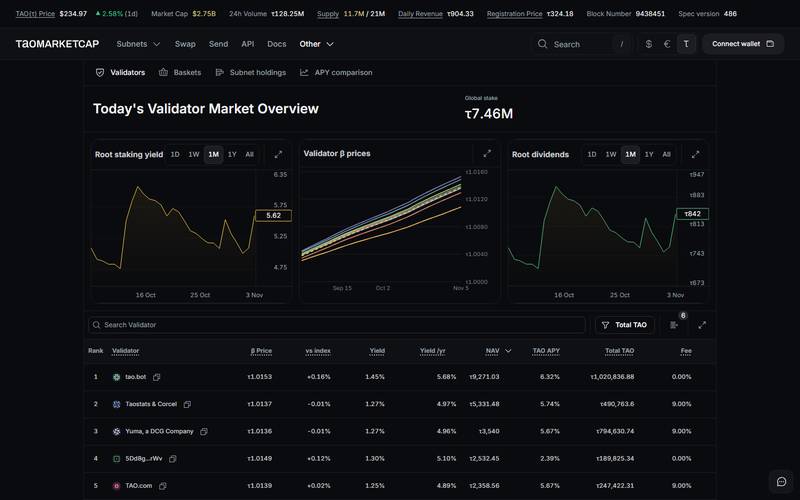
"Today's Validator Market Overview", Global stake 7.46M TAO.
What you see: Charts: Root staking yield (5.62), Validator beta prices, Root dividends (842 TAO). Tabs: Validators, Baskets, Subnet holdings, APY comparison.
| Rank | Validator | TAO APY | Total TAO | Fee |
|---|---|---|---|---|
| 1 | tao.bot | 6.32% | 1,020,836.88 TAO | 0.00% |
| 2 | Taostats & Corcel | 5.74% | 490,763.6 TAO | 9.00% |
| 3 | Yuma, a DCG Company | 5.67% | 794,630.74 TAO | 9.00% |
| 4 | 5Dd8g…rWv | 2.39% | 189,825.34 TAO | 0.00% |
| 5 | TAO.com | 5.67% | 247,422.31 TAO | 9.00% |
Fee and APY differ a lot between validators, so choosing one matters. We did not stake.
Taostats
Taostats showed a Cloudflare verification box over a blurred page.
What you see: We could not read its data, so we did not use it.
Market Data
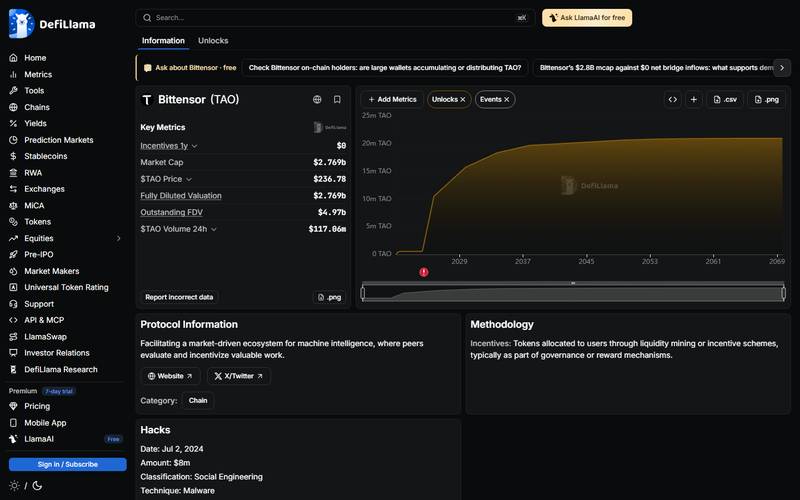
Bittensor on DeFiLlama.
What you see: DeFiLlama: category "Chain", description "Facilitating a market-driven ecosystem for machine intelligence, where peers evaluate and incentivize valuable work." Incentives 1y $0. The chart shows TAO unlocks up to about 21 million. A "Hacks" box lists a 2 July 2024 incident: $8m, social engineering, malware.
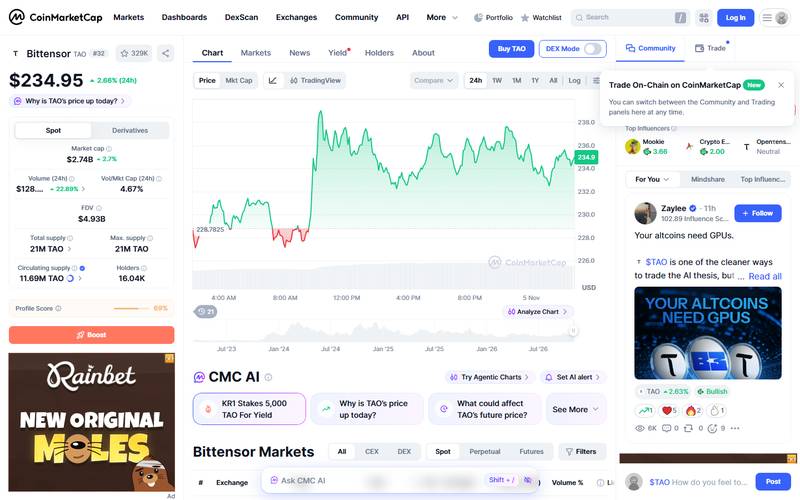
Bittensor on CoinMarketCap.
What you see: CoinMarketCap: rank #32, $234.95, market cap $2.74B, FDV $4.93B, circulating 11.69M of 21M, 16.04K holders, Profile Score 69%.
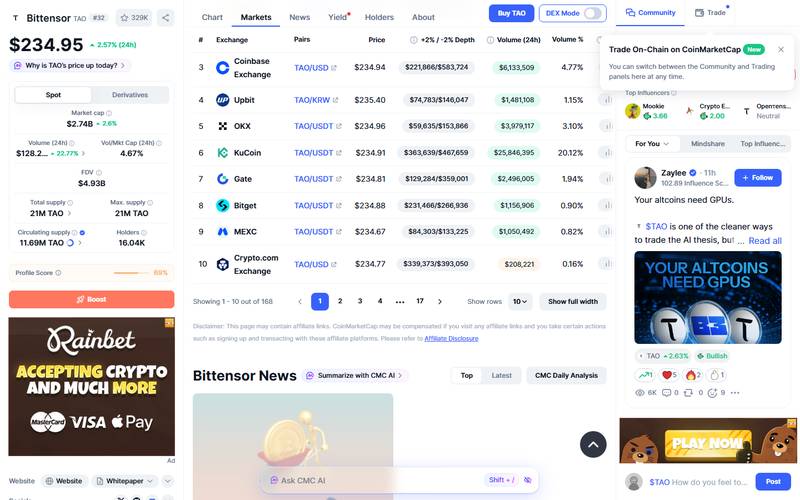
168 markets in total.
What you see: Rows 3 to 10 include Coinbase Exchange (TAO/USD, 24h volume $6,133,509), Upbit (TAO/KRW, $1,481,108), OKX ($3,979,117), KuCoin ($25,846,395, 20.12% of volume), Gate, Bitget, MEXC and Crypto.com Exchange. A large share of volume sits on a few venues.
Fees and Costs
We did not see network fees or swap fees because we did not connect a wallet. On the validator page, fees range from 0.00% to 9.00% in the rows we saw. The subnet page shows slippage set to 0.00% by default, which is a setting, not a promise of zero cost.
How to use Bittensor: step-by-step tutorial
I went through the official site, the docs, the wallet list and the public explorers in a clean browser on 5 November 2026. I did not create a wallet, buy TAO or stake, so each action that moves money is marked (Not verified). One note on sources: one explorer (Taostats) showed a bot check during my session, so the market views below come from TAOMARKETCAP instead.
Step 1: Start on the official site
First, I type bittensor.com. The page is almost empty on purpose: a rotating network graphic and a short menu.
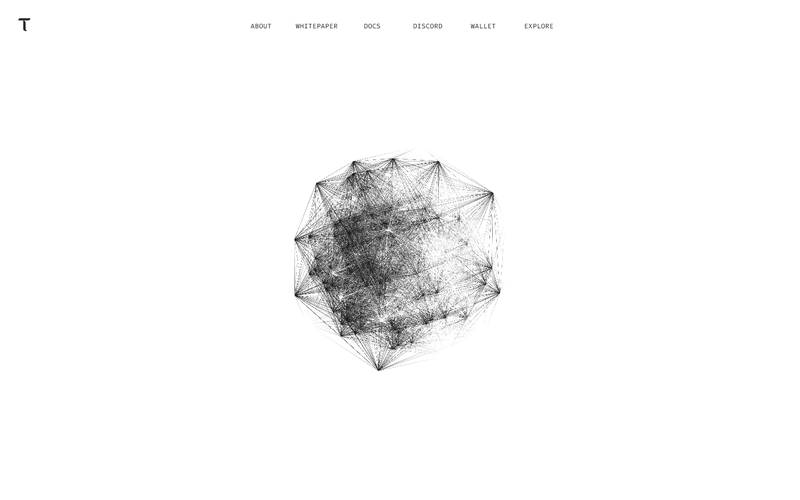
The official homepage.
What you see: A black network sphere sits in the middle of a white page. The menu offers About, Whitepaper, Docs, Discord, Wallet and Explore.
I notice there is no "Buy" or "Sign up" button. Bittensor is a network, not a product, so the site only points to tools built by others.
Step 2: Read the docs overview
Next, I open Docs.
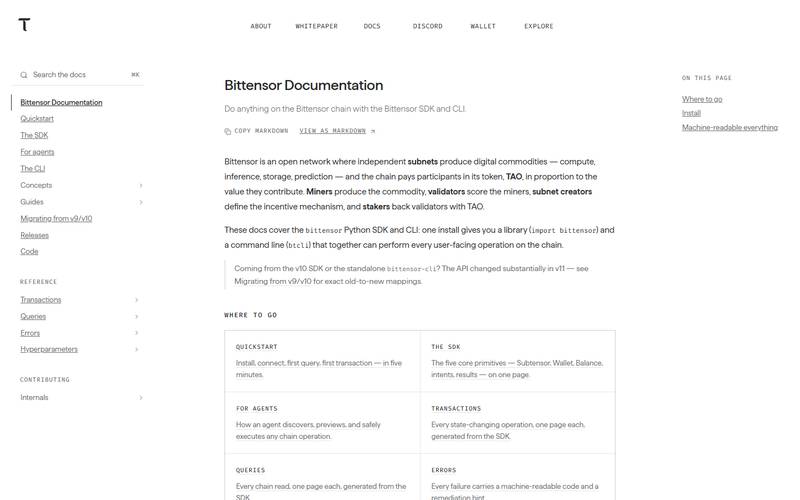
Bittensor documentation overview.
What you see: "Bittensor Documentation". The text explains that subnets produce digital commodities such as compute and inference, validators score the miners, and stakers back validators with TAO. A "Where to go" grid has Quickstart, The SDK, For Agents, Transactions, Queries and Errors.
This paragraph is the shortest explanation of the roles: miners do the work, validators score it, stakers back the validators.
Step 3: Follow the Quickstart
Then I click Quickstart.
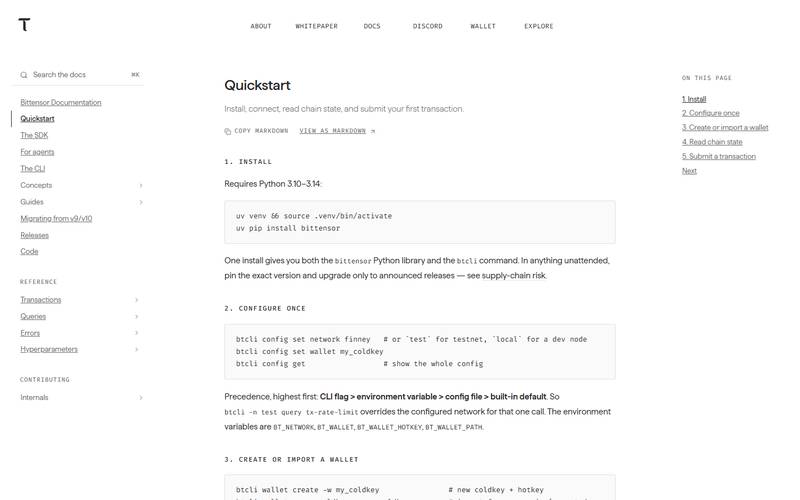
Bittensor Quickstart page.
What you see: The Quickstart page. Section 1, "Install", says it needs Python 3.10 to 3.14 and shows commands to create a virtual environment and install the bittensor package. Section 2, "Configure once", shows commands that set the network (finney, test or local) and a wallet name. Section 3, "Create or import a wallet", comes next.
- Install Python and the package as shown on the page.
- Choose a network. I would start on the test network, not the main one.
- Create a wallet with the command from section 3. Write the seed phrase on paper and never type it into a website. (Not verified)
Step 4: Look at the command-line tool
After that, I open The CLI.
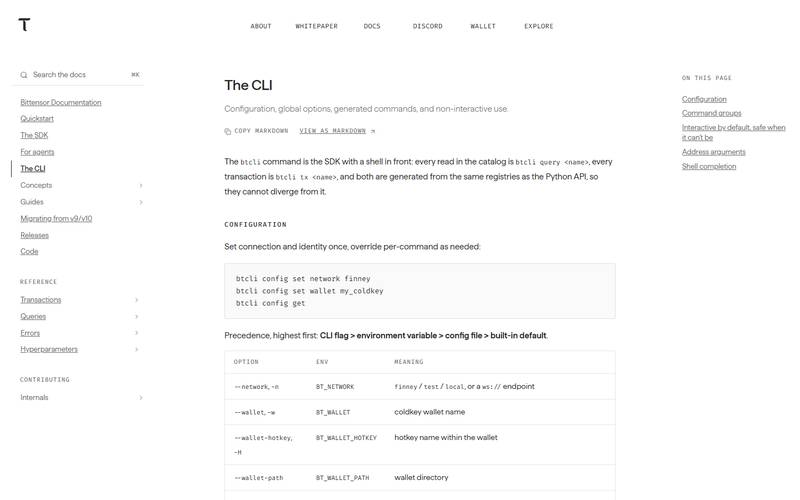
Bittensor CLI documentation.
What you see: "The CLI". The page says the btcli command is the SDK with a shell in front. A table lists options such as --network, --wallet-name, --wallet-hotkey and --wallet-path, each with its environment variable and a short meaning.
If you do not want a command line, the next step shows the wallets that have a normal interface.
Step 5: Pick a wallet
Now I press Wallet in the top menu.
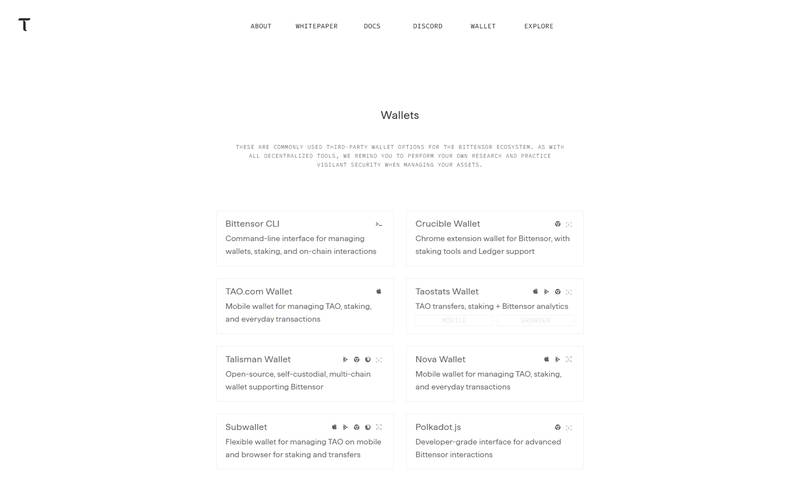
Bittensor wallet list.
What you see: The Wallets page. It lists community-built options: Bittensor CLI, Crucible Wallet (a Chrome extension with Ledger support), TAO.com Wallet, Taostats Wallet, Talisman Wallet, Nova Wallet, Subwallet and Polkadot.js. A grey note says these are third-party tools and reminds users to do their own research.
Which option should I pick? For a small first test, a well-known extension or mobile wallet is easier than the command line. For larger amounts, I would look for hardware-wallet support (the page mentions it for Crucible).
Step 6: Find the explorers
Then I open Explore.
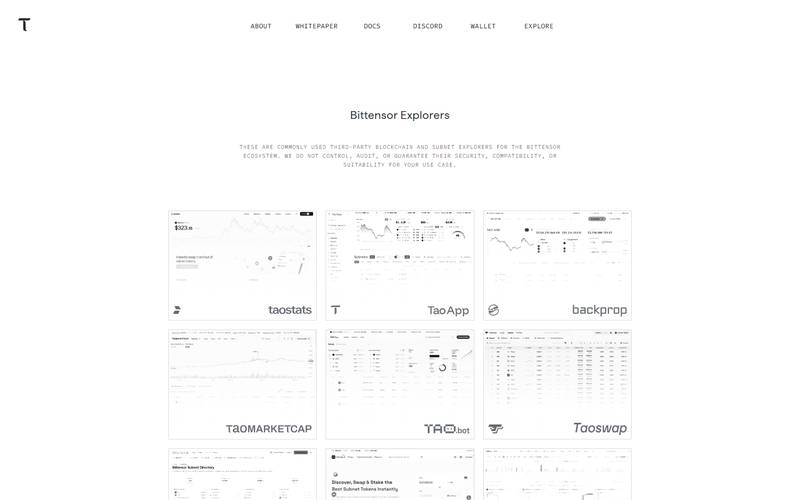
Bittensor explorers list.
What you see: The "Bittensor Explorers" page. A grid of third-party sites with small previews: taostats, TaoApp, backprop, TAOMARKETCAP and Tooswap. A note says they are not controlled or audited by the project.
I will use one of these to look at the market in the next steps.
Step 7: Browse the subnets
On TAOMARKETCAP I scroll to the subnet table.
TAOMARKETCAP subnet table.
What you see: The subnet overview with "Total Subnets 128" and a price chart. The table below lists SN0 Root, SN51 lium.io, SN64 Chutes, SN4 Targon, SN120 Affine and others, with emission, price, 1h/1d/7d change, market cap and lock columns.
I read the Emission column. It shows how much of the new TAO each subnet gets. A subnet with a big emission share has more to give its miners and stakers.
Step 8: Open one subnet
Next, I click SN64 Chutes.
TAOMARKETCAP page for SN64 Chutes.
What you see: The SN64 "Chutes" page, described as serverless compute for AI. It has a candle chart, a market cap, FDV and burn figures, and a swap box on the right with a Connect wallet button.
Staking into a subnet means swapping TAO for that subnet's own "alpha" token. I would only do it after I read what the subnet actually builds. (Not verified)
Step 9: Compare validators
Last, I open the Validators page.
TAOMARKETCAP validator overview.
What you see: "Today's Validator Market Overview" with global stake of about 7.46M TAO. Three charts show root staking yield, validator prices and root dividends. A table below ranks validators such as tao.bot, Taostats & Corcel and Yuma by price, yield, APY, total TAO and fee.
Which option should I pick? Compare the Fee column and the 30-day yield, not just the rank. A validator with a 0% fee and a lower yield can give you a different result from one with a 9% fee and a higher yield.
What I could not verify: creating a wallet, buying TAO, staking, unstaking and the real yield after fees.
How to read the TaoMarketCap table
The values with a leading "I," on the capture are the subnet's alpha token prices, shown with the site's symbol. A few reading tips:
- Emission is the share of daily new TAO that a subnet receives. It is the closest thing to "how much does the network value this subnet".
- Price and market cap are for the subnet's alpha token, not TAO. The lium.io alpha token had a market cap of about 546.82K in that unit and an FDV of about 2.29M.
- Sell-off price is a field the page shows (0.018426 for lium.io versus a price of 0.11901). We did not find its definition, so do not rely on it.
- Burned and Locked show how much alpha was burned or locked by the owner.
- Held in baskets counts how many baskets include the token.
- SN 0 Root shows 0.00% emission but a very large market cap, because it is the root network.
The long tail is the main difficulty. The bubble chart shows lium.io, Chutes and Targon dominating, while dozens of subnets are hard to see. Do not assume that a small subnet with a high daily change is a safe bet.
Validators and staking in simple terms
The validators page lists names, APY, total stake and fee. The top rows on our capture were tao.bot (6.32% APY, 0.00% fee, 1,020,836.88 TAO), Taostats & Corcel (5.74%, 9.00%), Yuma, a DCG Company (5.67%, 9.00%) and TAO.com (5.67%, 9.00%).
- APY is the estimated yearly return before price changes.
- Fee is the share the validator keeps. A 0% fee does not guarantee a better outcome; the validator's performance matters too.
- Total TAO shows how much is staked. Very large validators concentrate power.
- Some rows show addresses instead of names, such as 5Dd8g…rWv with 2.39% APY. Be careful with validators you cannot identify.
When you stake, you keep ownership of your TAO but delegate its weight. Unstaking can take time, and the price can change while you wait.
Risks in more detail
- Subsidy vs revenue. Emissions are new tokens paid to participants. A subnet that earns outside revenue is stronger than one that depends on emissions only. We did not measure subnet revenue.
- Concentration. A few subnets and validators hold a large share of emission and stake.
- Thin markets. Alpha tokens have market caps in the hundreds of thousands, so prices can move fast.
- Technical risk. Runtime upgrades can change staking rules and fees, so read release notes before large moves.
- Smart contract and software risk. Staking and subnet alpha trades run through Bittensor chain logic, and many users also go through third-party wallets, staking dashboards or bridges to buy wrapped TAO on other chains. A bug in any of those layers, or a malicious copy of a staking site, can cost you funds even if TAO itself is fine. We did not assess oracle or liquidation exposure, including whether either applies to native TAO staking, alpha-token trading or third-party lending integrations. Use official links and small test amounts first.
- Data availability. Taostats showed a Cloudflare check and we could not read it, so cross-checking was limited.
- Token risk. TAO was $234.95 with a market cap of $2.74B on our capture, and like most tokens it can fall sharply. DeFiLlama lists incentives of $0 for the year, which is a data category, not a statement about network rewards.
Competitors
We did not test these projects. The table only describes each project's focus, so check their own docs before comparing.
| Project | Focus |
|---|---|
| Bittensor | Marketplace of AI subnets paid in TAO |
| Render | GPU rendering network |
| Akash, io.net | Decentralized compute marketplaces |
| Fetch.ai / ASI alliance | AI agents and data |
| NEAR and others | General chains with AI narratives |
FAQ
What is a subnet? A separate marketplace inside Bittensor with its own rules and token. TaoMarketCap shows 128.
Can I mine with a PC? Mining is task-specific. Read the target subnet's GitHub and requirements first. We did not try.
Is staking safe? You are exposed to price risk, validator performance and smart contract or software bugs.
Why does TAO have a 21M cap? It follows Bitcoin's scarcity idea; 11.69M are in circulation now.
What does "registration price" mean? The cost to register a new neuron or subnet slot, shown on TaoMarketCap. We did not register.
Does Bittensor have a homepage with a pitch? The home page was only a graphic and a nav bar, so use the About page and docs.
Security and Risks
- 2024 hack. DeFiLlama lists a 2 July 2024 incident of $8m caused by social engineering and malware.
- Concentration. Emission and market cap are concentrated in a few subnets, and a few exchanges dominate volume.
- Third-party tools. TaoMarketCap and Taostats are separate from the official site, so check addresses before connecting a wallet.
- Validator choice. Validators differ in fee and APY.
- Complexity. The subnet system and its token mechanics are hard for new users to judge.
Pros and Cons
Pros
- Detailed public docs, whitepaper and SDK/CLI.
- Rich third-party data for subnets and validators, usable without a wallet.
- Listed on major trackers with a fixed 21M supply.
Cons
- The official home page gives no summary, numbers or call to action.
- Taostats was blocked for our automated browser.
- Concentrated emission and complex mechanics.
- We did not test staking, swaps or mining.
Verdict
Rating: 6.5 / 10 (based on what we could see, not on staking or mining results).
The data around Bittensor is deep and easy to browse, and the docs are clear. The official site itself is minimal. Because we did not use a wallet, we cannot judge the staking or swap experience.
Quick Links
| Website | bittensor.com |
| Docs | docs.learnbittensor.org |
| Subnet market caps | taomarketcap.com |
| Analytics | taostats.io |
| DeFiLlama | defillama.com/protocol/bittensor |
| CoinMarketCap | coinmarketcap.com/currencies/bittensor |
Not financial advice. Captured 5 November 2026 from Vietnam. No wallet or account was used.
Editorial credits
Checked by Defiliban QC Team before publishing on November 6, 2026 for headline accuracy, original value, factual consistency, metadata, authorship claims, review evidence and risk disclosure: our AI review system checks every article before it goes live, and our duty editor monitors it after publication. Report an error.
Defiliban uses AI for research, drafting and review. Our editorial team is responsible for every article and corrects or withdraws articles when needed. How we review.
Defiliban · Oliver Benjamin

Written by
DeFi Research Writer
Oliver Benjamin is a DeFi research writer at DefiLiban, specializing in decentralized finance systems, token economics, liquidity design, and blockchain market structure. His work focuses on analyzing how DeFi protocols function beneath surface-level narratives, with particular attention to incentives, on-chain behavior, yield systems, and emerging crypto infrastructure.