TurboFlow Review 2026: Short-Cycle Event Contracts, Perpetuals, Points, and Risks
ReviewA hands-on TurboFlow review covering its Higher/Lower Event Contracts, live trading interface, return rates, perpetuals, points, liquidity partners...


Meta description: A hands-on TurboFlow review covering its Higher/Lower Event Contracts, live trading interface, return rates, perpetuals, points, liquidity partners, competitors, and key risks.
TurboFlow combines perpetual futures with extremely short Event Contracts designed around a simple question: will a market finish higher or lower after a fixed interval? The product removes traditional margin management from the event side and replaces it with a fixed stake, locked return rate, and automatic settlement.
The simple presentation should not be confused with a simple probability problem. A 30-second contract can settle from a tiny price difference, the displayed return may require a win rate above 50% to break even, and the label used for estimated profit deserves close inspection.
This review is based on a public walkthrough completed on October 30, 2026, covering the Events interface, BTC/USDT chart, duration selector, Higher/Lower ticket, leaderboard, Public Trades, historical prices route, and official TurboFlow guides. All market prices, return rates, rankings, and activity figures are dated observations that can change continuously.
Note: This review is for informational purposes only and is not financial, investment, legal, or tax advice.
What is TurboFlow?
TurboFlow describes itself as an on-chain trading ecosystem at the intersection of perpetual contracts and prediction markets. Its product suite includes standard perpetuals, profit-sharing perpetuals with leverage up to 1000x, short-cycle Event Contracts, prediction products, rewards, and a public leaderboard.
The Event Contracts are not open-ended futures and are not conventional long-duration prediction-market shares. A user selects an asset, chooses a period from seconds to an hour, commits a fixed USDT stake, and selects Higher or Lower. The contract settles automatically by comparing its Enter Price and Exit Price. The stake defines the maximum loss.
The project targets retail traders, particularly in Asia-Pacific markets. TurboFlow reported $19.15 billion of cumulative volume across more than 14,540 users as of June 22, 2026. Those are company-reported beta figures, not independently audited exchange statistics.
Key TurboFlow features
- Short-cycle Event Contracts: Choose Higher or Lower on markets such as BTC, ETH, gold, and silver. Durations ranged from 30 seconds to 1 hour in the tested interface, and the amount committed is the maximum possible loss.
- Standard Perpetuals: Trade with Market, Limit, or Trigger Market orders, plus leverage, isolated or cross margin controls, TP/SL, and funding. These positions can be liquidated and require more risk management than Event Contracts.
- 1000x Perpetual: Access a separate isolated-margin product with leverage labels extending to 1000x. Instead of a standard maker or taker charge, TurboFlow applies a dynamic share to profitable trades.
- Market discovery tools: Check prices, 24-hour changes, volume, open interest, current funding, and recent funding records. Filters cover crypto, RWA, new listings, gainers, and favorites.
- Visible trading activity: Public Trades show recent positions, fees, PnL, and ROI, while the leaderboard highlights top trades and traders across several time periods. These views provide useful examples but do not represent every user outcome.
- Oracle-based settlement: Event Contracts compare an Enter Price with an Exit Price at the exact expiry time. The quoted return rate is locked when the order is confirmed and can vary by direction, duration, volatility, liquidity, and risk settings.
- Points and campaigns: Eligible trading, referrals, and campaigns may generate TurboFlow Points. Points record participation but do not confirm a token, conversion rate, or future airdrop allocation.
- Stablecoin deposits: TurboFlow lists USDT and USDC deposits through Solana and BNB Chain. The selected asset and network must match the route shown in the account interface.
Hands-on TurboFlow Events experience
The supplied Events URL opened a dark trading interface with Perp Trading, Event Contracts, Markets, Rewards, Docs, and Login across the top. A first-visit modal titled "Predict The Next Move" explained the core flow: choose Higher or Lower and wait for a selected period that can be as short as 30 seconds.
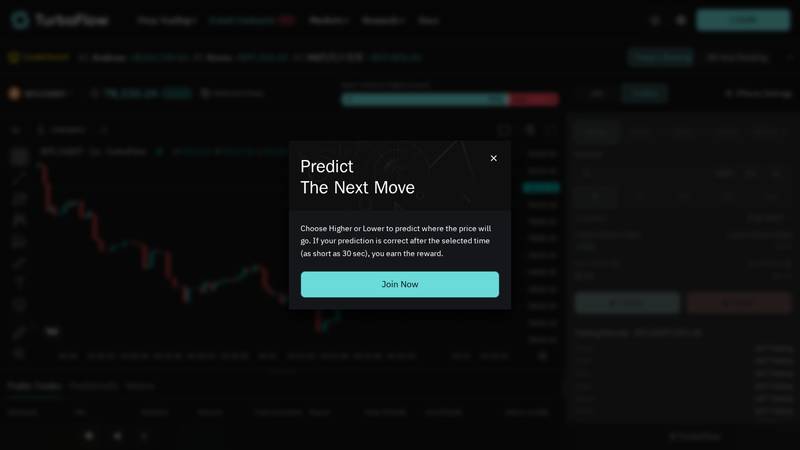
Figure 1. TurboFlow introduces Event Contracts through a Higher/Lower onboarding modal. The BTC/USDT chart, order ticket, and public activity remain visible behind it. Open TurboFlow Events. Captured October 30, 2026.
The interface is visually closer to a crypto derivatives exchange than a traditional prediction market. The center contains an interactive line or candle chart. The right column contains duration, stake, return rate, estimated result, and Higher or Lower execution controls. The lower section includes Public Trades, Positions, and History.
BTC/USDT was the default market. The walkthrough also surfaced ETH/USDT and GOLD/USD in public activity. The Event Contracts guide lists BTC, ETH, gold, and silver as supported markets, while emphasizing that live availability can change with liquidity and risk settings.
The onboarding is fast, but the modal temporarily obscures the chart and part of the ticket. It succeeds as a one-sentence product explanation, yet a first-time trader still needs the product guide to understand price sources, flat settlement, dynamic payouts, and the difference between gross return and net profit.
Event Contract workflow
The public ticket presented eight time increments during the walkthrough: 30 seconds, 1 minute, 3 minutes, 5 minutes, 10 minutes, 15 minutes, 30 minutes, and 1 hour.
The official guide lists 30 seconds, 1 minute, 3 minutes, 5 minutes, 15 minutes, and 1 hour. The additional 10-minute and 30-minute controls visible in the interface demonstrate why the live product is the final source for current parameters.
The workflow is straightforward:
- Choose BTC, ETH, gold, silver, or another supported market shown live.
- Select the contract duration.
- Enter a USDT stake.
- Review the Enter Price, Return Rate, and estimated result.
- Select Higher or Lower.
- Allow the contract to settle automatically at expiry.
A Higher contract wins when the Exit Price is above the Enter Price. A Lower contract wins when the Exit Price is below it. TurboFlow's guide says a flat result returns the principal. There is no need to manage maintenance margin, funding, or liquidation during the contract because the committed stake already defines maximum loss.
This structure is simple operationally, not necessarily easy economically. The outcome is binary, and a wrong direction loses the entire stake. A market can move in the predicted direction during most of the period and still finish on the wrong side at the exact settlement timestamp.
Return rate, gross payout, and break-even math
The observed BTC/USDT ticket showed direction-specific return rates changing around 83% to 93%. A representative screen displayed a 5 USDT stake, an 87% return rate, and "Est. Profit ($) $9.35."
The arithmetic is important:
5 USDT x 1.87 = 9.35 USDT
This indicates that the displayed $9.35 behaves like the total successful return, including the original 5 USDT stake. The net gain would be $4.35. Calling $9.35 "profit" can therefore be misread by a newcomer as a $9.35 gain on top of the stake. The interface would be clearer if it separated "Total Return" and "Net Profit."
An 87% net return on a winner also implies an approximate break-even win rate of:
1 / 1.87 = 53.48%
That estimate ignores execution differences, account-level incentives, and any other adjustments, but it shows why a 50% directional accuracy rate loses money over time at that quote. At an 83% rate, the approximate break-even level rises to 54.64%. At 93%, it falls to 51.81%.
No separate commission line was visible on the public Events ticket. The economic cost is reflected in the fact that a correct contract returns less than a one-for-one net gain. TurboFlow says the Return Rate is dynamically quoted using direction, duration, volatility, liquidity, and risk settings, then locked when an order is confirmed.
Stake limits and changing live terms
The live amount field displayed a 2 to 300 USDT range during the walkthrough, with 5, 20, 100, 200, and Max preset buttons. The whitepaper says the current limit is 200 USDT per duration.
Both values should not be presented as simultaneously universal. TurboFlow explicitly states that markets, limits, durations, and return rates can change as product rollout and risk settings evolve. A reasonable interpretation is that the interface had already moved beyond the published guide for at least some live configurations. The order preview shown immediately before confirmation is therefore the controlling reference for a specific contract.
The discrepancy is not automatically a fault. It is an editorial reason to timestamp every limit and avoid treating written guides as permanent product specifications.
Public Trades makes the risk concrete
The lower table displayed nickname, pair, direction, amount, time increment, payout, Enter Price, Exit Price, return amount, net PnL, and status. Both active and settled BTC, ETH, and gold contracts were visible.
One settled public example showed a 3.84 USDT BTC/USDT Lower contract with a 92% displayed payout. Its Enter Price was below the Exit Price, so the Lower direction lost and the row showed a $3.84 loss. Another ETH/USDT Higher row showed a 10 USDT stake returning $18.10, with $8.10 net PnL.
These rows are more educational than the leaderboard. They show the defining asymmetry directly: a winner earns less than the original stake in net profit, while a loser can lose the full stake.
Price sources and settlement
The Event Contracts guide says Enter Price and Exit Price come from TurboFlow's oracle-based pricing system. All trades require on-chain confirmation, with a project-stated delay of roughly 300 to 500 milliseconds under normal conditions.
TurboFlow also announced that it adopted Chainlink for continuous prediction markets involving XAU, BTC, and ETH.
The presence of an oracle does not remove settlement risk. Short windows make timestamp selection, update latency, data-source methodology, and flat-result rules especially important. A user can be directionally correct on a broader chart while losing at the exact on-chain settlement reference.
Hands-on TurboFlow perpetuals experience
The perpetual side provides a more conventional derivatives workflow than Events, with separate screens for Standard and profit-sharing positions. The walkthrough covered order controls, market selection, public trades, funding data, and the high-leverage interface.
Standard Perpetual trading screen
TurboFlow is not only an Events platform. The Standard Perpetual interface opened with BTC/USDT, a candlestick chart, live 24-hour statistics, an eight-hour funding countdown, and open interest. The order ticket showed Isolated margin, 10x leverage, One-way position mode, and Market, Limit, and Trigger Market order types.
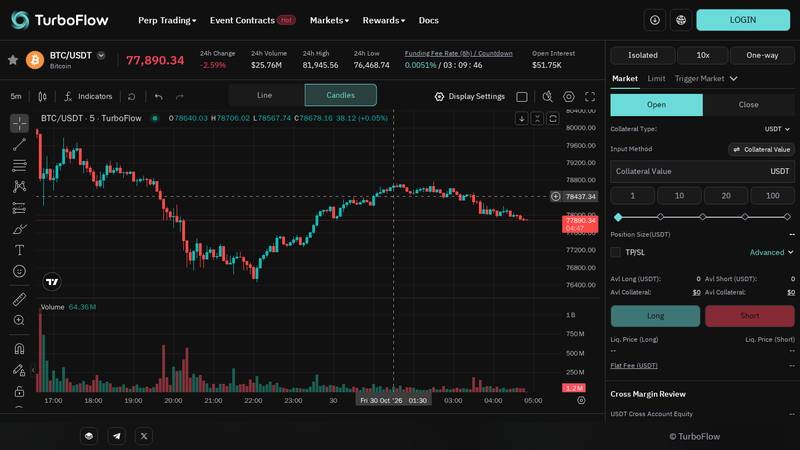
Figure 2. The Standard Perpetual interface exposes market statistics, funding, isolated margin, order types, TP/SL, Long and Short controls, liquidation estimates, and account risk fields in one screen. Open BTC/USDT Standard Perpetual. Captured October 30, 2026.
The Open and Close tabs sit above collateral controls. USDT was the selected collateral type, and the ticket exposed collateral-value presets, a position-size slider, TP/SL, Advanced controls, Long and Short buttons, estimated liquidation prices, and a Flat Fee field. The lower account panel included positions, open orders, trade history, order history, transactions, and position history.
This layout is substantially more complete than the Event Contract ticket. It gives experienced perpetual traders familiar controls without forcing a different navigation model. The density also creates a steeper learning curve than the Higher/Lower flow, particularly because isolated or cross margin, fee mode, position mode, leverage, funding, and liquidation must be understood together.
Market selector and leverage labels
Opening the BTC/USDT selector exposed All, Crypto, RWA, New Listings, Gainers, and Favorites filters. Visible rows included BTC, ETH, SOL, HYPE, BNB, DOGE, ZEC, SNDK, ENA, and SPY.
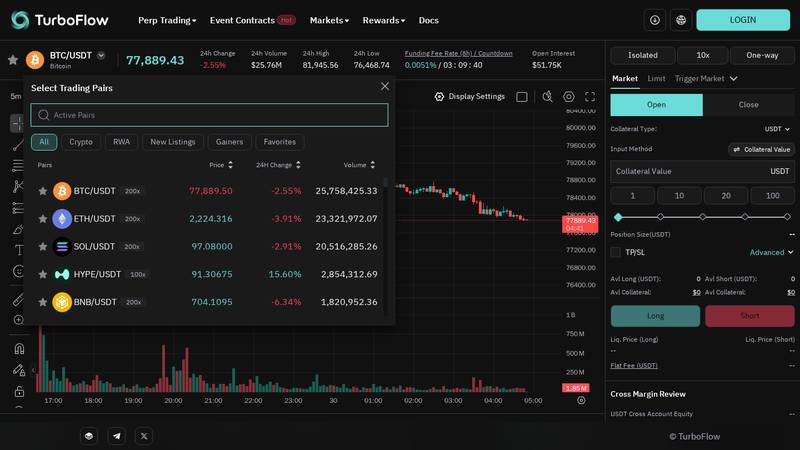
Figure 3. The selector combines crypto and RWA products and displays price, 24-hour change, volume, and maximum leverage labels. Open the Standard Perpetual interface. Captured October 30, 2026.
BTC, ETH, SOL, and BNB displayed 200x labels in this snapshot. HYPE, DOGE, ZEC, SNDK, ENA, and SPY displayed 100x. These are live interface labels, not a recommendation to use the maximum. A 200x position has only a narrow theoretical distance between entry and complete margin loss before maintenance requirements, fees, and execution effects are considered.
Public perpetual trades expose both fee modes
The Public Trades table displayed pair, margin mode, fee mode, size, collateral, entry and exit prices, PnL, and ROI. Rows included both Flat Fee and PNL Fee. Several observed 500x isolated PNL Fee trades showed a 10 USDT collateral amount and a complete 100% loss.
The table is useful because it prevents the 1000x label from remaining an abstract marketing number. High leverage can turn a very small adverse move into complete collateral loss. The public list also displayed profitable cross-margin trades, but the interface does not show the complete distribution of all trader outcomes.
1000x Perpetual trading screen
The separate 1000x Perpetual interface retained the same BTC chart and account tabs but replaced the Standard ticket's margin and order-type controls with a prominent leverage slider. Labels included 1x, 10x, 100x, 500x, and 1000x.
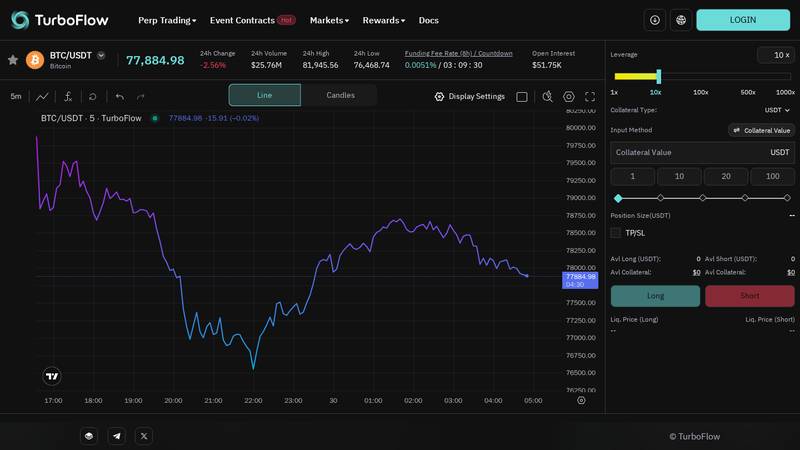
Figure 4. TurboFlow's 1000x product places the leverage range directly above the USDT collateral ticket. Open BTC/USDT 1000x Perpetual. Captured October 30, 2026.
The ticket still showed collateral value, position size, TP/SL, available collateral, Long and Short buttons, and estimated liquidation prices. A Profit Share Calculator and How it works links appeared lower on the page, reinforcing that this is a separate fee model rather than a higher-leverage version of the Standard ticket.
The 1000x product claims zero maker/taker fees and zero spread. Instead, the platform takes a dynamic share of winning profits, with losing trades paying no trading fee. The whitepaper's worked example converges toward a base profit-share rate around 10% on larger moves, while small moves and position size can increase the effective share.
That model is not free trading. It moves the charge from every executed side to successful PnL. The product also uses isolated margin and retains liquidation risk. At 100x leverage, the official guide's simplified reference leaves roughly a 0.5% adverse-move buffer; 1000x is materially more sensitive.
Event Contracts avoid that margin-management burden, but they exchange it for all-or-nothing stake risk at a fixed timestamp. Standard Perpetuals, 1000x Perpetuals, and Event Contracts should not share one sizing rule simply because they appear in the same account.
Market overview and funding history
The Market Overview separated Standard Perpetual, 1000x Perpetual, and Favorites. It displayed last price, 24-hour change, volume, and funding fee for each pair. Crypto markets appeared beside RWA-style products such as SPY, oil, natural gas, silver, copper, and equity-linked names.
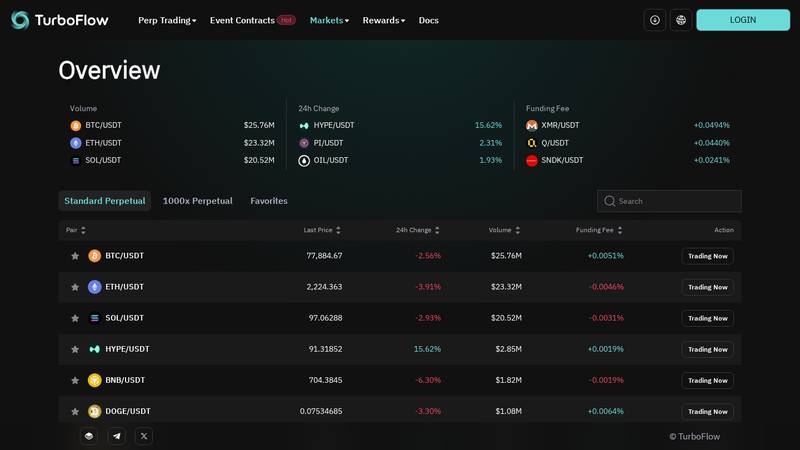
Figure 5. Market Overview combines volume, price movement, and funding information before a trader opens the trading screen. Values are a dated snapshot. View current TurboFlow markets. Captured October 30, 2026.
BTC, ETH, and SOL led the visible 24-hour volume panel at capture. XMR, Q, and SNDK appeared in the highest-funding panel. These rankings can change rapidly and should be used for discovery, not as evidence of persistent liquidity or predictable funding income.
The Funding History page provided a more useful pre-trade check. BTC/USDT showed an eight-hour interval, current funding, a line chart, and the latest 20 records with mark prices.
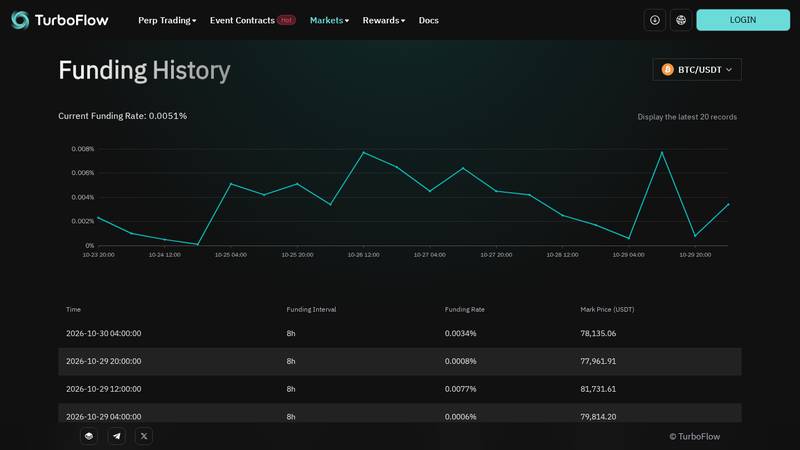
Figure 6. The Funding History page exposes recent eight-hour BTC/USDT rates instead of showing only the current value. Open Funding History. Captured October 30, 2026.
The current BTC rate was 0.0051% during capture, while the displayed recent records ranged from 0.0001% to 0.0077%. Funding is a recurring position cost or receipt, not a one-time trading fee, and its direction and magnitude can change before the next interval.
TurboFlow Points and possible airdrop expectations
The official Points page says eligible activity may include trading, referrals, and campaigns. Points are updated on a schedule rather than in real time, and the interface may show categories such as "airdrop points" when applicable.
The word "airdrop" does not establish a token allocation. TurboFlow explicitly says points are not cash, tokens, or guaranteed future benefits. No confirmed conversion rate, token symbol, snapshot date, claim schedule, or vesting plan was identified in the official sources reviewed for this article.
The sensible interpretation is that Points measure participation and may support future campaigns. Creating unnecessary volume in 30-second contracts to chase an unpriced reward can rapidly convert a speculative future benefit into a realized present loss.
The leaderboard guide says rankings can surface PnL, ROI, top traders, and time-based views. The live product offered Top Trades and Top Traders, PnL sorting, and 1D, 7D, 1M, and All Time filters.
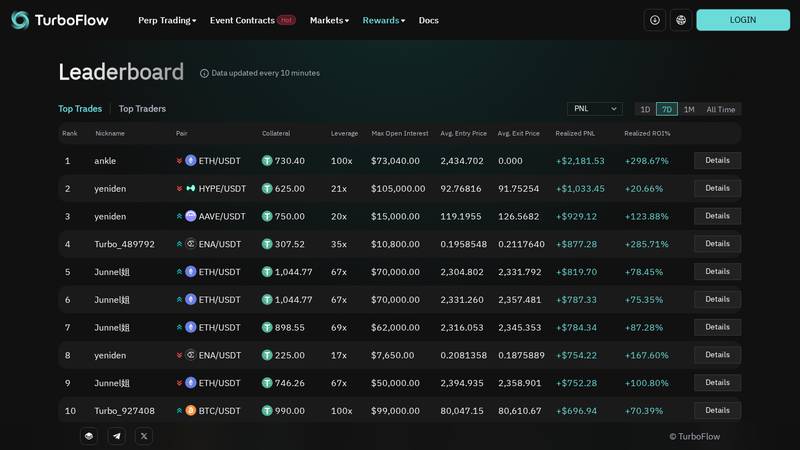
Figure 7. The seven-day Top Trades view displayed collateral, leverage, maximum open interest, entry and exit prices, realized PnL, and ROI. Open the live leaderboard. Captured October 30, 2026.
The selected seven-day page included trades using 20x to 100x leverage and highlighted positive PnL. Leaderboards emphasize standout winners and do not display the full distribution of user outcomes, so they should not be treated as a representative profitability sample.
Deposits and withdrawals
TurboFlow's deposit and withdrawal guide lists USDT and USDC deposits through Solana and BNB Chain. USDT is the default quote asset, while USDC balances may reflect a live premium or discount when converted for valuation.
The public state showed Available 0.00 USDT and a Login button. TurboFlow's FAQ says account access uses Privy to generate and bind a wallet address after registration or login. That simplifies onboarding, but users should understand the recovery, authentication, and withdrawal controls attached to the embedded-wallet experience.
The same page says certain withdrawals may enter additional review based on thresholds, abnormal activity, multi-account abuse, or attempts to bypass trading rules. That is important operational risk for a platform marketed around fast trading.
Backing, liquidity, and infrastructure
TurboFlow's official funding announcement says Pantera Capital led its $6 million seed round, with Susquehanna Crypto and Digital Currency Group participating. Pantera Capital's investment thesis describes TurboFlow as a self-custodial platform that hides blockchain complexity behind a consumer interface and targets Asia-Pacific traders.
TurboFlow also announced a strategic liquidity partnership with Susquehanna Crypto. The project says the firm supports market making, price discovery, and liquidity across its product lines. This relationship matters because Event Contract return rates depend partly on liquidity and directional demand, but it does not prove that every market or duration always has the same capacity or quote quality.
The execution-layer page claims an SVM-compatible architecture capable of more than 100,000 transactions per second. This is a project specification, not a benchmark independently reproduced during the walkthrough. The official materials reviewed did not verify the network hosting TurboFlow’s trading protocol and settlement contracts, a protocol version, or a relevant contract deployment, address, or governance reference. No named public smart-contract audit report was found in the official materials reviewed.
Funding and market-maker relationships indicate access to capital and industry resources. They do not guarantee product solvency, fair resolution, uninterrupted withdrawals, or profitable user outcomes.
How TurboFlow compares with Polymarket and Kalshi
| Platform | Core contract style | Typical time horizon | Pricing model | Best fit |
|---|---|---|---|---|
| TurboFlow Events | Higher or Lower on an asset price | 30 seconds to 1 hour in the tested interface | Dynamic locked return rate | Short-term directional trading |
| Polymarket | Tradable outcome shares, commonly Yes or No | Event-dependent, often days or longer | Order-book shares priced from $0 to $1 | Market-implied probability and position trading |
| Kalshi | Regulated event contracts between opposing participants | Event-dependent | Exchange prices for event outcomes | Users seeking a regulated US event exchange where eligible |
Sources: TurboFlow Event Contracts, Polymarket 101, Polymarket prices and order book, and Kalshi prediction markets.
TurboFlow is closer to a rapid directional product than a market for holding an event opinion over days or months. Its key differentiator is speed and simplicity. Its weakness is that a trader has less time to evaluate noise, price-source behavior, and implied payout economics before the fixed endpoint arrives.
TurboFlow strengths and areas for improvement
| Strengths | Areas for improvement |
|---|---|
| Higher/Lower contracts are easy to understand operationally. | "Est. Profit" appears to show gross return, which can overstate net profit in a quick reading. |
| Durations from 30 seconds to 1 hour cover several short-term styles. | Very short contracts can encourage repetitive, high-frequency risk taking. |
| Public Trades reveal stakes, prices, payouts, and net PnL. | The interface and whitepaper showed different maximum stake figures during the review. |
| Fixed stake removes liquidation management from Events. | Losing contracts can still lose 100% of the committed stake. |
| Chainlink and Susquehanna relationships address pricing and liquidity needs. | Partner announcements are not substitutes for public execution benchmarks or audit reports. |
| Points and leaderboard layers make participation visible. | Points lack a confirmed token conversion or future-benefit schedule. |
Final verdict
TurboFlow has built a distinctive Events interface rather than another long-duration prediction-market clone. The strongest part of the experience is the compact contract definition: asset, duration, stake, return rate, and direction are visible in one ticket. Public Trades also make wins and total stake losses easier to understand than abstract risk language.
The largest concern is behavioral. Fast settlement, leaderboards, preset stakes, and prominent return rates can turn a simple interface into an aggressive repeat-trading loop. Profitability depends on beating a break-even win rate above 50% while handling exact timestamp settlement and variable quotes.
TurboFlow is most suitable for experienced short-term traders who can size each contract as a complete-loss position and calculate the real break-even rate before entry. Users looking for slower event research, tradable probability shares, or regulated US access may find Polymarket or Kalshi structurally closer to their needs, subject to jurisdictional eligibility.
Frequently asked questions
What is TurboFlow?
TurboFlow is an on-chain platform combining perpetual futures, short-cycle Event Contracts, prediction products, rewards, and public performance rankings.
How do TurboFlow Event Contracts work?
A trader selects a market, duration, stake, and Higher or Lower direction. The contract settles automatically by comparing its Enter Price with its Exit Price at expiry.
How do Standard and 1000x Perpetuals differ?
Standard Perpetuals use conventional order types, funding, margin, and a Flat Fee field. The 1000x product uses isolated margin and a profit-sharing model on winning trades, with leverage labels extending to 1000x.
What is the maximum loss on a TurboFlow Event Contract?
The maximum loss is the committed stake. Event Contracts do not require ongoing margin, funding, or liquidation management during their fixed life.
Are TurboFlow Points a confirmed airdrop?
No. The official guide says Points may reflect eligible trading, referral, campaign, or airdrop-related categories, but Points are not guaranteed tokens or future benefits.
Editorial credits
Checked by Defiliban QC Team before publishing on November 6, 2026 for headline accuracy, original value, factual consistency, metadata, authorship claims, review evidence and risk disclosure: our AI review system checks every article before it goes live, and our duty editor monitors it after publication. Report an error.
Defiliban uses AI for research, drafting and review. Our editorial team is responsible for every article and corrects or withdraws articles when needed. How we review.
Defiliban · Briar Ellington

Briar Ellington
@briar-ellington