io.net Review 2026: A Look at the GPU Cloud, io.intelligence, Explorer and IO Token
ReviewA screenshot-based walkthrough of io.net on November 5, 2026: the marketing site, GPU price cards, io.cloud console, io.intelligence, the network explorer with its co-staking shutdown notice, the docs and IO token market data. No account created.


Who this is for
- AI developers and startups who want rented GPUs without a big cloud contract.
- Crypto readers following DePIN (decentralized physical infrastructure) projects and the IO token.
- Anyone checking how io.net presents pricing and network size before signing up.
What we tested
On November 5, 2026 we opened these pages and captured them at desktop (1440×900), tablet (1024×1366) and phone (430×932) sizes:
io.net(home page and its sections)io.net/cloudandio.net/intelligenceio.net/blogcloud.io.net(console before login)explorer.io.net(network explorer)docs.io.net- CoinMarketCap page for IO
What we did NOT test
- We did not sign up, log in, rent a GPU or run any workload. Real performance, latency, availability and billing are not verified.
- The 70% savings claim is the site's own claim. We did not run a price comparison against AWS or others.
- We did not use the io.intelligence chat box.
- Several guessed URLs (
/pricing,/staking,/supply,/compute) returned "Page not found", and DeFiLlama has no page at the address we tried, so those are not covered.
What io.net is, in plain English
io.net sells GPU computing power for AI work. Instead of owning all the hardware, it connects GPUs from independent data centers, mining operations and private clusters into one network, and rents them out by the hour. It also offers io.intelligence, a place to run open-source AI models. The docs describe the network as "Powered by Solana". The IO token is used for network rewards and staking. We did not verify a Solana program or token address, protocol version, proposal identifier or block timestamp.
Background: what io.net is built on
This background uses io.net's own site and docs as captured on 5 Nov 2026 and the live market data in the table below.
io.net is a DePIN project. DePIN means "decentralized physical infrastructure network": instead of one company owning all the machines, many independent owners connect their hardware to a shared network and get paid in tokens. For io.net the hardware is GPUs, the chips used to train and run AI models. Settlement and the IO token run on Solana. The live token data below shows about 797.59M IO in total supply. We do not cover io.net's funding history here because we could not confirm it from a primary source on our capture date.
The plain-English analogy
Imagine Airbnb for graphics cards. Owners of idle GPUs (data centers, miners, small operators) list them. AI teams that need compute rent them by the hour through one website instead of negotiating with a big cloud. io.net sits in the middle, checks that the machines are real, groups them into clusters, and handles payment. The pitch is lower prices and no waiting list, which matches the hero line on the site: "70% cheaper than AWS. Zero waitlists."
Two products, two audiences
| Product | What it does | Who it is for |
|---|---|---|
| io.cloud | Rent GPU virtual machines, containers or bare-metal clusters | AI developers and startups that need training or inference compute |
| io.intelligence | A chat and API platform with 50+ open and commercial AI models | Developers who want to call models without managing GPUs |
| IO Worker / Explorer | Suppliers connect hardware and track the network | GPU owners who want to earn |
Why Solana, and how the token fits
Solana suits a network that makes many small payments, such as hourly GPU billing and supplier payouts, because its transactions are fast and cheap. The IO token is used for supplier rewards and staking. It is issued on Solana as an SPL token; check the token address listed on CoinMarketCap or in io.net's docs before buying, because copycat tokens with similar names exist. Earlier io.net material mentioned a lower fee when paying for compute in IO rather than USDC, but we could not find a current fee table on 5 Nov 2026, so we do not quote any fee figure.
Live numbers (captured November 5, 2026)
Each figure below is a single snapshot taken during our session on November 5, 2026. We did not record the exact UTC time, block height or epoch for each capture, and prices, rankings and explorer counts change by the minute, so use the linked sources for current values. Market, inventory and reward figures are displayed values rather than independently calculated measures; we did not verify their calculation basis. The GPU and CPU count is what the explorer displayed at that moment, not an average.
| Metric | Value | Source |
|---|---|---|
| Headline claim | "70% cheaper than AWS. Zero waitlists." | io.net hero |
| H100 price vs AWS | $2.19/hr vs $6.88/hr | io.net landing page |
| DGX A100 cluster (8x, 80 GB) from | $10.50/hr | io.net GPU cards |
| B200 (1x, 180 GB) from | $10.22/hr | io.net GPU cards |
| Total cluster-ready GPUs/CPUs | 1,562 | Explorer |
| Hired / idle | 1,554 / 8 | Explorer |
| AI models offered | 50+ | io.intelligence section |
| IO price | $0.1279 (+2.41% 24h) | CoinMarketCap |
| IO rank | #345 | CoinMarketCap |
| Market cap | $54.52M | CoinMarketCap |
| 24h volume | $27.4M | CoinMarketCap |
| FDV | $101.63M | CoinMarketCap |
| Circulating / total / max supply | 426.13M / 797.59M / 800M IO | CoinMarketCap |
| Holders | 86.01K | CoinMarketCap |
The Explorer displayed 1,562 devices in one snapshot and 1,558 in a separate snapshot later in this review; exact capture times were not recorded, so we cannot reconcile the change. Both figures are much smaller than the "thousands of GPU clusters" wording on the marketing page, so read the marketing claim with care.
Device views
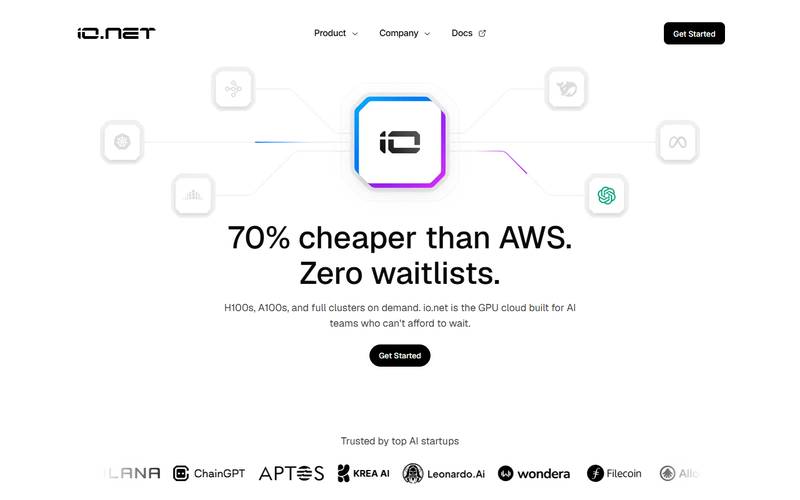
io.net on desktop.
What you see: Desktop: a clean white page with a large "70% cheaper than AWS. Zero waitlists." headline, one Get Started button and a "Trusted by top AI startups" strip (ChainGPT, Aptos, Krea AI, Leonardo.Ai, Wondera, Filecoin, Allora).
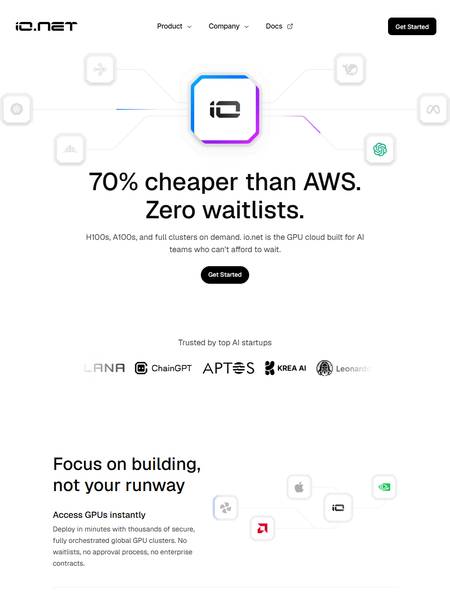
io.net on tablet.
What you see: Tablet: same hero, with the first benefit section ("Focus on building, not your runway") visible below.
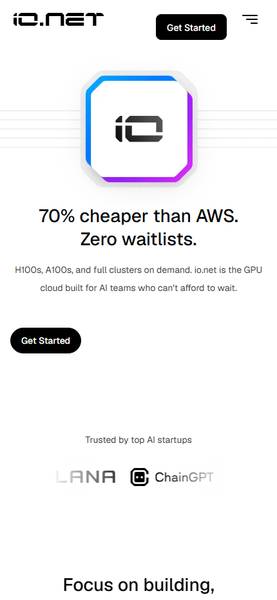
io.net on phone.
What you see: Phone: the menu becomes a hamburger icon and the hero stacks. The page stays readable, but the call to action sits left-aligned beside empty space.
Landing page, section by section
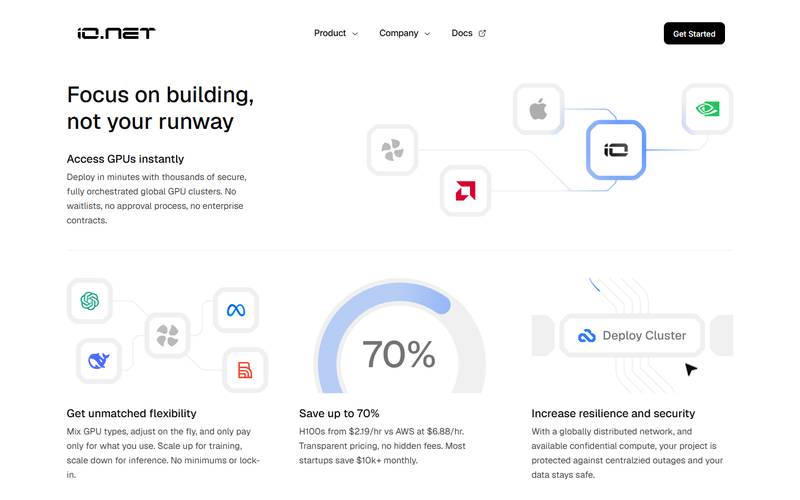
"Focus on building, not your runway": three benefits.
What you see: Flexibility (mix GPU types, no minimums or lock-in), "Save up to 70%" (H100 from $2.19/hr vs AWS at $6.88/hr) and resilience (distributed network and confidential compute).
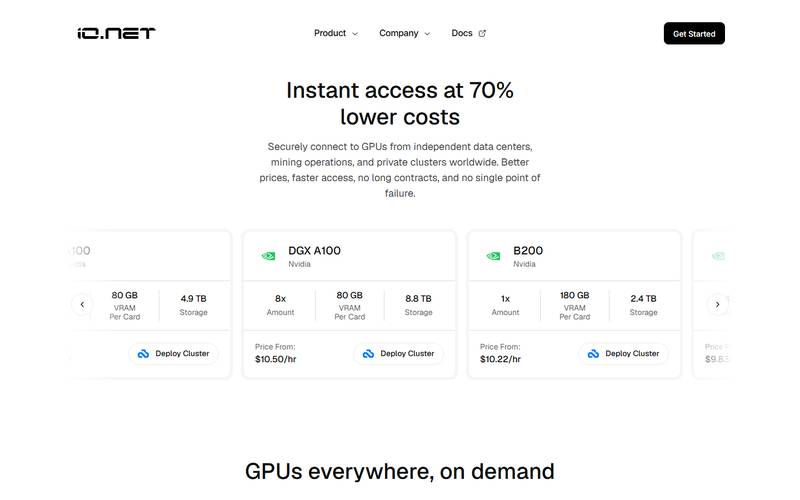
"Instant access at 70% lower costs".
What you see: "Instant access at 70% lower costs": a carousel of GPU packages with a Deploy Cluster button. DGX A100 is 8x with 80 GB VRAM per card and 8.8 TB storage, from $10.50/hr. B200 is 1x with 180 GB VRAM and 2.4 TB storage, from $10.22/hr.
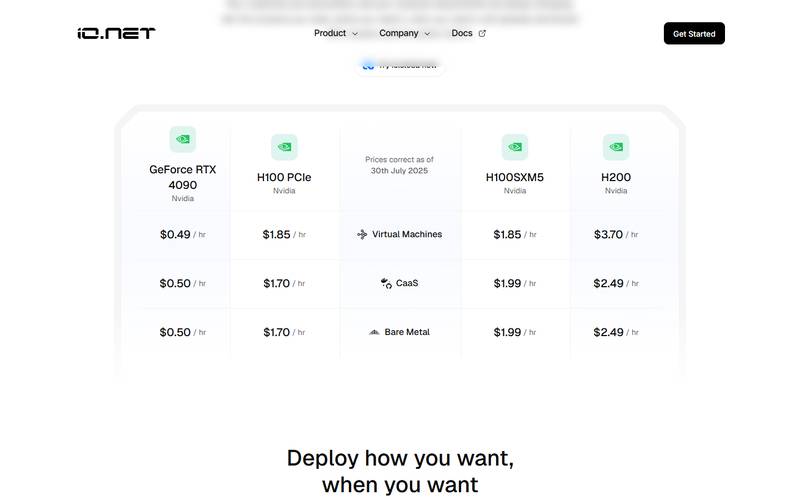
Price table by deployment type.
What you see: Prices are labeled "correct as of 30th July 2025", which is over a year old at our capture date, so treat the figures as stale.
| GPU | Virtual Machines | CaaS | Bare Metal |
|---|---|---|---|
| GeForce RTX 4090 | $0.49/hr | $0.50/hr | $0.50/hr |
| H100 PCIe | $1.85/hr | $1.70/hr | $1.70/hr |
| H100 SXM5 | $1.85/hr | $1.99/hr | $1.99/hr |
| H200 | $3.70/hr | $2.49/hr | $2.49/hr |
(The row assignment follows the order of the rows in the screenshot. The labels in the middle column are Virtual Machines, CaaS and Bare Metal.)
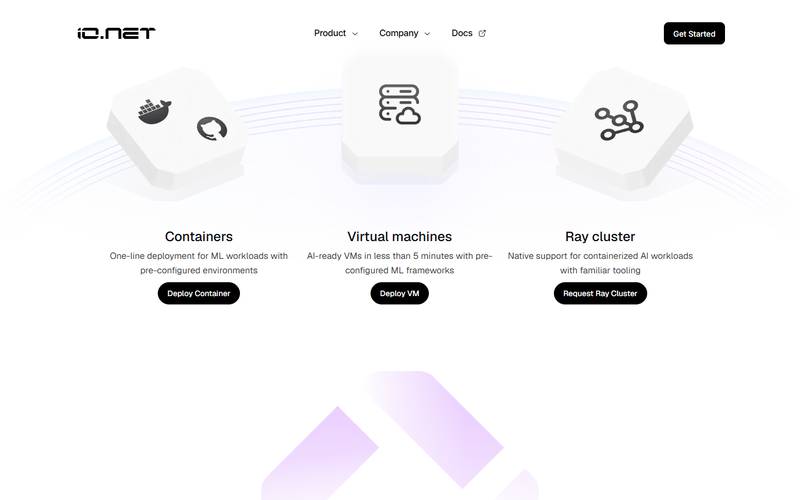
"Deploy how you want".
What you see: "Deploy how you want": Containers (one-line deployment with pre-configured environments), Virtual machines (AI-ready in under 5 minutes) and Ray cluster (native support for containerized AI workloads).

io.intelligence: a chat box.
What you see: io.intelligence: a chat box with a model picker (gemma-4-26b-a4b-it shown) and the line "Scale with over 50+ AI Models" listing Tencent, Reflection, Xiaomi, DeepSeek, Z.AI, Alibaba Cloud, Moonshot AI, MiniMax, Google, OpenAI, Meta AI and Mistral AI.
Core pages
io.cloud
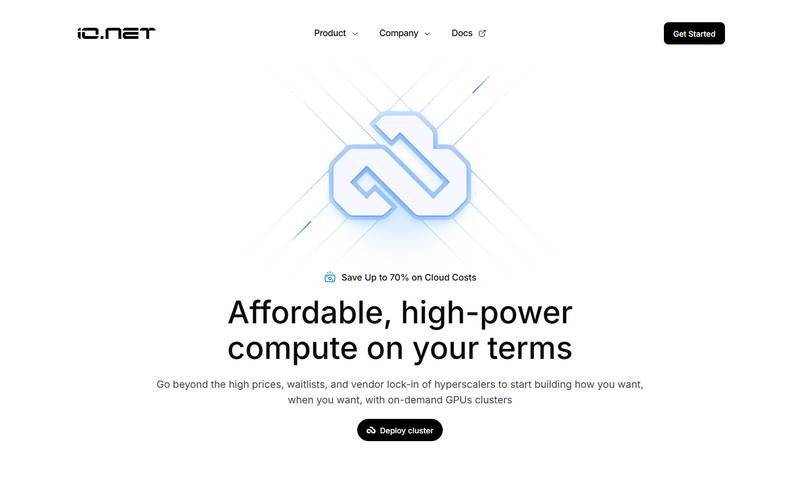
io.cloud: "Affordable, high-power compute on your terms".
What you see: io.cloud: "Affordable, high-power compute on your terms", with a "Save Up to 70% on Cloud Costs" tag and a Deploy cluster button. The copy promises no waitlists and no vendor lock-in.
Cloud console
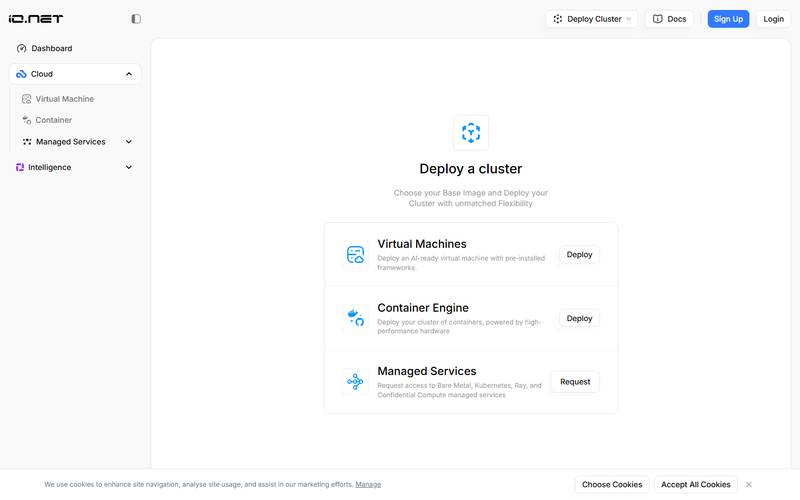
Console without login: sidebar with Dashboard, Cloud (Virtual Machine, Container, Managed Services) and Intelligence.
What you see: The main panel offers "Deploy a cluster" with Virtual Machines, Container Engine and Managed Services (Bare Metal, Kubernetes, Ray and Confidential Compute by request). Sign Up and Login buttons are at the top right, plus a cookie banner.
io.intelligence
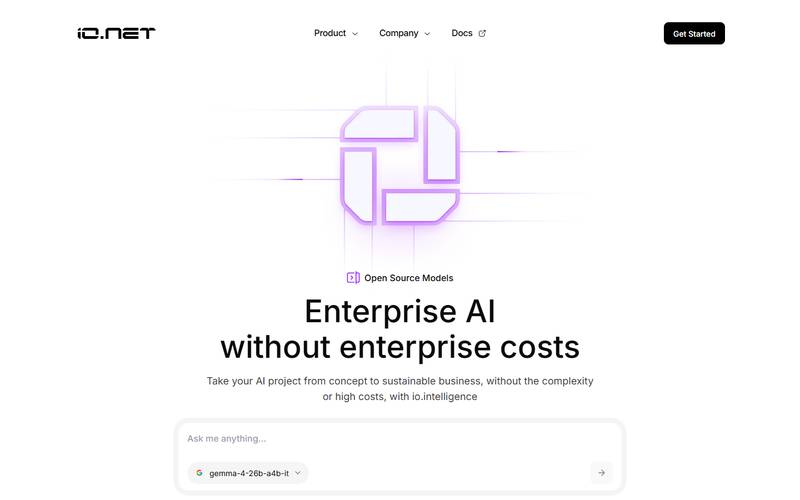
"Enterprise AI without enterprise costs".
What you see: "Enterprise AI without enterprise costs" with the label "Open Source Models" and the same chat box.
Explorer
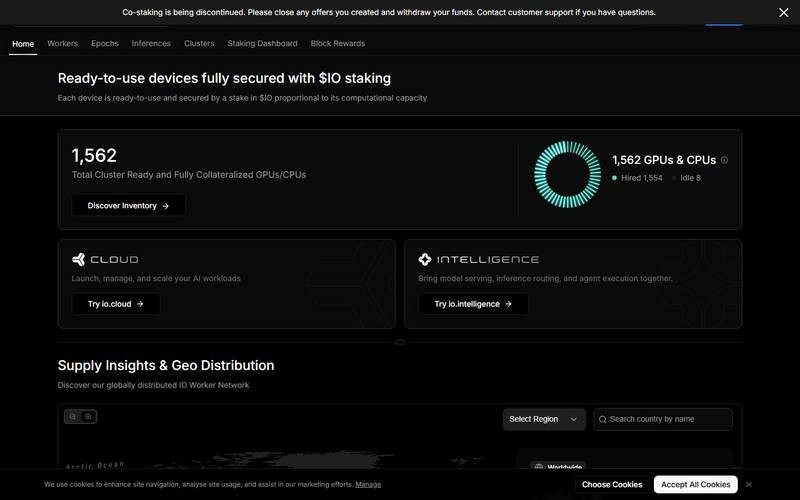
Explorer home: tabs for Home, Workers, Epochs, Inferences, Clusters, Staking Dashboard and Block Rewards.
What you see: A banner at the top says co-staking is being discontinued and users should close offers and withdraw funds.
| Explorer item | Shown |
|---|---|
| Total cluster-ready, fully collateralized GPUs/CPUs | 1,562 |
| Hired | 1,554 |
| Idle | 8 |
| Headline | "Ready-to-use devices fully secured with $IO staking" |
Nearly all listed devices show as hired. That can mean strong demand, or that the explorer lists a limited inventory. We cannot tell which from the page alone.
Blog

Blog: recent posts dated Nov 3.
What you see: Blog: recent posts dated Nov 3, Oct 29 and Oct 27, 2026, on choosing where to run AI workloads, short-term vs long-term GPU contract pricing and GPU procurement strategy. The page links to io.intelligence and io.cloud.
Docs
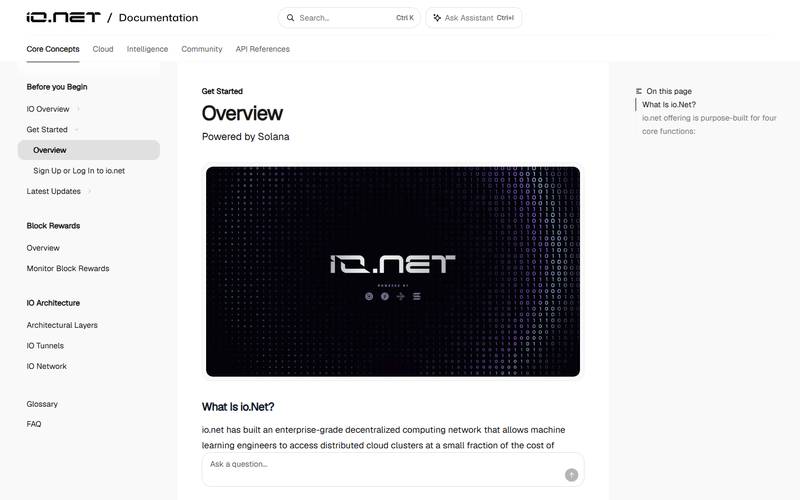
Docs: sections for Core Concepts, Cloud, Intelligence, Community and API References.
What you see: The side menu includes Block Rewards, IO Architecture (Architectural Layers, IO Tunnels, IO Network), Glossary and FAQ.
Market data
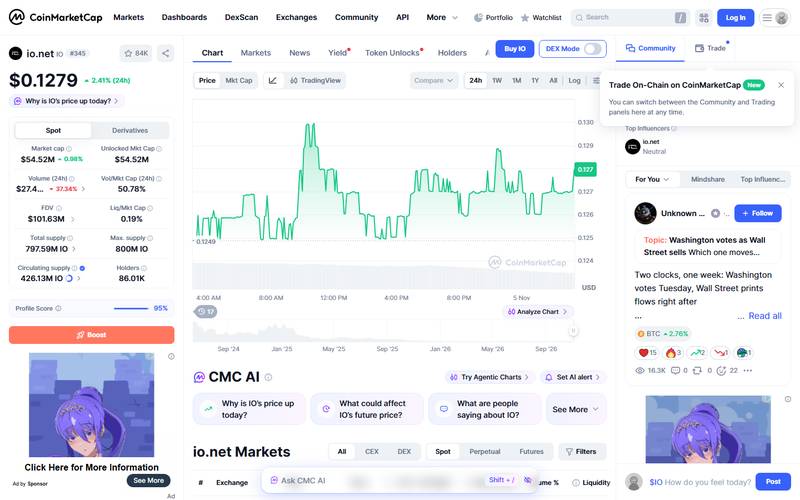
CoinMarketCap: IO at $0.1279, rank #345.
What you see: CoinMarketCap: IO at $0.1279, rank #345, market cap $54.52M, FDV $101.63M, 86.01K holders, profile score 95%.
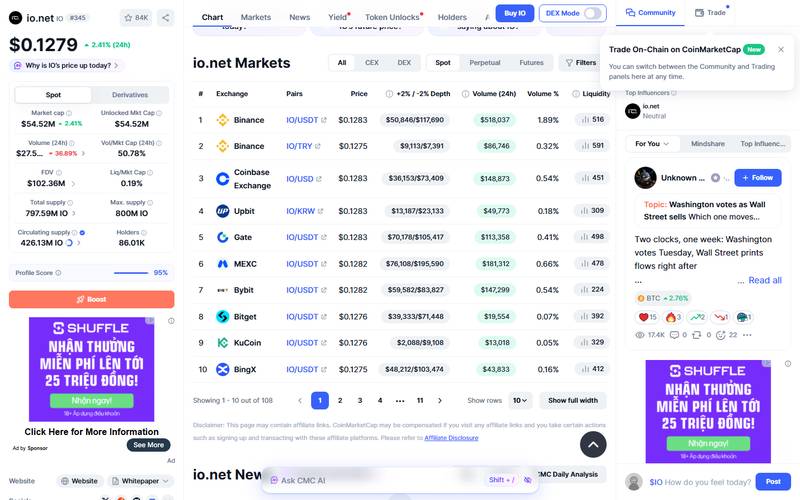
Markets: 108 listed pairs.
What you see: Top rows are Binance (IO/USDT, 1.89% of volume), Binance (IO/TRY), Coinbase (IO/USD), Upbit (IO/KRW), Gate and MEXC.
Customers
The landing page shows a "Trusted by top AI startups" logo strip (ChainGPT, Aptos, Krea AI, Leonardo.Ai and others). A logo strip is not proof of usage or savings. We did not contact any of these companies and we do not repeat vendor savings claims that we could not trace to a current io.net page.
What I could not verify: creating an account, paying for a machine, the speed of the GPUs and any staking flow.
How to judge the "70% cheaper" claim
The landing page compares an H100 at $2.19/hr with $6.88/hr at AWS. Three things to remember:
- Check the date. The price table says "correct as of 30th July 2025", over a year old on our capture date.
- Compare like for like. A single GPU hour is not the whole bill. Networking, storage, support, availability guarantees and data transfer change the total.
- Test your own workload. Run the same job on both and compare finished cost, not hourly price. We did not do this.
Fair summary: the lower hourly rate is plausible for a marketplace that sells spare capacity, but the size of the saving depends on your job.
Fees and pricing
| Item | What we saw |
|---|---|
| GPU rental | Hourly prices on the cards and price table |
| Platform or network fees | (Not verified) |
| Minimums or contracts | Marketing says none (not tested) |
| Price table date | 30 July 2025 |
How to use io.net: step-by-step tutorial
I went through the live io.net site, the cloud console, the public explorer and the docs in a clean browser on 5 November 2026. I did not sign up, rent a machine or stake, so everything that needs an account is marked (Not verified). One important finding first: the explorer shows a banner saying co-staking is being discontinued, so I describe staking only as something to check before you act.
Step 1: Start on the homepage
First, I open io.net. The headline is "70% cheaper than AWS. Zero waitlists", and it is clear that this page is aimed at AI teams that need GPUs, not at token holders.
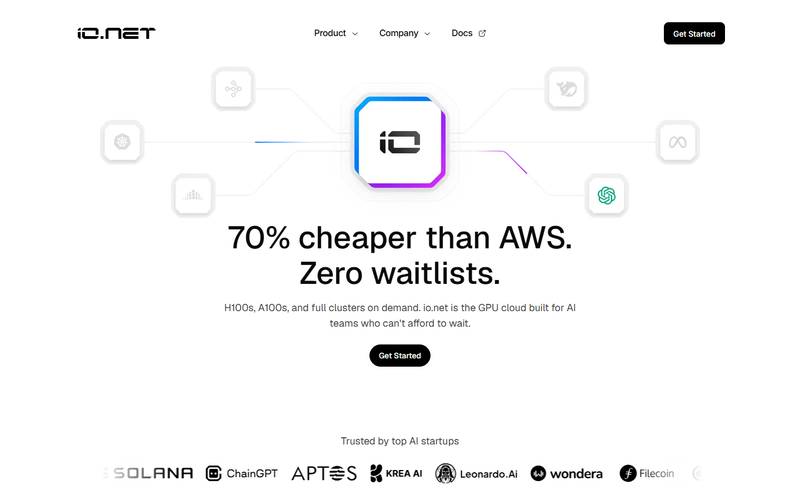
The homepage.
What you see: A black "Get Started" button sits under the claim "70% cheaper than AWS. Zero waitlists." with the subtitle about H100s, A100s and full clusters on demand. A "Trusted by top AI startups" row shows Solana, ChainGPT, Aptos, Krea AI, Leonardo.Ai, wondera and Filecoin. The menu has Product, Company and Docs.
The price claim is the marketing line. In the next steps I check it against the real price list.
Step 2: Open the cloud console
Next, I go to cloud.io.net, which is where a customer actually rents hardware.
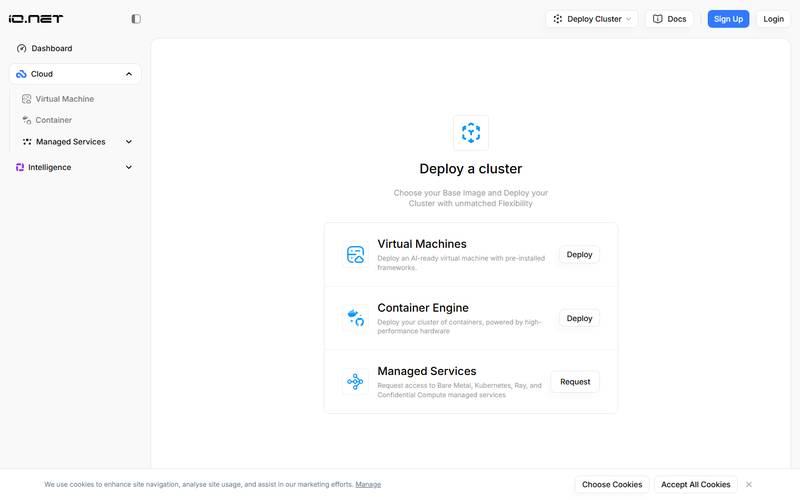
io.net cloud console home.
What you see: The console home, "Deploy a cluster". The left menu shows Dashboard, Cloud (Virtual Machine, Container, Managed Services) and Intelligence. The centre lists three options: Virtual Machines (Deploy), Container Engine (Deploy) and Managed Services (Request). Sign Up and Login are in the top right.
Without an account I can look around, but launching anything requires signing in. The three options match three kinds of users: someone who wants a full machine, someone who runs containers, and a company that wants a managed cluster.
Which option should I pick? For a first test, I would pick Virtual Machines. It is the closest to renting a normal server, and the page shows the price before you commit.
Step 3: Read the price list for virtual machines
Then I press Deploy next to Virtual Machines.
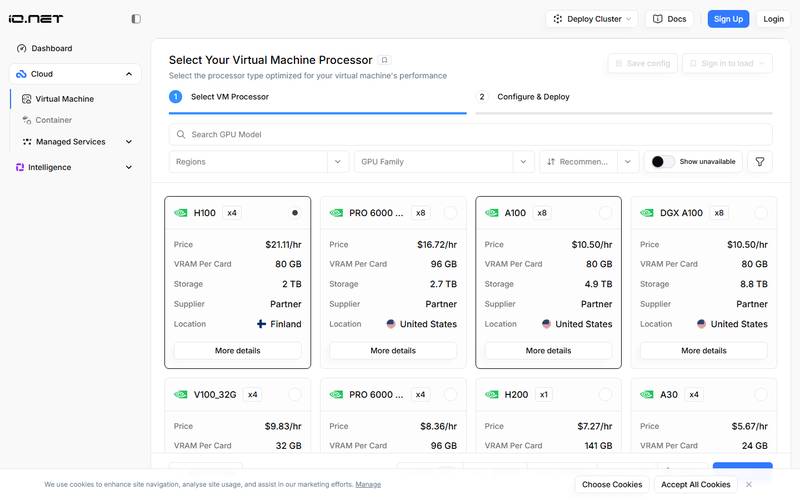
io.net virtual machine processor list with hourly prices.
What you see: "Select Your Virtual Machine Processor", step 1 of 2 (the second step is "Configure & Deploy"). Filters: Regions, GPU Family, Recommended and "Show unavailable". Cards include H100 x4 at $21.11/hr in Finland, PRO 6000 x8 at $16.72/hr, A100 x8 at $10.50/hr, DGX A100 x8 at $10.50/hr, H200 x1 at $7.27/hr and A30 x4 at $5.67/hr. Each card lists VRAM per card, storage, supplier and location.
This is the page I trust most in the whole review, because it shows real hourly prices. I notice that every card says "Supplier: Partner", so the hardware here comes from partner suppliers.
- Pick a processor card.
- Choose the region and the number of GPUs.
- Press the next button to open "Configure & Deploy".
- Sign up or log in, add credit and start the machine. (Not verified)
Step 4: Sign up (what the docs say)
Before I would rent anything, I read how an account is created in the docs.
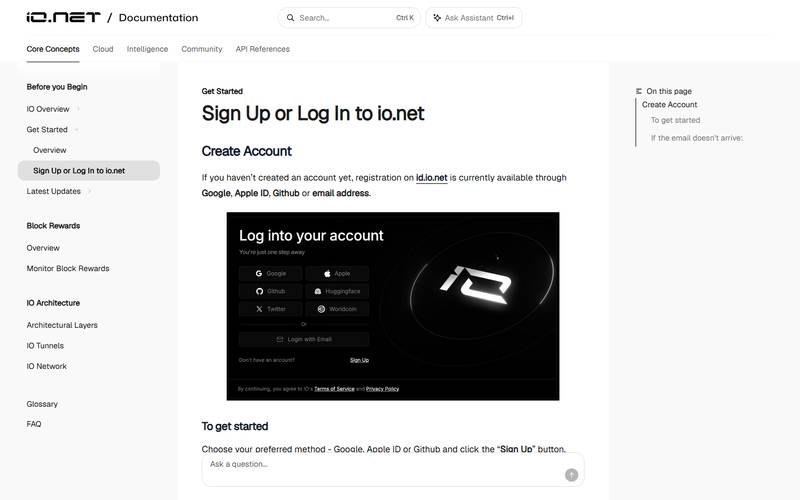
io.net docs page Sign Up or Log in to io.net.
What you see: The "Sign Up or Log in to io.net" page in the documentation. It explains that registration goes through id.io.net with Google, Apple ID, GitHub or email, and it shows a mock-up of the login window with several social buttons.
The docs route is simple: no wallet is needed to rent a machine. A wallet matters only if you are a supplier.
Step 5: Check how much hardware is online
Now I open the explorer at explorer.io.net to see whether the supply is real.
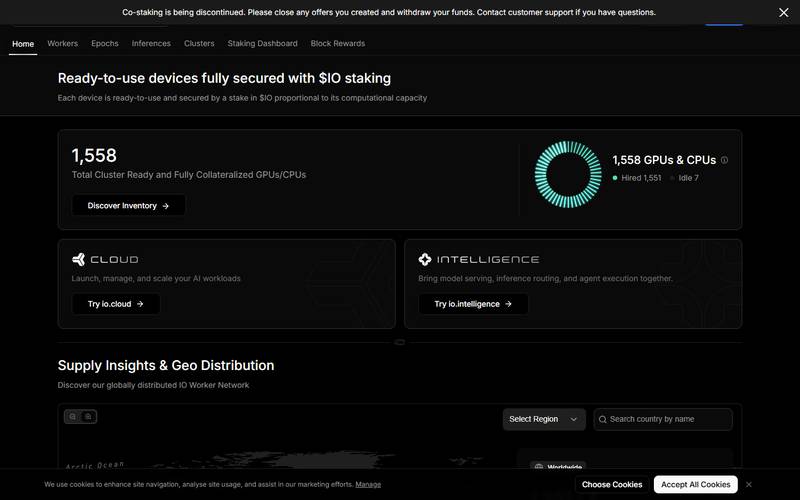
io.net explorer home with the co-staking notice.
What you see: The explorer home. A dark banner at the top says co-staking is being discontinued and tells users to close offers and withdraw funds. Tabs: Home, Workers, Epochs, Inferences, Clusters, Staking Dashboard and Block Rewards. The main card shows 1,558 total cluster-ready GPUs and CPUs, 1,551 hired and 7 idle. Cloud and Intelligence tiles sit below.
This banner is the most important line on the page. If you were planning to use co-staking, read it and contact support first.
Step 6: Look at the workers
Next, I open the Workers tab.
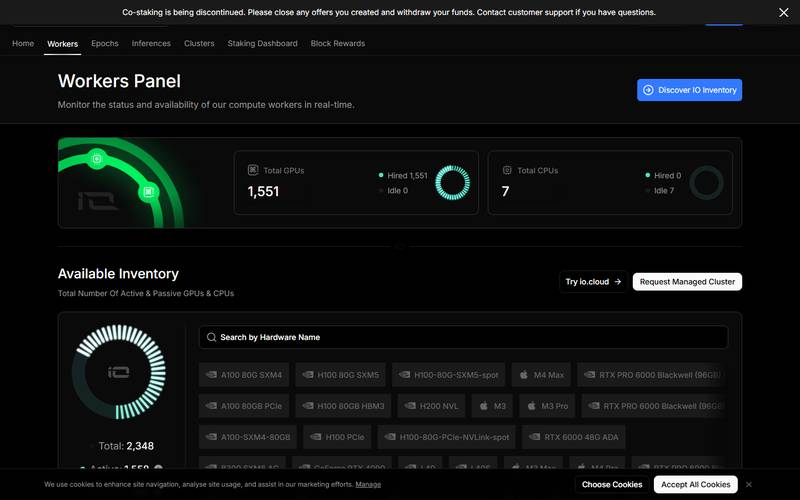
io.net Workers Panel.
What you see: The Workers Panel. Total GPUs 1,551 (1,551 hired, 0 idle) and total CPUs 7 (0 hired, 7 idle). "Available Inventory" shows 2,348 GPUs and a search box with hardware chips such as A100 80G SXM4, H100 80G SXM5, RTX PRO 6000 Blackwell and M4 Max.
Almost every GPU is listed as hired. That is good for demand, but it also means little spare capacity at that moment. I note that the list includes consumer-style chips such as Apple M4 Max, which is a different quality tier from an H100.
Step 7: Check what suppliers earn
Then I open Block Rewards.
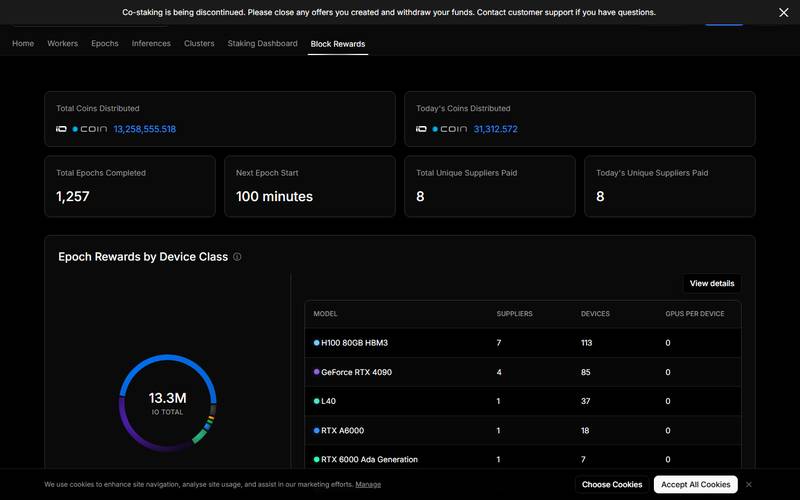
io.net Block Rewards page.
What you see: The Block Rewards page. Total coins distributed: 13,258,555.518 IO. Today's coins: 31,312.572 IO. 1,257 epochs completed, the next one starts in 100 minutes, and 8 unique suppliers were paid today. A table lists device classes: H100 80GB HBM3 with 7 suppliers and 113 devices, GeForce RTX 4090 with 4 suppliers and 85 devices, L40, RTX A6000 and RTX 6000 Ada.
The page displayed 8 suppliers paid today, but we did not record an exact observation time or epoch, or verify the reward calculation basis, so this single snapshot does not establish how concentrated supplier rewards are.
Step 8: Check real usage
Finally, I open Clusters.
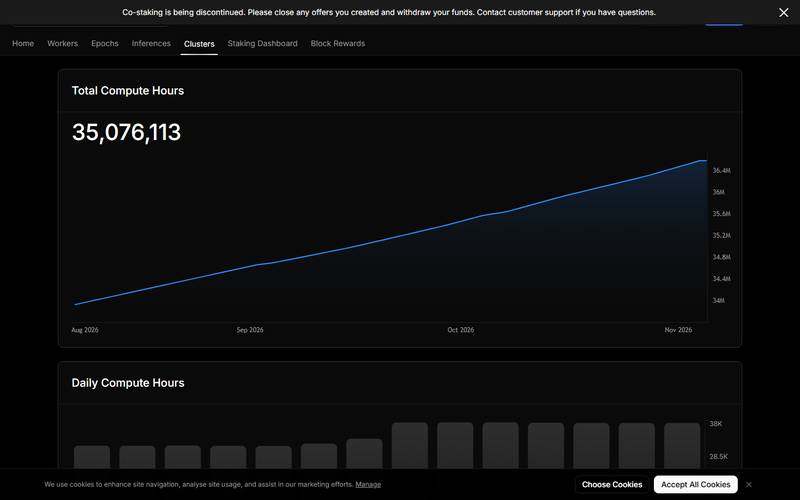
io.net Clusters page with compute hours chart.
What you see: The Clusters page. The headline card shows "Total Compute Hours: 35,076,113" with a rising line from August to November 2026. A "Daily Compute Hours" bar chart starts below it.
A rising line is a good sign, but compute hours alone do not show paid revenue. I would still want to see income figures before I treat this as proof of demand.
Step 9: Read the docs overview
If I wanted to go deeper, I would start with the documentation.
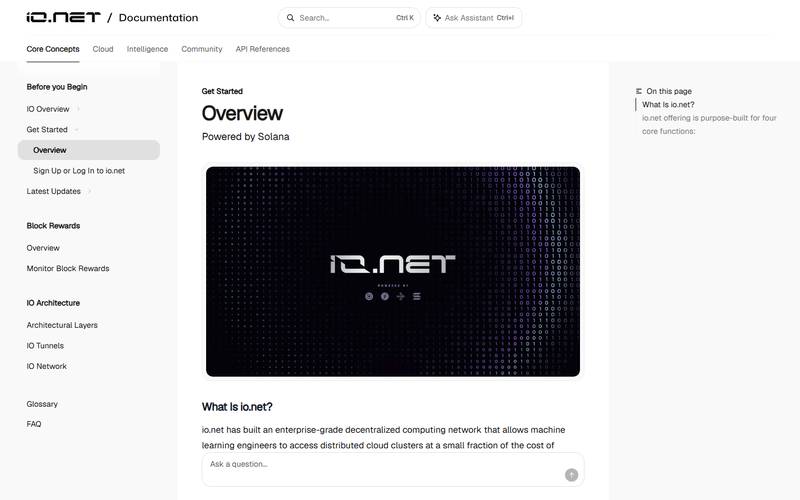
io.net documentation overview.
What you see: The documentation "Overview" page, "Powered by Solana". The left menu has Before You Begin, Get Started, Block Rewards, IO Architecture and a Glossary and FAQ. The page asks "What is io.net?".
What I could not verify: creating an account, paying for a machine, the speed of the GPUs and any staking flow.
Security and risks
- Proof that machines are real. The Explorer on 5 Nov 2026 describes verified inventory ("fully collateralized" devices secured with $IO staking). We did not audit how devices are checked or what happens to suppliers who fail a check.
- Almost everything is hired. One Explorer snapshot shows 1,554 hired out of 1,562 devices, so only 8 were idle; a separate snapshot showed 1,551 hired out of 1,558. Exact capture times were not recorded, so we cannot reconcile the difference. Either snapshot may mean new customers face limited choice of specific GPU types at that moment.
- Co-staking is being discontinued. The Explorer banner told users to close offers and withdraw. If you are an IO staker, read it before you act. We could not verify smart-contract, oracle, bridge, collateral, liquidation or withdrawal mechanics and risks from the pages reviewed.
- Data privacy. Your job runs on third-party hardware. For sensitive data, ask how isolation and encryption work. We did not test it.
- Token risk. IO is $0.1279 with a market cap of $54.52M and 86.01K holders. FDV is $101.63M versus market cap of $54.52M, so unlocks of the remaining supply (426.13M circulating out of 797.59M total) can add selling pressure.
- Stale pricing. Rates in the table are from July 2025; check the console for live prices.
Who should use io.net
- Good fit: AI teams with flexible jobs (batch training, inference, experiments) that can compare cost.
- Good fit: GPU owners who want to rent out idle hardware.
- Poor fit: Teams that need strict enterprise compliance guarantees or a single provider SLA without extra checks.
- Poor fit: People who only want to speculate on the token. The product is cloud compute.
Competitors
Short descriptions of each provider's main model. Check each provider directly for current pricing and terms.
| Provider | Model | Strength |
|---|---|---|
| io.net | Decentralized GPU marketplace on Solana | Low advertised price, no waitlist |
| AWS, Google Cloud, Azure | Hyperscale cloud | Reliability, ecosystem, compliance |
| CoreWeave, Lambda | Specialized GPU clouds | Large GPU fleets and AI focus |
| Akash, Render | Other decentralized compute projects | Open marketplaces with their own tokens |
FAQ
What is io.net in one sentence? A marketplace where people rent GPU compute from a distributed network of independent hardware suppliers.
Do I need crypto to use it? We did not create an account, so we could not confirm which payment methods checkout accepts (Not verified).
Is it really 70% cheaper? That is the site's claim. The H100 comparison is $2.19/hr versus $6.88/hr; real savings depend on workload.
What is the Explorer for? It shows inventory, workers, epochs, inferences, clusters, a staking dashboard and block rewards.
Can I earn by connecting my GPU? That is the supplier pitch. We did not connect hardware, so payouts and requirements are (Not verified).
What is io.intelligence? A chat window and API with 50+ models; the capture showed a model picker.
Where is the token traded? CoinMarketCap lists 108 pairs, with Binance, Coinbase, Upbit, Gate and MEXC among the top rows.
Pros and cons
Pros
- Clear product: rent GPUs by the hour with VM, container and Ray options.
- Plain, readable site and a console that shows the deploy options without login.
- Wide model list in io.intelligence (50+ models).
- Public explorer with live inventory counts.
- Active blog and full docs.
Cons
- Price table is more than a year old.
- Savings claim not independently shown.
- Explorer inventory looks small and almost fully hired.
- Co-staking is being discontinued.
- No pricing page found at the URL we tried.
Verdict
io.net has a simple pitch and a usable console, and the product pages make clear what you can deploy. The main concerns are outdated pricing on the landing page, claims that are larger than what the explorer shows, and the co-staking shutdown for token holders.
Rating: 3.6 / 5 for presentation and transparency as seen without an account. Compute quality and billing were not tested.
Quick links
Disclosure: This is an independent editorial review. It is not sponsored by io.net, contains no affiliate links, and we received no payment or tokens for it.
Not financial advice. Do your own research and never risk funds you cannot afford to lose.
Editorial credits
Checked by Defiliban QC Team before publishing on November 6, 2026 for headline accuracy, original value, factual consistency, metadata, commercial disclosure, authorship claims, review evidence and risk disclosure: our AI review system checks every article before it goes live, and our duty editor monitors it after publication. Report an error.
Defiliban uses AI for research, drafting and review. Our editorial team is responsible for every article and corrects or withdraws articles when needed. How we review.
Defiliban · Oliver Benjamin

Written by
DeFi Research Writer
Oliver Benjamin is a DeFi research writer at DefiLiban, specializing in decentralized finance systems, token economics, liquidity design, and blockchain market structure. His work focuses on analyzing how DeFi protocols function beneath surface-level narratives, with particular attention to incentives, on-chain behavior, yield systems, and emerging crypto infrastructure.